When you’re pregnant, even a simple headache can make you pause. Medication use during pregnancy isn’t just about what works-it’s about what’s safe. And that’s where safety alerts come in. These aren’t just warnings on a label. They’re life-or-death signals built into the system to protect both you and your baby. But here’s the problem: most people don’t understand them.
Think about this: 70 to 90% of pregnant women take at least one medication during pregnancy. Half take four or more. And nearly half of all pregnancies are unplanned. That means a lot of women are taking meds-antidepressants, thyroid pills, asthma inhalers, even over-the-counter painkillers-before they even know they’re pregnant. The system was never designed for that kind of reality.
What Changed with Pregnancy Drug Labels?
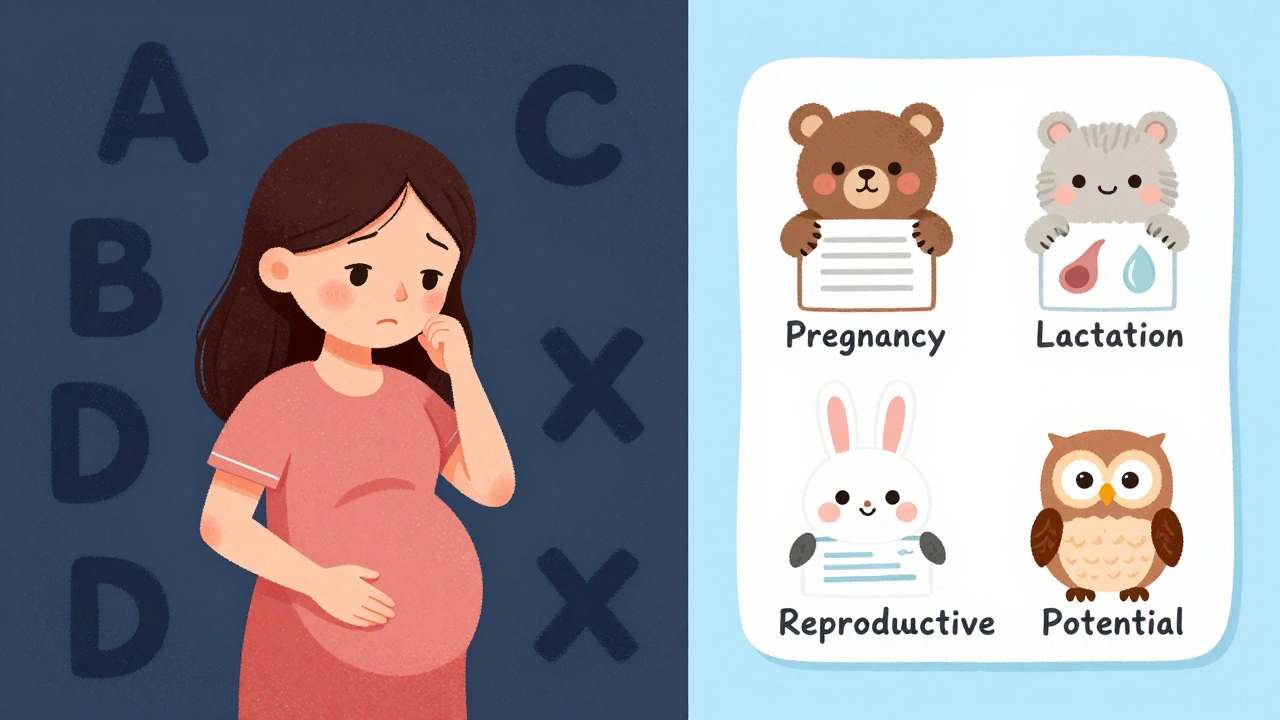
Before 2015, you’d see a letter on a drug label: A, B, C, D, or X. It sounded simple. A was safe. X was dangerous. But it wasn’t that simple. Doctors misread them. Patients panicked. A “C” didn’t mean “maybe risky”-it meant “we don’t have enough human data.” That’s not the same thing. So the FDA scrapped the letter system entirely. In its place came the Pregnancy and Lactation Labeling Rule (PLLR), which rolled out in 2018.
Now, every drug label has three clear sections: Pregnancy, Lactation, and Females and Males of Reproductive Potential. No more guessing. No more misleading letters. Instead, you get real information: what animal studies showed, what human data exists, how much of the drug crosses the placenta, and whether there are registries tracking outcomes. It’s better-but it’s still not perfect.
Why So Little Data Exists
Here’s the hard truth: pregnant women were almost never included in clinical trials. Not because they’re too risky-but because companies were afraid of lawsuits. So when a drug gets approved, we often have zero human data on how it affects a developing fetus. A 2020 study found that only 5 to 10% of drugs approved between 2003 and 2012 had enough human pregnancy data to make a solid call. That’s not a gap. That’s a chasm.
That’s why pregnancy exposure registries exist. These are voluntary programs where doctors and patients report what meds were taken, when, and what happened after birth. The FDA tracks 38 of them. But here’s the catch: only 22% of drugmakers actually run them. And even when they do, they capture less than 1% of all pregnancies where medication was used. That means safety alerts are often years behind the real world.
U.S. vs. Europe: Two Different Systems
The U.S. and Europe handle this differently. The FDA focuses on clear labeling. The EMA (European Medicines Agency) goes further. For high-risk drugs like lenalidomide, they require mandatory pregnancy tests, contraception for six months after stopping the drug, and even patient education cards. It’s stricter. But enforcement is patchy. A 2022 audit found that 41% of companies in the EU didn’t even meet minimum reporting standards.
And here’s another problem: U.S. labels rarely give you numbers. A 2019 study found only 32% of PLLR-compliant labels included actual risk percentages. So if a drug says “may cause birth defects,” you don’t know if that’s 1 in 1,000 or 1 in 10. That’s not helpful. It’s terrifying.
What Medications Are Actually Dangerous?
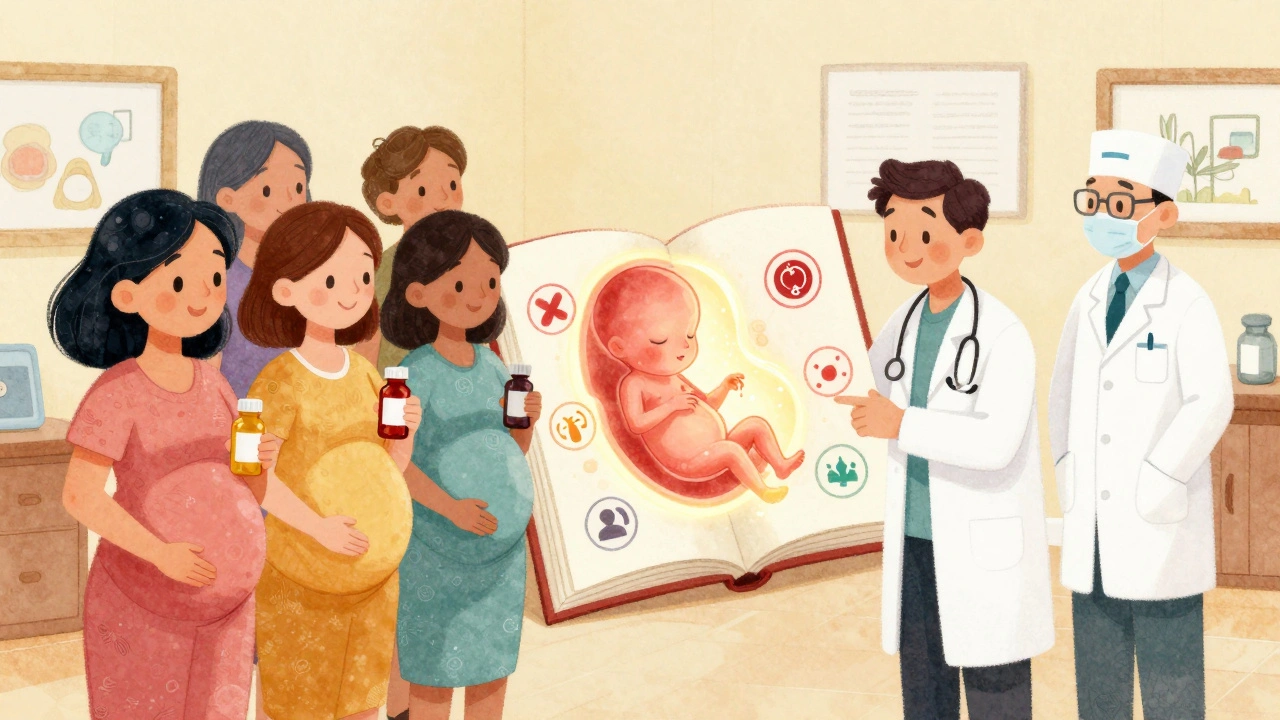
Some risks are well-documented. Isotretinoin (Accutane) for acne? It causes severe birth defects in 20 to 35% of exposed pregnancies. Valproate for epilepsy? It raises the risk of neural tube defects from 0.1% to 1-2%. Thalidomide? Still banned for a reason. These aren’t hypotheticals. They’re facts.
But here’s what most people don’t realize: stopping your medication can be just as dangerous. Untreated depression increases the risk of preterm birth, low birth weight, and developmental delays. Uncontrolled diabetes can cause miscarriage or major birth defects. High blood pressure without treatment can lead to preeclampsia-a leading cause of maternal death.
Dr. Siobhan Dolan says it plainly: “Only 12% of medications have enough safety data for evidence-based recommendations.” That means for 88%, you’re weighing two unknowns: the risk of the drug versus the risk of the illness. And that’s a decision only you and your doctor can make.
What You Should Do Before and During Pregnancy
Don’t wait until you’re pregnant to think about meds. If you’re trying to conceive, schedule a medication review. Bring every pill, supplement, and herb you take-even CBD gummies or herbal teas. Your OB-GYN should do a full reconciliation at your first prenatal visit. That process takes about 22 minutes, but it can change everything.
Keep taking folic acid. 800 mcg daily, starting before conception and continuing through at least 12 weeks. It cuts neural tube defect risk by up to 70%. It’s one of the few things you can do with near-certainty of benefit.
Check labels. The Pregnancy section is now required on every prescription and many OTC meds. Don’t skip it. If it says “insufficient data,” don’t panic. Call your doctor. Ask: “Is there a safer alternative? Or is it safer to keep taking this?”
And if your doctor tells you to stop your antidepressant immediately? Ask why. A 2022 study from Mass General found that 78% of calls to their pregnancy hotline were about anxiety meds-and 63% of those cases ended with the recommendation to continue, not stop.
Where to Find Reliable Info
Not all sources are equal. Reddit threads and drug review sites are full of fear and conflicting advice. One user wrote: “My doctor said stop my antidepressant. Now I’m in withdrawal. Why isn’t there clearer guidance?” That’s the system failing.
Go to the FDA’s “Medicine and Pregnancy” page. It’s clear, updated, and free. It includes real alerts-like the 2022 warning on valproate. It even has a section on cannabis use during pregnancy, which many women still aren’t told about.
Mass General’s Medication Safety Hotline handles over 12,000 calls a year. They don’t sell anything. They don’t push agendas. They just answer questions. If you’re unsure, call them. Or ask your pharmacist. They’re trained for this now.
The Bigger Picture: Why This Matters
This isn’t just about one pill. It’s about trust. When women don’t know what’s safe, they stop everything. A 2021 survey found that 29% of women with chronic conditions stopped their meds the moment they found out they were pregnant. That’s not caution. That’s fear.
The global market for pregnancy medication safety is growing fast-projected to hit $2.8 billion by 2029. But funding is falling behind. There’s a $312 million annual gap in monitoring funding through 2030. Without more money, registries shut down. Alerts get delayed. More babies get hurt.
And the future? AI might help. The NIH is launching PREGNET in 2024, collecting data from 100,000 pregnancies across 45 medical centers. IBM says AI could predict risks with 70% accuracy by 2027. But tech won’t fix this alone. We need better data, better communication, and better support for pregnant women.
Medication safety during pregnancy isn’t about avoiding all drugs. It’s about choosing wisely. It’s about knowing when to keep taking something-even if the data isn’t perfect. And it’s about demanding better from the system that’s supposed to protect you.
11 Comments
So let me get this straight: the FDA says 'insufficient data'... but we're supposed to trust them??! Meanwhile, Big Pharma is quietly funding 'registry' studies that disappear into black holes... and you think this is about safety? No-it's about liability avoidance. They don't want to be sued if a baby's born with six fingers. So they hide behind 'insufficient data' while women panic... and the system? It's rigged. Always has been. Always will be.
Let’s break this down statistically, because the post is full of emotional rhetoric. 70-90% of pregnant women take meds? That’s not a crisis-it’s a norm. The real issue is the lack of prospective longitudinal data. We’ve got retrospective cohort studies with selection bias, and zero RCTs. The PLLR improved transparency, but it didn’t fix the fundamental flaw: we still treat pregnancy as a pathological state rather than a physiological one. And yes-88% of meds lack evidence. That’s not a failure of communication. It’s a failure of research infrastructure. We need dedicated funding, not more labels.
Oh great, another liberal guilt-trip wrapped in FDA jargon. You act like stopping meds is some kind of moral failure. Newsflash: I took ibuprofen at 6 weeks and my kid’s now a Harvard grad. Meanwhile, my cousin stopped her antidepressants because some 'expert' told her to-and now she’s in a psych ward. Stop scaring women with vague percentages. Let them decide. We’re not lab rats. We’re mothers.
It is profoundly irresponsible to suggest that 'stopping medication can be just as dangerous' without first establishing a clear hierarchy of risk. The moral equivalency drawn between untreated depression and teratogenic exposure is not only scientifically unsound-it is ethically negligent. The burden of proof must rest with the pharmaceutical industry, not the pregnant individual. To normalize pharmacological intervention in pregnancy without mandatory, pre-conception pharmacogenomic screening is to commodify fetal life.
look. i got pregnant on accident. took my anxiety med for 3 weeks before i knew. panicked. called my dr. she said 'keep taking it.' i did. baby's 2 now. talks in full sentences. no issues. the system is broken. but your fear? that's what's really hurting us.
OMG I CRIED reading this 😭💔 My OB told me to stop my thyroid med because 'it might affect the baby'... I didn't know it was life-threatening to STOP it... I almost lost myself... and then I found the Mass General hotline... they saved my life. Thank you for writing this. I’m not alone. 🙏❤️
The PLLR implementation is a textbook case of regulatory theater. The structural shift from letter categories to narrative sections was necessary, yes-but the lack of standardized risk quantification renders it functionally inert. We now have rich narrative descriptions, but no unified ontology for teratogenic risk. The absence of relative risk metrics (e.g., RR, OR, NNT) in 68% of labels undermines clinical utility. Until we adopt a Bayesian risk modeling framework, we’re just decorating the same broken system with prettier fonts.
i think we're all just trying to do the best we can with incomplete info. no one wants to hurt their kid. no one wants to die from untreated depression either. maybe the real answer isn't more labels... but more trust. trust in doctors. trust in ourselves. and maybe... less noise from people who think they know what's best for everyone else.
Thank you for this comprehensive and compassionate overview. As a healthcare professional from India, I’ve seen too many women discontinue essential medications due to misinformation. The key is not fear, but education. We need community health workers trained to explain PLLR sections in local languages. We need pharmacists to be the first point of contact-not Google. And we need global collaboration to fund registries. This isn’t just an American problem. It’s a human one.
Let me be blunt: this entire system is a corporate-designed trap. The FDA? A revolving door of ex-pharma executives. The 'registries'? PR stunts with 1% participation. The 'safe' alternatives? Often just generics with no pregnancy data either. And don’t get me started on how they silence whistleblowers who expose suppressed fetal toxicity data. This isn’t about safety-it’s about profit. Women are being used as test subjects without consent. And the media? They cheerlead the labels like they’re gospel. Wake up.
One must acknowledge the epistemological limitations inherent in teratogenic risk assessment. The absence of randomized controlled trials in gestational populations is not merely a methodological deficiency-it is a foundational violation of the principle of non-maleficence in clinical ethics. The current regulatory framework, while ostensibly progressive, perpetuates a state of epistemic injustice by delegating decisional authority to clinicians who themselves operate under conditions of profound uncertainty. Until the epistemic community prioritizes prospective, longitudinal, and pharmacogenomic cohort studies funded independently of industry, the discourse remains performative rather than substantive.