
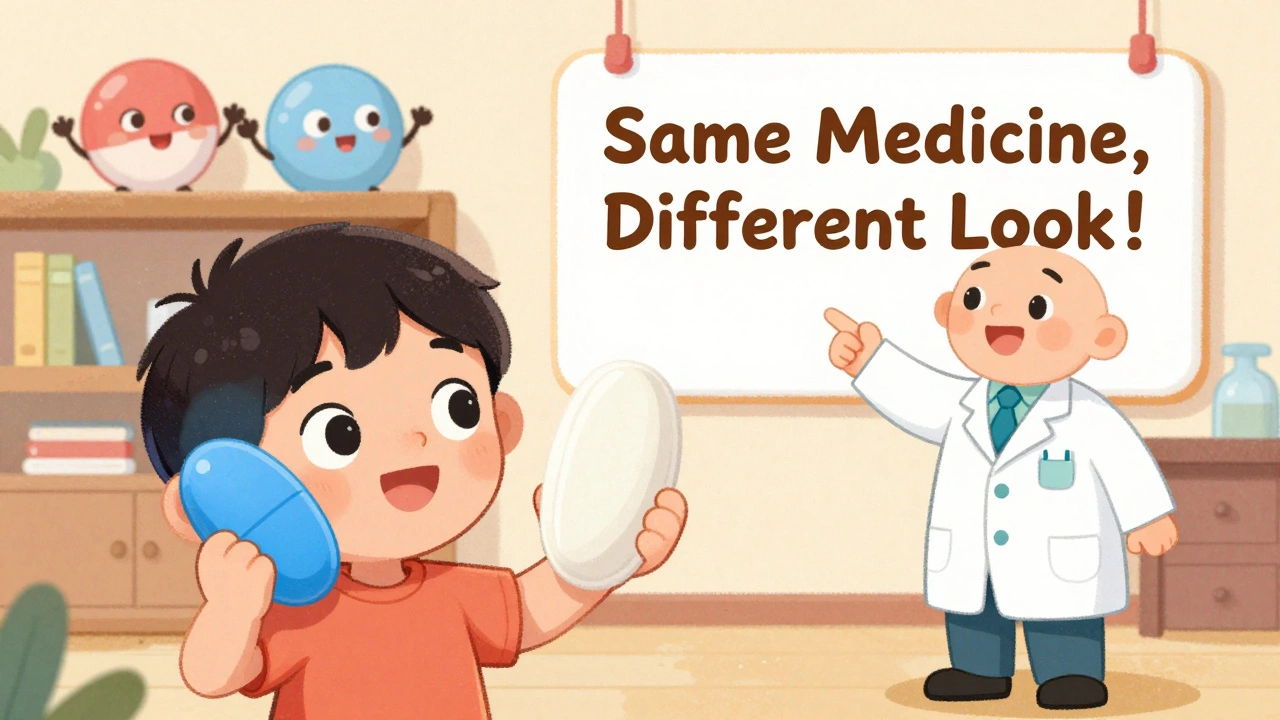
Have you ever picked up your prescription and thought, Wait, this pill doesn’t look like the last one? Maybe it’s a different color, shape, or size. You’re not imagining things. And it’s not a mistake. It’s the law.
Generic drugs are just as effective as their brand-name counterparts. They contain the same active ingredient, work the same way, and meet the same safety standards. But if you look at them side by side, they often look completely different. That’s not a flaw. It’s required.
Why Can’t Generic Drugs Look Like the Brand Name?
It’s not about science. It’s about trademark law. In the United States, trademark rules protect the visual identity of products. That includes pills. When a pharmaceutical company spends millions developing a drug, they also design its appearance - the color, shape, and imprint - to make it recognizable. That’s their brand. And the law says no one else can copy it.
The U.S. Food and Drug Administration (FDA) makes this clear: generic drug manufacturers cannot make a pill that looks identical to a brand-name drug already on the market. This rule isn’t about safety or effectiveness. It’s about preventing confusion in the marketplace. If every generic looked exactly like the original, patients, pharmacists, and even doctors could mix them up. Trademark law keeps things distinct.
So while the active ingredient - the part that actually treats your condition - is identical, everything else can change. Colors, fillers, binders, flavors, and even the shape of the pill are all fair game for the generic maker. As long as the drug works the same way in your body, the FDA allows the differences.
What Exactly Changes Between Brand and Generic?
Here’s what you’ll notice when you switch from a brand-name drug to a generic:
- Color: The brand might be blue. The generic could be white or yellow.
- Shape: A round pill might become oval. A capsule might switch from two-tone to solid.
- Size: One pill could be slightly larger or smaller than the original.
- Imprint: The letters or numbers stamped on the pill will be different.
- Flavor: For liquid or chewable versions, the taste might change slightly due to different flavoring agents.
These aren’t random choices. Generic manufacturers pick these features to make sure their product doesn’t accidentally look like any other drug on the market - including other generics. That’s why two different companies making the same generic drug might still make pills that look different from each other.
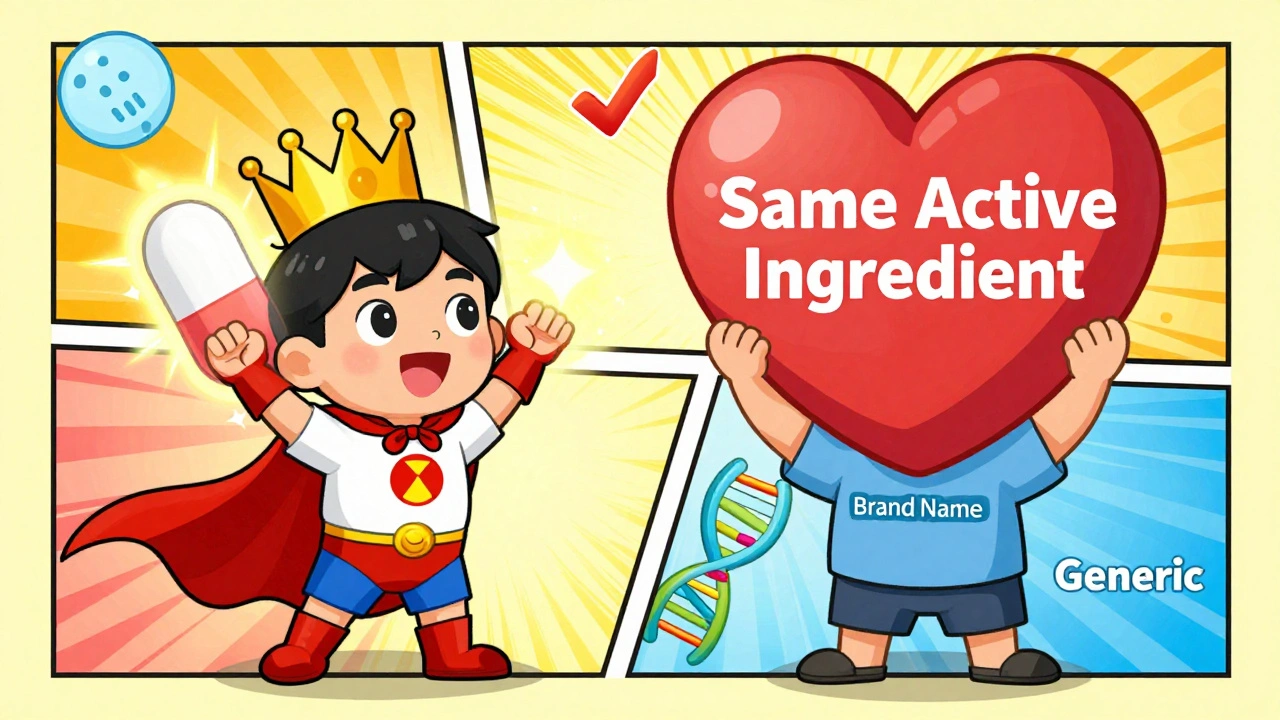
Even though the appearance changes, the science doesn’t. A large study comparing absorption rates found that generics differ from brand-name drugs by only about 3.5% on average. The FDA’s acceptable range for bioequivalence is 80% to 125%. So even the small differences in how quickly your body absorbs the drug are well within safe limits.
How Do We Know Generics Work the Same?
Before a generic drug hits the shelf, the manufacturer must prove to the FDA that it’s bioequivalent to the brand-name version. That means it delivers the same amount of active ingredient into your bloodstream at the same rate. The FDA reviews this data carefully. They also inspect manufacturing facilities and keep monitoring the drug after it’s approved.
Doctors and pharmacists rely on this system. The American Medical Association and the FDA both confirm: generic drugs are just as safe and effective as brand-name ones. You’re not getting a lower-quality version. You’re getting the same medicine, just packaged differently.
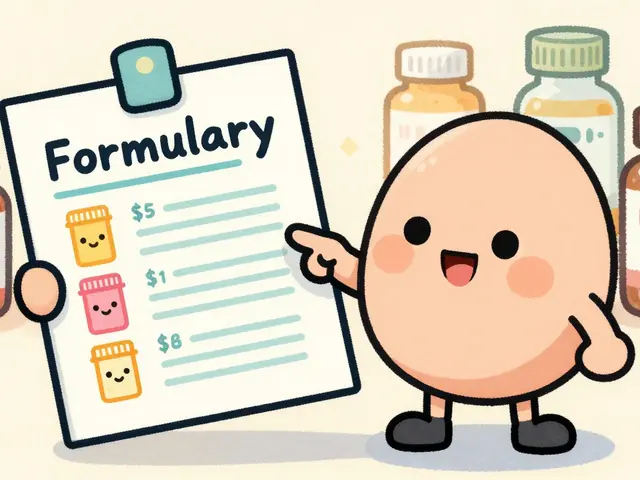
And the cost difference? That’s where generics shine. They typically cost 80% to 85% less than the brand-name version. In the U.S., generics make up about 90% of all prescriptions filled - but only about 23% of total drug spending. That’s billions saved every year.
Why Do Some People Get Confused?
Even though generics are safe, the visual changes can cause real problems. Many people take the same medication for years. They know what their pill looks like. When it changes - maybe because the pharmacy switched suppliers - they think something’s wrong. They might stop taking it. Or worse, they might think the new pill is a different drug entirely.
Pharmacies see this all the time. UMass Memorial Health reports that appearance changes can lead to medication errors. One patient might think their blood pressure pill turned into a sleeping pill because it went from green to white. Another might refuse a refill because it’s a different shape.
That’s why pharmacies now put clear labels on vials. They’ll write: “This is a generic version of [Brand Name]. Active ingredient: [Drug Name].” Some even include a picture of the pill. These aren’t just helpful - they’re a safety step.
And if you’re ever unsure? Always ask your pharmacist. They’re trained to explain these changes. Don’t assume a different-looking pill is weaker, fake, or wrong. It’s probably just following the law.
What About the Future?
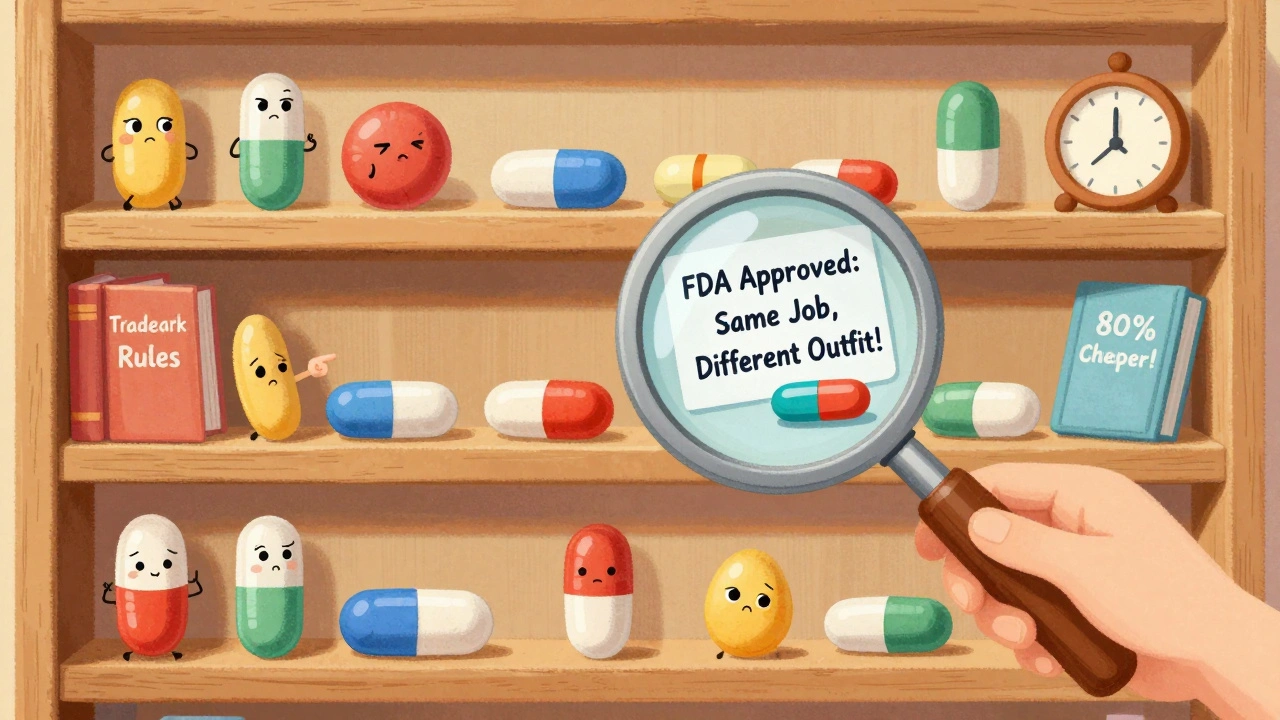
The FDA has started encouraging generic makers to design pills that are closer in size and shape to the brand-name version - as long as they still don’t copy the exact look. It’s a small shift, but it shows regulators are listening to patients. Reducing visual confusion doesn’t mean breaking trademark rules. It means being smarter about them.
Still, the core rule won’t change: generics can’t look identical to brand-name drugs. The system works because it balances two goals: letting competition lower prices, and keeping patients safe from mix-ups.
For now, the best advice is simple: don’t judge a pill by its color. Check the label. Check the name of the active ingredient. And if you’re ever confused, call your pharmacist. They’ll tell you it’s normal - and that your medicine is still doing exactly what it’s supposed to.
What You Can Do
- Keep your medication list updated with the name of the active ingredient, not just the brand or generic name.
- Ask your pharmacist to explain any changes in pill appearance when you refill.
- Don’t stop taking your medicine just because it looks different.
- Use the same pharmacy when possible - they’ll keep a record of what you’ve taken before.
Generic drugs are one of the most successful public health innovations of the last 40 years. They’ve saved trillions in healthcare costs. And they work just as well as the originals - even if they don’t look the same.
11 Comments
Wait so you're telling me my blood pressure pill turned into a candy because some lawyer said so? This is wild. I thought generics were just cheaper versions, not a whole new art project.
lol trademark law for pills?? who thought this was a good idea?? the FDA must be bored outta their minds if this is their top priority
Actually, the legal framework stems from the 1984 Hatch-Waxman Act, which deliberately preserved brand identity to prevent consumer confusion while enabling market competition. The FDA's bioequivalence thresholds-80-125% AUC and Cmax-are statistically rigorous and empirically validated across thousands of studies. To dismiss this as mere aesthetics reveals a profound misunderstanding of pharmacoeconomics and intellectual property law.
It's fascinating how something so mundane-like pill color-can be governed by centuries-old legal principles. Trademark law was never meant for pharmaceuticals, but it's adapted surprisingly well. The real win is that patients get the same medicine at a fraction of the cost. That’s the quiet triumph here.
Thank you for this clear and thoughtful exposition. It is a pleasure to encounter such a well-reasoned explanation of a topic that often causes undue anxiety among patients. The FDA's regulatory balance is, in fact, a model of prudent public policy.
so uhh what if i just paint my generic pill to look like the brand?? like with nail polish?? i mean its still the same chemical right??
It's so easy to panic when your pill looks different-but you're not alone. I used to think my meds were changing on me until my pharmacist showed me the label. Now I keep a photo of each pill on my phone. Small thing, big peace of mind.
MY PHARMACY SWITCHED MY ANTIDEPRESSANT TO A YELLOW PILL AND I THOUGHT I WAS LOSING MY MIND. I CALLED MY MOM AND SHE SAID I WASN'T TAKING IT RIGHT. I DIDN'T LEAVE MY BED FOR THREE DAYS.
Generics are one of the few places where capitalism actually works for the people. Same medicine. Lower price. Same results. The fact that we argue over color instead of cost says more about our culture than the drug system.
I get why the law exists, but it’s also kind of ridiculous. My grandma takes five different generics. She calls them ‘the blue one,’ ‘the green one,’ ‘the weird oval one.’ She doesn’t know what’s in them. She just knows what they look like. Maybe the FDA should let generics match the brand shape-just not the color or imprint. That’d cut down on so much confusion without breaking the law.
Just wanted to say thank you for this. I work in a pharmacy and every week someone comes in convinced their medication is fake because it’s not the same color. We print out pill images now. We write the active ingredient in big letters. We even hand them a little card with a photo. It’s not just helpful-it’s life-saving. You don’t know how many people stop taking their meds because they’re scared. This post? It helps. Keep doing this.