



Sleep Aid Cognitive Risk Assessment Tool
How This Works
Based on the latest research, we'll assess your risk of cognitive side effects and dementia from sleep medications. Answer a few questions to get personalized guidance.
More than 1 in 10 adults in the U.S. take sleep aids every night. For many, it’s the only way to get through the week without feeling drained. But what happens when that nightly pill starts to blur your memory, slow your reactions, or leave you foggy in the morning? The truth is, not all sleep aids are created equal-and some may be quietly harming your brain.
Not All Sleep Aids Are the Same
When people talk about sleep aids, they’re usually thinking of a few common names: Ambien, trazodone, melatonin, or maybe even Benadryl. But these aren’t the same kind of drug. They work in completely different ways-and their effects on your brain vary wildly.
Benzodiazepines and drugs like zolpidem (Ambien) target GABA receptors in the brain. These are the same receptors that alcohol affects. They calm neural activity, which helps you fall asleep-but they also dull your thinking. Studies show people on these drugs make 20% more errors on memory and reaction tests. In older adults, this isn’t just about feeling groggy. It’s about increased fall risk, car accidents, and long-term cognitive decline.
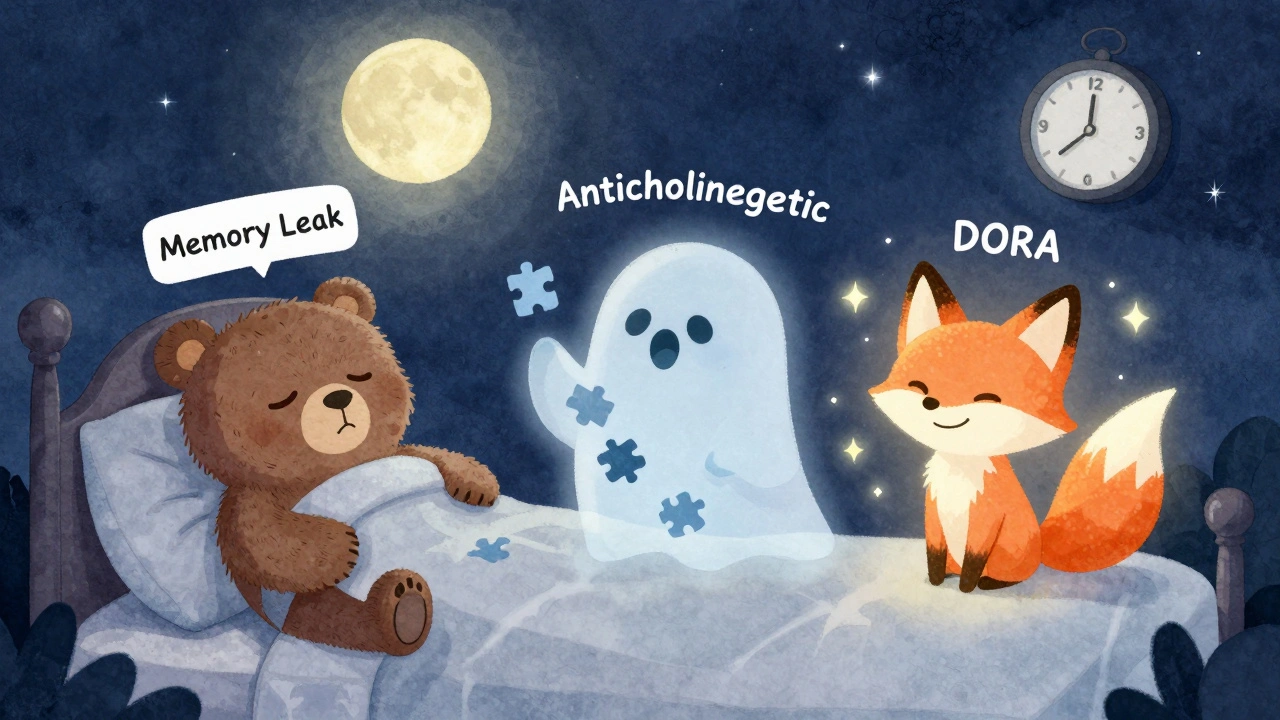
Then there are anticholinergics. These include older antidepressants like doxepin and even some over-the-counter sleep aids. They block acetylcholine, a key brain chemical for learning and memory. A 2010 study from Indiana University found these drugs are strongly linked to mild cognitive impairment-memory lapses that don’t yet affect daily life, but can be a warning sign. The good news? This kind of impairment might be reversible if you stop the drug.
On the other end of the spectrum are the newer drugs called DORAs-dual orexin receptor antagonists. Suvorexant (Belsomra) and daridorexant (Quviviq) work by blocking orexin, a brain signal that keeps you awake. Unlike GABA drugs, they don’t mess with memory circuits. In fact, a 2023 study from Washington University found that just two nights of suvorexant lowered levels of two key Alzheimer’s proteins in the brain. That’s not proof it prevents dementia-but it’s a sign these drugs might be safer, even protective.
The Real Risk: Who’s Most Affected?
Not everyone who takes sleep aids sees cognitive side effects. Age, race, and how long you’ve been using them matter a lot.
People over 65 are far more vulnerable. Their brains process drugs slower. Their liver and kidneys don’t clear medications as quickly. That’s why the American Geriatrics Society’s Beers Criteria says older adults should avoid zolpidem, benzodiazepines, and even trazodone for sleep. The risks-falls, confusion, memory loss-outweigh the benefits.
Even more surprising: race plays a role. A nine-year study of 3,000 older adults found white participants who used sleep meds regularly had a 79% higher chance of developing dementia. But Black participants showed no increased risk. Researchers aren’t sure why. Could be genetics. Could be differences in how drugs are metabolized. Could be underlying health conditions. But it’s clear the risk isn’t the same for everyone.
And duration matters. Taking a sleep aid for a few nights? Low risk. Taking it every night for months or years? That’s when problems build up. A 2021 study found routine users had a 30% higher risk of dementia over time. But zolpidem and trazodone? One 2019 NIH study found no link to cognitive decline-suggesting these drugs might not be the problem, or could even help by improving sleep in people with early brain changes.
What Users Actually Experience
Real people report what studies can’t always capture.
On Reddit, a thread with 147 comments about zolpidem showed that 78% of users felt groggy the next day. 42% said they had memory lapses-like waking up and not remembering getting out of bed. On Drugs.com, nearly 40% of zolpidem reviews gave it 2 stars or less, with ‘amnesia episodes’ mentioned in almost a third of negative reviews.
Compare that to suvorexant. Of 850 reviews, 62% gave it 4 or 5 stars. Common praise: ‘I wake up clear-headed.’ ‘No brain fog.’ ‘Finally, a sleep aid that doesn’t make me feel drugged.’
And the numbers back it up. A 2022 survey of 1,200 patients found 58% quit their sleep meds within six months-not because they didn’t work, but because of side effects. ‘Brain fog’ was the top reason. ‘Trouble concentrating’ came in second. For many, the cost of better sleep was too high.
What Doctors Are Saying Now
Medical guidelines have changed dramatically in the last five years.
Back in 2015, only 12% of primary care doctors recommended non-drug treatments first. By 2023, that number jumped to 47%. Why? Because the evidence got too strong. The American College of Physicians now says: Cognitive Behavioral Therapy for Insomnia (CBT-I) should be the first-line treatment. Not pills.
CBT-I isn’t magic. It’s structured. You work with a therapist for 6 to 8 weeks, learning how to fix sleep habits, manage racing thoughts, and reset your body clock. It takes time-usually 2 to 3 weeks before you see results. But the effects last. Unlike pills, which stop working after a few months, CBT-I helps you sleep well for years.
And it’s more accessible than ever. Digital programs like Sleepio cost $300-$500, compared to $1,500+ for in-person therapy. The American Academy of Sleep Medicine lists over 1,200 certified CBT-I providers. The National Sleep Foundation’s free online tools get 2.5 million visits a month.
For those already on sleep meds, quitting cold turkey is dangerous. Withdrawal can cause rebound insomnia, anxiety, even seizures. The smart move? Gradual tapering over 4 to 8 weeks, with CBT-I as your support system.
The Future of Sleep Aids
The pharmaceutical industry is shifting. In 2023, the global sleep aid market was worth $85.7 billion-but growth is slowing. Meanwhile, non-drug solutions are growing at nearly twice the rate.
Companies like Merck and Eisai are pouring money into next-gen DORAs. Daridorexant (Quviviq) hit the market in 2022 and made $85 million in its first year. Eisai’s E2086 is in Phase II trials, showing promise for improving sleep without touching memory pathways.
The FDA is stepping up too. In December 2022, they required stronger warning labels on benzodiazepines about cognitive risks. And the National Institutes of Health is funding a massive 10,000-person study tracking sleep meds and dementia over 15 years. Results won’t be in until 2038-but the direction is clear.
Meanwhile, researchers like Dr. Brendan Lucey at Washington University are cautious. Yes, suvorexant lowered Alzheimer’s proteins. But he warns: ‘Don’t start taking it hoping to prevent dementia.’ We don’t know the long-term effects yet. What we do know is this: the safest sleep aid is the one that doesn’t touch your brain chemistry at all.
What You Can Do Today
If you’re on a sleep aid and feeling foggy, you’re not alone. And you’re not stuck.
- Track your use. How many nights a week are you taking it? Are you using it for more than 2 weeks straight?
- Check your meds. Look up your pill. Is it an anticholinergic? A benzodiazepine? A GABA drug? You can find this on Drugs.com or by asking your pharmacist.
- Try CBT-I. Even one session can change your perspective. Apps like Sleepio, CBT-i Coach, or Good Nights are backed by science.
- Talk to your doctor. Don’t quit cold turkey. Ask about a taper plan. Ask if CBT-I is right for you.
- Give it time. If you’re switching from a GABA drug to CBT-I, expect 2-3 weeks of adjustment. Your sleep won’t be perfect overnight-but it will get better without the fog.
The goal isn’t just to sleep. It’s to wake up clear-headed, focused, and in control of your own mind. There are better ways than pills to get there.
Can sleep aids cause dementia?
Some sleep aids, especially long-term use of benzodiazepines and anticholinergics, are linked to higher dementia risk in older adults. But not all sleep meds carry the same risk. Newer drugs like suvorexant show no cognitive harm-and may even reduce Alzheimer’s-related brain changes. The key is the type of drug, not just taking a pill.
Is zolpidem (Ambien) safe for long-term use?
No. Zolpidem is not recommended for long-term use. It impairs memory, slows reaction time, and increases fall risk, especially in people over 65. While one 2019 NIH study found no link to mild cognitive impairment, the FDA and American Geriatrics Society still advise against regular use due to safety concerns. It’s best for short-term, occasional use only.
What are the safest sleep aids?
The safest option is non-drug treatment: Cognitive Behavioral Therapy for Insomnia (CBT-I). If you need a medication, newer DORAs like suvorexant and daridorexant have the best safety profile for cognition. They don’t affect memory or cause next-day grogginess like older drugs. Melatonin is also low-risk for short-term use, though it’s less effective for chronic insomnia.
Why do I feel foggy after taking sleep meds?
Many sleep aids, especially benzodiazepines and zolpidem, slow brain activity by boosting GABA. This helps you fall asleep but also blunts alertness, memory, and focus the next day. This is called residual sedation. It’s not just ‘being tired’-it’s a direct effect of the drug on your brain’s ability to process information. DORAs don’t do this, which is why users report feeling clearer in the morning.
Can I stop taking sleep aids cold turkey?
No. Stopping benzodiazepines or zolpidem suddenly can cause rebound insomnia, anxiety, seizures, or hallucinations. Always work with your doctor to taper off slowly-usually over 4 to 8 weeks. Combine tapering with CBT-I to help your brain relearn healthy sleep patterns without drugs.
Are over-the-counter sleep aids safer?
Not necessarily. Many OTC sleep aids contain anticholinergics like diphenhydramine (Benadryl) or doxylamine (Unisom). These drugs are strongly linked to memory problems and cognitive decline, especially in older adults. Just because they’re sold without a prescription doesn’t mean they’re safe for regular use. They’re often worse than prescription sleep aids because people take them longer without medical oversight.
14 Comments
man i took ambien for like 3 months and woke up once trying to brush my teeth with a sock 😅 guess i wasnt the only one who forgot where the toothpaste was
this is wild but i actually switched from trazodone to suvorexant last year and my brain feels like it’s been un-fogged? like i can remember names now and my wife says i don’t mumble in my sleep anymore 🤯
Let me be clear: the pharmaceutical industry has weaponized sleep deprivation as a market opportunity. We’ve normalized chemical sedation as a lifestyle choice while simultaneously abandoning the ancient, proven art of circadian alignment. The fact that 47% of doctors now recommend CBT-I is not progress-it’s a delayed reckoning. We’ve been sold a lie: that sleep is a problem to be pharmacologically solved rather than a biological rhythm to be respected. The cognitive decline isn’t a side effect-it’s the inevitable consequence of treating your brain like a malfunctioning appliance.
people who take melatonin like it’s candy are the same ones who think ‘natural’ means ‘safe.’ diphenhydramine is literally in allergy pills and people take it every night like it’s chamomile tea. 🤦♂️
I’ve been on a taper plan for 6 weeks now, off zolpidem. It’s been brutal-waking up at 3 a.m. for days, racing thoughts, the whole thing. But the fog? It’s lifting. Not all at once. Slowly. Like sunlight through thick clouds. I didn’t realize how much I’d been missing-simple things. Like reading a paragraph without losing the thread. Or remembering why I walked into the kitchen. It’s not just about sleep. It’s about being present.
i cried reading this. not because i’m sad but because i finally feel seen. i thought i was just getting old. turns out i was just drugged.
The data is statistically significant, but correlation does not imply causation. The confounding variables-sleep apnea, depression, polypharmacy, socioeconomic stressors-are rarely controlled for in these studies. To attribute dementia risk solely to sleep aids is reductive and dangerously alarmist. The real epidemic is not pharmacological-it’s societal: the erosion of sleep hygiene in the digital age.
y’all need to try CBT-I. it’s not magic, but it’s the closest thing. i was on trazodone for 5 years. woke up like a zombie. started sleepio, did the 8-week thing, now i’m off meds and actually enjoy bedtime. no brain fog, no hangover, no ‘did i take my pill?’ panic. it’s like my brain remembered how to sleep on its own 🙌
CBT-I is expensive and time consuming. In India we dont have access. Sleep meds are the only option. Stop preaching to poor people.
i tried suvorexant last month and it was like my brain finally got a break. no groggy mornings, no weird dreams. just sleep. and wake up feeling like me again. wish i knew this sooner
Oh please. DORAs are just the next Big Pharma lie. They’ll be linked to dementia in 10 years too. Everything that touches your brain is poison. The only safe sleep aid is exhaustion. And a cold room. And no screens. And discipline. But no one wants to hear that.
so you're telling me i've been paying $120/month for a chemical nap? and the 'safe' one costs $300? thanks for the luxury upgrade, doctor.
CBT-I works. I did it. No meds. No drama. Just sleep.
The pharmacokinetic variability across ethnic groups is a critical oversight in Western-centric clinical trials. African populations exhibit higher CYP2D6 metabolic activity, which may explain differential responses to anticholinergics. This is not a racial issue-it's a metabolic one. Ignoring it is medical malpractice.