


Imagine a life-saving medication that costs $500 a month. Now imagine the exact same medicine, chemically identical and just as effective, selling for $15. That dramatic price drop doesn't happen by magic. It happens because of a specific legal loophole in U.S. law known as a Paragraph IV patent challenge. This mechanism allows generic drug manufacturers to challenge the patents held by brand-name companies before those patents even expire.
If you are navigating the complex world of pharmaceutical regulations or curious about why some drugs stay expensive while others become affordable quickly, understanding this process is key. The system was created under the Hatch-Waxman Act of 1984, which fundamentally changed how we get medicines today. Before this law, generics made up only 19% of prescriptions. Today, they account for roughly 90%. This article breaks down exactly how generic makers use Paragraph IV certifications to compete with big pharma brands, the risks involved, and what it means for patients.
The Core Mechanism: What Is a Paragraph IV Certification?
To understand the challenge, you first need to understand the battlefield. When a brand-name drug receives approval from the U.S. Food and Drug Administration (FDA), the company can list certain patents related to that drug in a public database called the Orange Book. Officially titled "Approved Drug Products with Therapeutic Equivalence Evaluations," this book tells the world which patents protect a specific drug.
When a generic manufacturer wants to sell their version of that drug, they must file an Abbreviated New Drug Application (ANDA). In this application, they have four choices regarding the listed patents:
- Paragraph I: No patents exist for the drug.
- Paragraph II: Patents exist but have already expired.
- Paragraph III: Patents exist, and the generic maker will wait until they expire to launch.
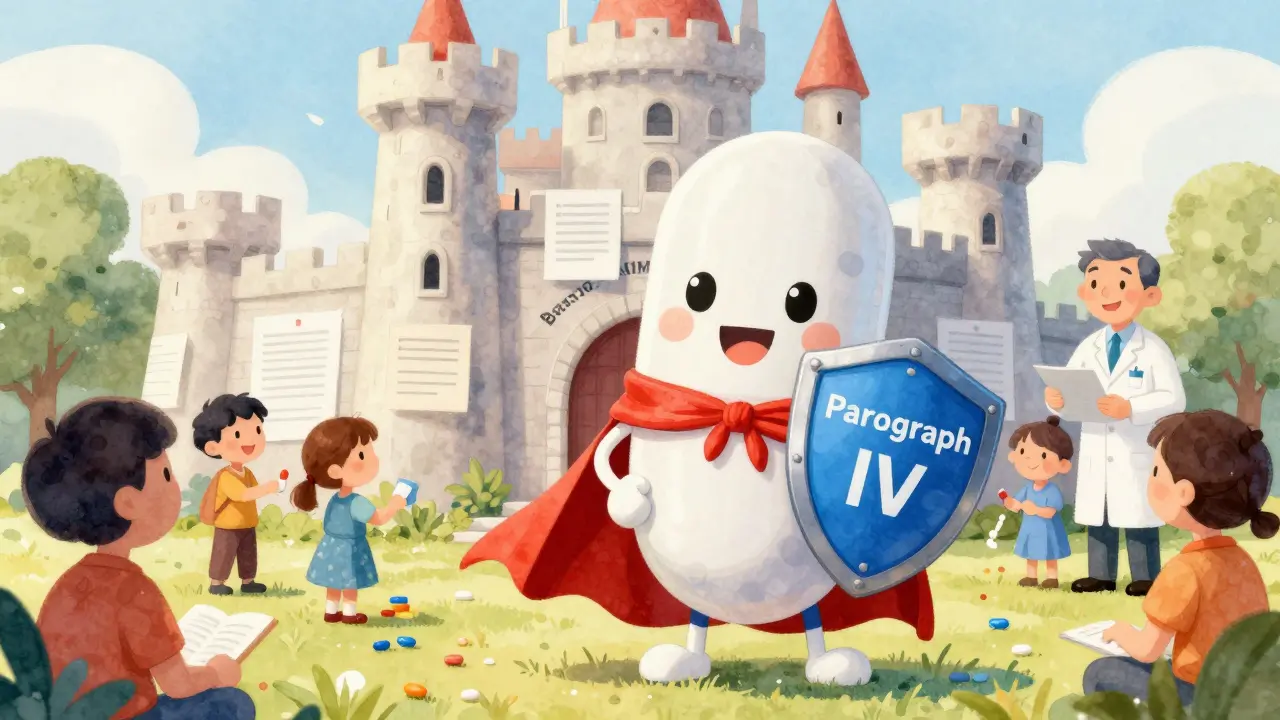
- Paragraph IV: The patents are invalid, unenforceable, or will not be infringed by the generic product.
Choosing Paragraph IV is the aggressive move. It is a formal declaration that the brand’s intellectual property protection is flawed or inapplicable. By filing this certification, the generic company is essentially saying, "We believe your patent shouldn't stop us from selling this cheaper alternative right now." This triggers a specific set of legal and regulatory events designed to balance innovation incentives with consumer access.
The Timeline: From Filing to Courtroom
The process moves fast once the generic maker pulls the trigger. Here is the step-by-step sequence that unfolds after a Paragraph IV ANDA is submitted:
- The Notification: Within 20 days of submitting the ANDA to the FDA, the generic applicant must notify the brand-name holder (the NDA owner) and the patent owner. They provide a detailed statement explaining why they believe the patent is invalid or won't be infringed.
- The 45-Day Window: The brand company has exactly 45 calendar days to decide whether to sue for patent infringement. If they do nothing, the FDA can approve the generic drug immediately upon review completion.
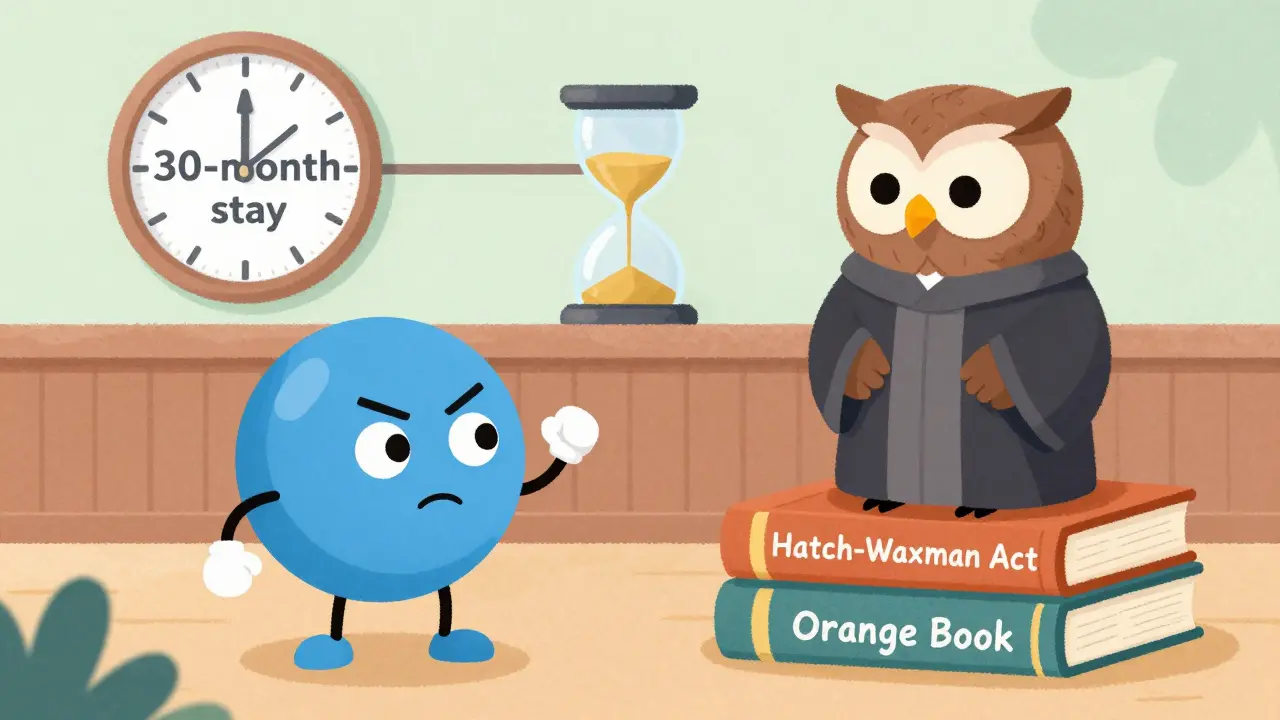
- The Lawsuit and Stay: If the brand files a lawsuit within those 45 days, an automatic 30-month regulatory stay begins. During this time, the FDA is legally barred from approving the generic application, regardless of its safety or efficacy data.
- The Resolution: The stay ends if the court rules in favor of the generic (invalidating the patent), if the parties settle, or if the 30 months pass. At that point, the FDA can finalize approval.
This timeline creates high stakes for both sides. For the generic maker, the clock is ticking. For the brand, the threat of losing exclusivity early forces them to defend their patents vigorously. In many cases, such as the 2020 Celgene v. Hetero Labs case, the stay might end earlier than 30 months if the patent is invalidated sooner, allowing faster market entry.
The Carrot: 180 Days of Exclusivity
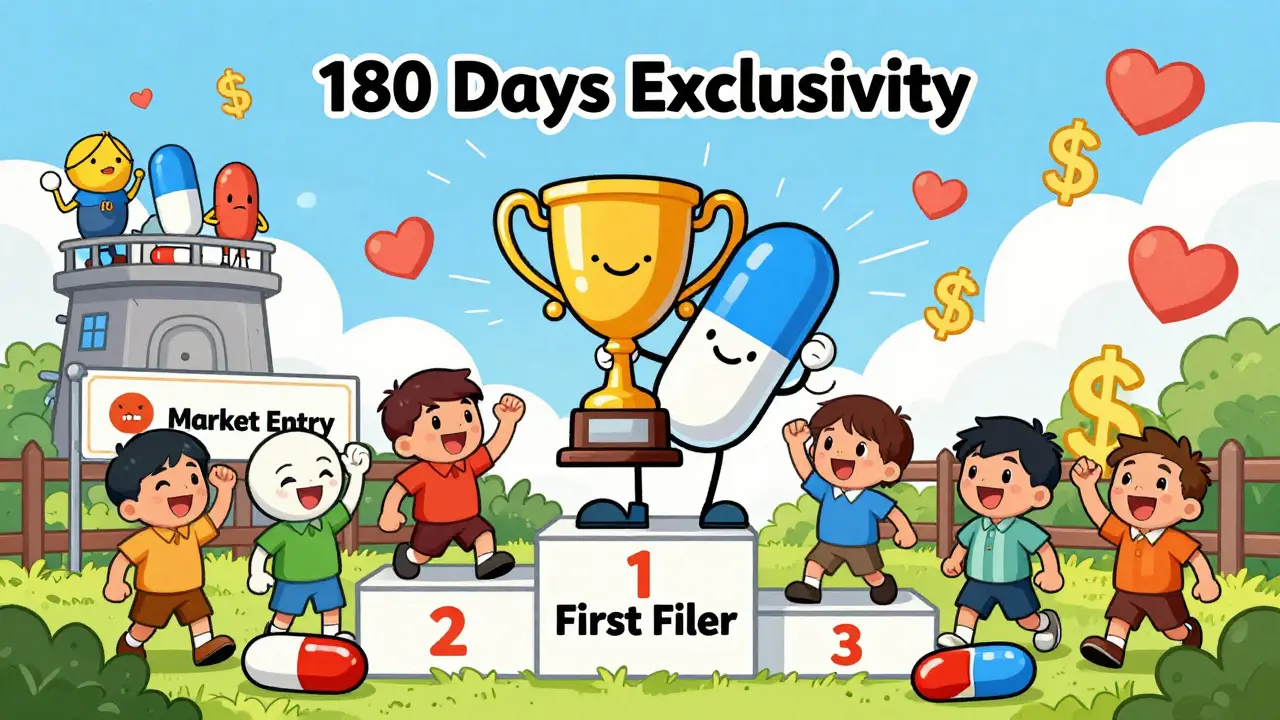
Why would a generic company risk millions in legal fees and years of delay? The answer lies in a massive financial incentive built into the Hatch-Waxman Act: 180 days of marketing exclusivity.
The first generic applicant to file a 'substantially complete' ANDA with a Paragraph IV certification-and who successfully launches the product-gets exclusive rights to sell that generic version for six months. During this window, no other generic competitors can enter the market. This period is incredibly lucrative. For example, when Teva Pharmaceuticals secured exclusivity for generic Copaxone in 2017, it generated approximately $1.2 billion in earnings during that short timeframe.
This exclusivity period drives competition among generic manufacturers. It turns the race to challenge patents into a high-stakes sprint. Companies invest heavily in identifying "weak" patents-those vulnerable to challenges based on prior art or obviousness-often starting their analysis 7 to 8 years before a patent is set to expire. The goal is to be the first filer, capture the 180-day monopoly, and establish a strong market presence before other generics flood in.
Brand Defense Strategies and Patent Thickets
Brand-name pharmaceutical companies are not sitting idle. They employ sophisticated strategies to protect their revenue streams, often creating what experts call "patent thickets." A patent thicket involves surrounding a core drug patent with dozens of secondary patents covering formulations, manufacturing processes, dosing methods, or packaging.
For instance, former FDA Commissioner Scott Gottlieb noted in a 2021 report that drugs like Copaxone accumulated over 40 patents. This makes the landscape daunting for generic challengers. Even if the main composition patent expires, the brand can argue that the generic infringes on a method-of-use patent or a formulation patent listed in the Orange Book.
Another tactic is "product hopping." This occurs when a brand company slightly modifies a product-such as changing from a tablet to a capsule or introducing a new extended-release version-just as a generic is about to launch. They then encourage doctors and patients to switch to the new version, rendering the pending generic obsolete. While controversial and sometimes challenged under antitrust laws (as seen in the 2019 case against Allergan’s Restasis), these tactics complicate the Paragraph IV landscape significantly.
Settlements and the "Pay-for-Delay" Debate
Given the high costs of litigation-averaging $15.7 million per case in 2022 according to industry expert John Thomas-most Paragraph IV disputes never go to trial. In fact, about 72% of these cases settle before a verdict is reached.
Historically, these settlements often included "pay-for-delay" agreements, where the brand paid the generic company to delay its market entry. These deals kept prices high for consumers. However, following the Supreme Court's 2013 Actavis decision, these arrangements came under intense scrutiny from the Federal Trade Commission (FTC). Post-Actavis, settlements typically include provisions ensuring generic entry no later than 75 days before the patent expiration, avoiding direct antitrust violations while still managing market timing.
Despite these reforms, critics argue that settlement culture still delays generic competition. A 2021 study in JAMA Internal Medicine found that Paragraph IV challenges result in generic entry a median of 5.2 years after brand approval. While this is earlier than waiting for full patent expiration, it remains a significant gap compared to ideal competition timelines.
| Feature | Paragraph IV Litigation | Inter Partes Review (IPR) |
|---|---|---|
| Venue | Federal District Court | PATB (Patent Trial and Appeal Board) |
| Burden of Proof | Preponderance of evidence | Clear and convincing evidence |
| Timeline | Average 30+ months (due to stays) | Typically concludes within 18 months |
| Regulatory Impact | Triggers 30-month FDA stay | No automatic FDA stay |
| Exclusivity Reward | 180 days for first filer | No exclusivity reward |
Economic Impact and Market Reality
The economic implications of Paragraph IV challenges are staggering. The FTC estimated in 2022 that successful challenges save consumers $13.7 billion annually per drug challenged. Since 1990, total savings exceed $1.2 trillion. This underscores why the system is considered essential by 92% of industry executives.
However, the playing field is shifting. The top 10 generic manufacturers now account for 68% of Paragraph IV filings, up from 52% in 2015. This consolidation means smaller players find it harder to compete due to rising legal costs. Additionally, the focus is increasingly on high-value targets. Drugs with annual sales exceeding $500 million represent 82% of all challenges, despite being only 18% of the market by volume.
Recent legislative changes, such as the 2022 Inflation Reduction Act, may further influence this dynamic. New Medicare negotiation provisions could increase the value of challenging high-cost drugs, potentially leading to a 15-20% increase in challenges for top Medicare drugs by 2025, according to projections from the USC Schaeffer Center.
Challenges and Future Trends
As we look toward 2026 and beyond, several trends are reshaping Paragraph IV strategy. First, there is a rise in "patent cliff stacking," where generic manufacturers challenge multiple patents sequentially to extend their market presence beyond the initial 180-day exclusivity. Hikma Pharmaceuticals successfully used this approach in its 2022 challenge to Novo Nordisk's Victoza.
Second, the FDA is tightening listing requirements. New guidance in 2023 has reduced "evergreening" tactics, resulting in approved drugs showing 23% fewer patents than those approved before 2020. This simplifies the landscape for challengers but also raises the bar for patent quality.
Finally, the scope of challenges is expanding. Analysts predict a 30% increase in challenges for drugs with abuse-deterrent formulations between 2023 and 2027. As generic makers target more complex generics and 505(b)(2) applications, the technical and legal complexity of Paragraph IV cases will continue to grow.
What happens if a brand company does not sue within 45 days?
If the brand-name manufacturer does not initiate patent infringement litigation within 45 days of receiving the Paragraph IV notice, the automatic 30-month regulatory stay is not triggered. The FDA can then proceed to approve the generic drug's Abbreviated New Drug Application (ANDA) as soon as it determines the application is substantially complete and meets all safety and efficacy standards.
Who gets the 180-day exclusivity period?
The 180-day marketing exclusivity is granted to the first generic applicant who files a 'substantially complete' ANDA with a Paragraph IV certification and successfully commercializes the product. If the first filer fails to launch the product within 120 days of final FDA approval or court resolution, the exclusivity period may shift to the next eligible filer.
How does a Paragraph IV challenge differ from an IPR proceeding?
A Paragraph IV challenge is filed in federal district court and triggers a 30-month FDA approval stay, offering 180 days of exclusivity to the winner. An Inter Partes Review (IPR) is an administrative proceeding at the Patent Trial and Appeal Board (PTAB) that typically resolves within 18 months but does not offer regulatory exclusivity or trigger an automatic FDA stay.
Why do most Paragraph IV cases settle?
Litigation is extremely expensive, averaging over $15 million per case, and outcomes are uncertain. Both brand and generic companies prefer to manage risk through settlements that define clear market entry dates. Historically, these settlements sometimes included payments to delay entry, but post-2013 regulations have tightened restrictions on such "pay-for-delay" agreements.
What is the role of the FDA Orange Book in this process?
The FDA Orange Book lists all approved drug products along with their associated patents. Generic manufacturers consult this book to identify which patents protect a brand drug. Filing a Paragraph IV certification specifically targets the patents listed in the Orange Book, asserting that they are invalid or non-infringing.