

When you pick up a prescription for high blood pressure, cholesterol, or antibiotics, there’s a 90% chance it’s a generic drug. These pills look different from the brand-name versions you see on TV, cost up to 85% less, and work just the same. But how exactly are they made? It’s not just copying a pill. It’s a highly controlled, science-backed process that ensures safety, consistency, and effectiveness - down to the last milligram.
What Makes a Drug "Generic"?
A generic drug isn’t a copycat. It’s a legally approved equivalent. To be called generic, it must contain the exact same active ingredient, in the same strength, dosage form (tablet, capsule, injection), and route of administration (oral, topical, etc.) as the original brand-name drug. It must also work the same way in the body. The FDA requires that generic drugs deliver the same therapeutic effect - meaning they get absorbed into your bloodstream at the same rate and to the same extent as the brand version. The key term here is bioequivalence. This means the generic drug’s maximum concentration in the blood (Cmax) and total exposure over time (AUC) must fall within 80% to 125% of the brand-name drug’s values. That’s not a wide range - it’s a tight window designed to ensure no meaningful difference in how the drug performs in patients. You might notice the color, shape, or flavor is different. That’s allowed. Inactive ingredients - like fillers, dyes, or coatings - can vary. But the active ingredient? Identical. And that’s what matters.The Legal Pathway: The ANDA Process
You don’t need to run new clinical trials to prove a generic drug works. That’s the whole point of the Abbreviated New Drug Application (ANDA), created by the 1984 Hatch-Waxman Act. Instead of spending 10-15 years and over $2 billion like brand-name companies do, generic manufacturers use the brand drug’s existing safety and efficacy data. All they need to prove is that their version performs the same way in the body. The ANDA process has five clear steps:- Submission: The manufacturer files the ANDA with the FDA, including detailed data on chemistry, manufacturing, and controls.
- Bioequivalence testing: A small study with 24-36 healthy volunteers compares how quickly and completely the generic and brand drugs enter the bloodstream.
- Facility inspection: The FDA sends inspectors to the manufacturing site to verify compliance with quality standards.
- Labeling approval: The generic’s label must match the brand’s in terms of dosage, warnings, and instructions - even if the packaging looks different.
- Post-approval monitoring: Once on the market, the drug is tracked for any safety issues or quality complaints.
Step-by-Step: How a Generic Pill Is Made
Making a generic tablet isn’t like baking cookies. It’s a precision engineering process with strict controls at every stage. Here’s how it works:1. Reverse Engineering the Reference Drug
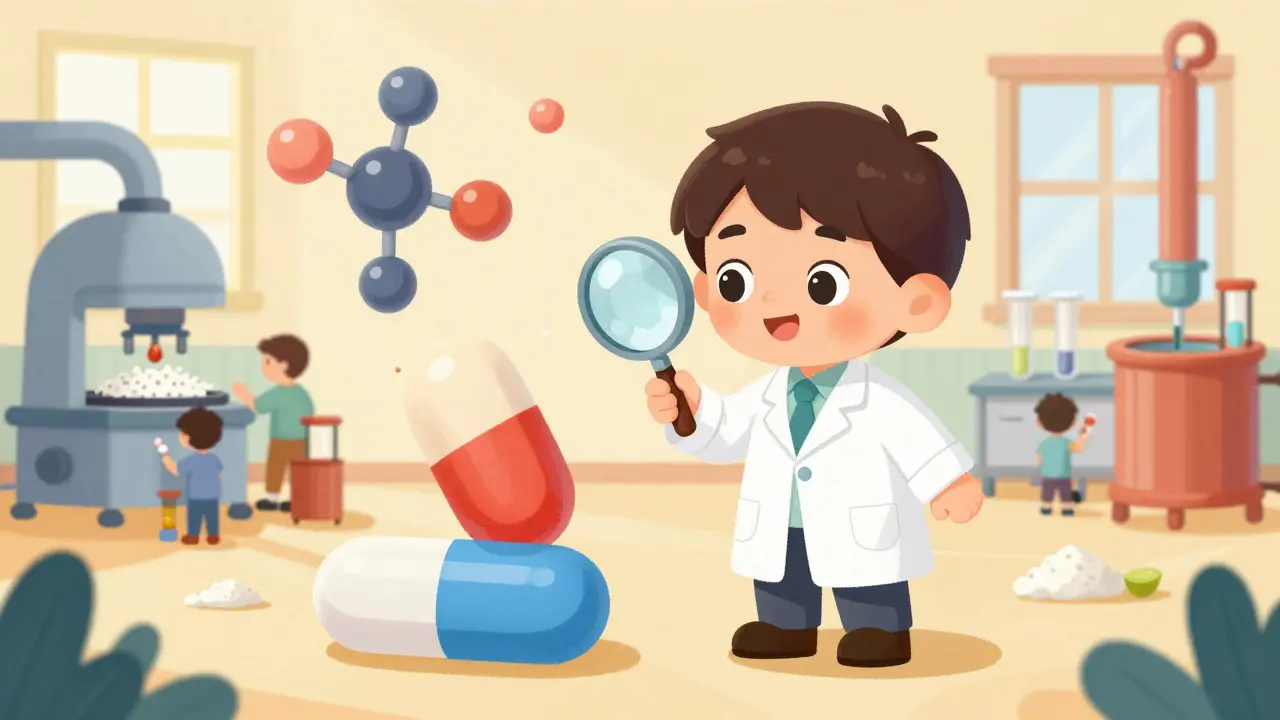
Before production starts, manufacturers buy the brand-name drug and break it down. They analyze the active ingredient’s molecular structure, how it dissolves, how it’s coated, and what excipients (inactive ingredients) are used. This is called characterizing the Reference Listed Drug (RLD). Even small differences in particle size or crystal form can change how the drug behaves in the body.2. Formulation Development (Quality by Design)
Manufacturers use the Quality by Design (QbD) framework, recommended by the International Council for Harmonisation (ICH). This means they don’t just guess what works - they test variables systematically to find the best combination of ingredients and processes. They identify:- Critical Quality Attributes (CQAs): What must be perfect? (e.g., dissolution rate, tablet hardness)
- Critical Material Attributes (CMAs): Which raw material properties matter? (e.g., lactose particle size, API purity)
- Critical Process Parameters (CPPs): Which steps must be tightly controlled? (e.g., mixing time, compression force)
3. Mixing and Granulation
The active ingredient (API) is blended with excipients like starch, cellulose, or magnesium stearate. This mixture is then turned into granules - tiny clumps that flow better and compress evenly. Granulation can be wet (using water or alcohol) or dry (using pressure). The goal? Uniform distribution of the active ingredient. If it’s not mixed right, one pill might have twice the dose of another.4. Drying
If wet granulation was used, the granules must be dried to remove moisture. Too much water? The tablet can degrade. Too little? It won’t hold together. Drying is done in controlled ovens with precise temperature and airflow settings.5. Compression and Encapsulation
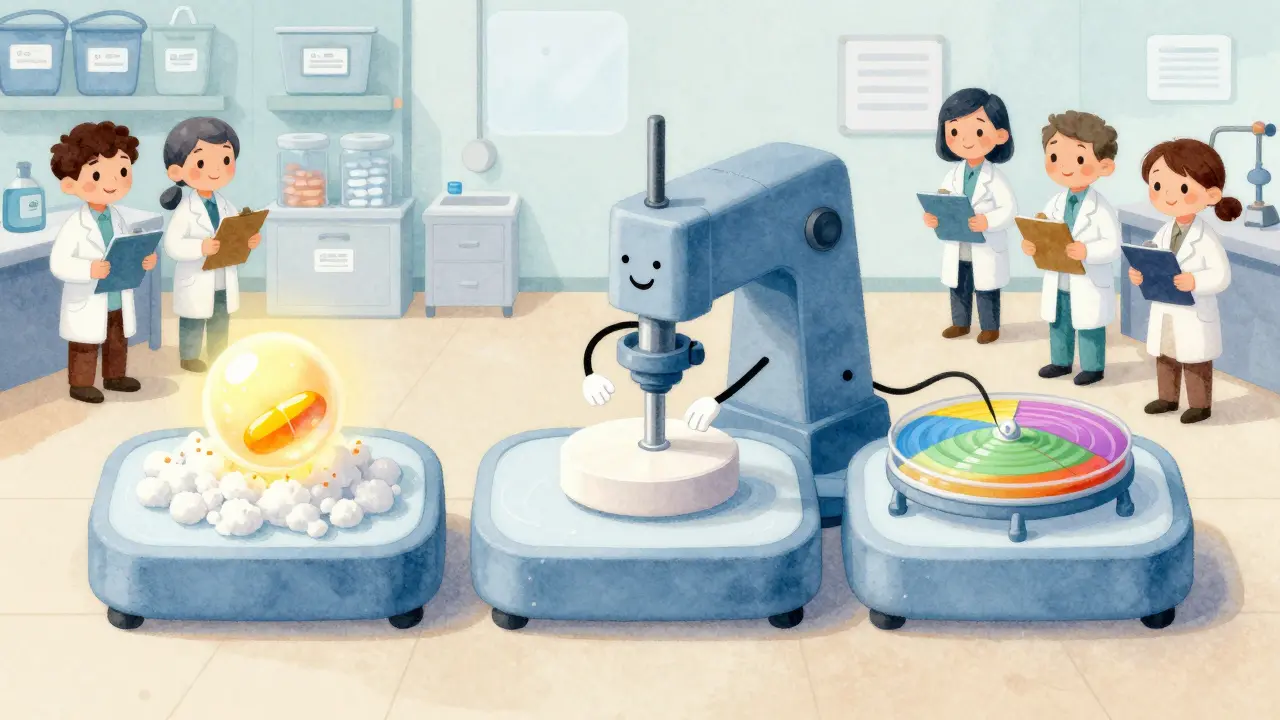
Dry granules are pressed into tablets using high-speed tablet presses. These machines can produce 10,000+ tablets per minute. Each tablet must weigh within ±5% for pills under 130mg, or ±7.5% for pills between 130-324mg - or it’s rejected. For capsules, the powder blend is filled into gelatin or vegetarian shells using automated fillers. Both processes require constant monitoring. A single faulty tablet can mean a whole batch gets scrapped.6. Coating
Many tablets get a thin coating - not just for looks, but for function. Coatings can:- Protect the drug from stomach acid
- Mask bitter tastes
- Control how fast the drug is released (extended-release)
7. Quality Control
This isn’t one test at the end. It’s checks at every stage:- Raw materials tested for identity and purity
- Granules checked for flow and moisture content
- Tablets tested for weight, hardness, thickness, and disintegration time
- Dissolution testing: Each batch is tested to ensure the drug releases at the same rate as the brand
- Final packaging inspected for correct labeling and seal integrity
Manufacturing Standards: CGMP
All generic drug factories must follow Current Good Manufacturing Practices (CGMP). These aren’t suggestions - they’re legally binding rules enforced by the FDA. CGMP requires:- Controlled environments (cleanrooms with ISO Class 5-8 ratings)
- Temperature kept at 20-25°C, humidity at 45-65% RH
- Trained staff with documented procedures for every task
- Complete records of every batch - from raw material receipt to final shipment
- Regular equipment calibration and validation
Challenges in Making Complex Generics
Not all generics are created equal. Simple pills - like metformin or lisinopril - are easy to copy. But complex drugs? That’s where things get hard. Examples include:- Inhalers (like albuterol)
- Topical creams (like clobetasol)
- Extended-release tablets
- Injectable suspensions
Why Quality Can Vary - And Why It Usually Doesn’t
Some people worry: if different companies make the same drug, could one be better than another? The answer is: technically yes - but practically, no. All generics must meet the same FDA standards. But differences in excipients, manufacturing equipment, or even the water used can lead to small variations in dissolution profiles. For most drugs, this doesn’t matter. But for drugs with a narrow therapeutic index - like warfarin, lithium, or levothyroxine - even tiny changes can affect how the body responds. Studies show that 89% of pharmacists have high confidence in generic quality. Only 3% report any meaningful clinical differences. That’s why most doctors prescribe generics without hesitation. Still, recalls happen. In 2021, Teva recalled 14 generic products due to CGMP violations at its Puerto Rico plant. But that’s rare. Most manufacturers - like Mylan, Sandoz, and Dr. Reddy’s - have built reputations on consistent quality.What’s Changing in Generic Drug Manufacturing?
The industry is evolving fast:- Continuous manufacturing: Instead of making drugs in batches (which can take weeks), some plants now use continuous lines - like a conveyor belt for pills. Vertex’s cystic fibrosis drug now runs with 99.98% batch acceptance, up from 95% with batch processing.
- AI in quality control: Pfizer’s pilot program used AI to inspect tablets for defects. It cut visual inspection errors by 40%.
- Digital twins: Virtual models of manufacturing lines predict problems before they happen.
- Regulatory changes: GDUFA IV (effective 2022) cut FDA review times from 17 to 10 months for most applications.
Why This Matters to You
Generic drugs aren’t just cheaper. They’re essential. Without them, millions of people couldn’t afford insulin, statins, or antidepressants. The savings from generics keep healthcare costs down for everyone - insurers, employers, and taxpayers alike. If you’ve ever wondered if a generic is safe, the answer is yes - if it’s approved by the FDA. The process is longer, more detailed, and more regulated than most people realize. It’s not about cutting corners. It’s about proving, scientifically and legally, that your pill works just like the expensive one. The next time you pick up a generic prescription, remember: it’s not a compromise. It’s a triumph of science, regulation, and public policy working together to make medicine affordable.Are generic drugs as safe as brand-name drugs?
Yes. The FDA requires generic drugs to meet the same strict standards for safety, strength, quality, and performance as brand-name drugs. Every generic must prove bioequivalence - meaning it delivers the same amount of active ingredient at the same rate as the original. Millions of patients use generics safely every day.
Why do generic pills look different from brand-name ones?
U.S. trademark laws prevent generics from looking identical to brand-name drugs. So manufacturers change the color, shape, or markings. But the active ingredient, dose, and effectiveness are the same. These differences are only cosmetic - they don’t affect how the drug works.
Can different generic brands of the same drug work differently?
All FDA-approved generics must meet the same bioequivalence standards. For most drugs, switching between generic brands causes no difference. But for drugs with a narrow therapeutic index - like warfarin or thyroid medication - some patients may respond better to one brand over another. If you notice a change after switching, talk to your doctor or pharmacist.
How long does it take to make a generic drug?
From start to approval, it typically takes 3-4 years and costs $5-10 million. This includes reverse engineering the brand drug, developing the formulation, running bioequivalence studies, and passing FDA inspections. Complex generics can take longer - up to 7 years - and cost significantly more.
Why are generic drugs so much cheaper?
Generic manufacturers don’t have to repeat expensive clinical trials. They use the brand drug’s existing safety and efficacy data. They also avoid the massive marketing and R&D costs that brand-name companies incur. This lets them sell the same drug at 80-85% lower prices while still making a profit.
Is the FDA inspecting generic drug factories?
Yes. The FDA inspects all manufacturing facilities - whether they make brand-name or generic drugs - before approval and regularly after. In 2023, the agency conducted over 1,000 inspections of generic drug plants worldwide. Facilities must meet the same CGMP standards regardless of location.
11 Comments
Bro this is wild 😍 I had no idea pills go through THIS much science before hitting the shelf. My grandma takes 7 generics and I always thought they were just cheap knockoffs. Turns out they’re basically FDA-certified robots in capsule form 🤖💊
lol so the fda just lets china make all our meds and calls it good?? i mean i got my blood pressure pill from a factory that smells like wet socks and it still works?? 🤨
The assertion that generic drugs are therapeutically equivalent to their branded counterparts is predicated upon an oversimplification of pharmacokinetic dynamics. Bioequivalence, as defined by the 80-125% AUC and Cmax window, permits clinically significant inter-individual variability. The regulatory framework, while ostensibly rigorous, systematically neglects the impact of excipient heterogeneity on patient-specific metabolic pathways, particularly in populations with polymorphic CYP450 enzyme expression. This constitutes a latent public health vulnerability masked by statistical aggregation.
Actually, the FDA’s bioequivalence standards are based on decades of peer-reviewed clinical data and are far more stringent than most people realize. The 80-125% range isn’t arbitrary-it’s statistically validated across thousands of trials. If you’re worried about quality, check the manufacturer’s lot number and look up the FDA’s inspection history. Most generics are produced in facilities that meet or exceed brand-name standards.
so we spend billions to make a pill that works the same as the one that costs 10x more... and yet we still act like medicine is some kind of luxury?? 🤔 maybe the problem isnt the pill... its the whole system that makes us feel guilty for wanting to live without going broke
The transition from batch manufacturing to continuous processing in generic pharmaceutical production represents a paradigm shift in quality assurance. By leveraging real-time process analytical technology (PAT) and closed-loop control systems, manufacturers are achieving unprecedented batch-to-batch consistency-reducing variability by up to 70% compared to traditional discrete batch operations. This is not merely incremental improvement; it is a fundamental re-engineering of pharmaceutical quality culture.
i just take whatever’s cheapest. if i feel weird, i switch back. it’s not that hard.
This is a very informative write-up. I come from a country where generics are often the only option, and seeing the level of precision involved gives me a new appreciation. The fact that even particle size matters is humbling. Thank you for sharing.
Let me be clear: the entire generic drug system is a Western colonial construct disguised as healthcare reform. India and China produce 78% of our active pharmaceutical ingredients because the West outsourced its manufacturing to exploit cheap labor and lax environmental regulations. The FDA inspections? A theater. The real control lies with multinational conglomerates who profit from the illusion of choice. We are not patients-we are consumers in a pharmacological empire.
It’s fascinating how much engineering goes into something so small. I used to think generics were just a cost-cutting measure, but now I see them as a triumph of precision science and public policy. The fact that millions can access life-saving medication because of this system is nothing short of remarkable.
The regulatory architecture governing generic drug approval is predicated upon a flawed epistemological assumption: that bioequivalence equates to therapeutic equivalence. This reductionist paradigm ignores the complex interplay of microbiome variability, epigenetic modulation, and polypharmacological interactions that are unique to each patient. The FDA’s reliance on healthy volunteer studies-a demographic that constitutes less than 5% of actual users-is not merely inadequate; it is ethically indefensible. The current system is not safety-oriented; it is profit-optimized.