




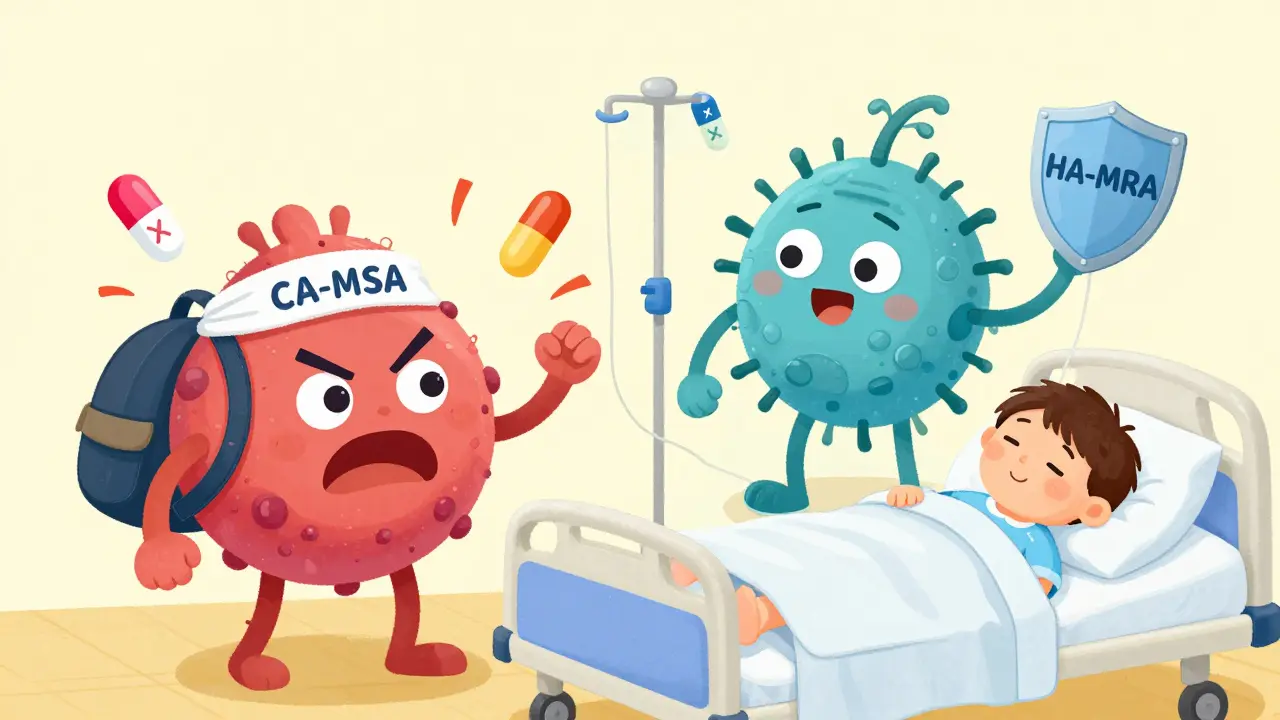
MRSA isn’t just one bug. It’s two very different ones wearing the same name. You’ve probably heard of it as a dangerous superbug, but what most people don’t realize is that the MRSA you catch at the gym is genetically and clinically different from the MRSA you pick up in a hospital. And mixing them up could mean the difference between a quick fix and a life-threatening delay.
What Exactly Is MRSA?
MRSA stands for Methicillin-Resistant Staphylococcus aureus. That’s a mouthful, but here’s the simple version: it’s a type of staph bacteria that doesn’t respond to common antibiotics like penicillin, amoxicillin, or methicillin. Staph is everywhere - on skin, in noses, in armpits. Most of the time, it’s harmless. But when it gets inside a cut, a boil, or a surgical wound, it can turn dangerous. And when it’s MRSA, your usual antibiotics won’t touch it.
For decades, MRSA was seen as a hospital-only problem. It showed up in patients who’d been in the hospital for weeks, had catheters, or were on ventilators. But since the late 1990s, something unexpected happened. Healthy people - athletes, kids, military recruits, people living in crowded housing - started getting MRSA infections with no hospital connection at all. That’s when doctors realized: there are at least two versions of this bug.
Community MRSA: The Sneaky Strain
Community-associated MRSA, or CA-MRSA, spreads outside hospitals. It doesn’t need a sick person or a medical device to survive. It thrives where people are close: gyms, locker rooms, dorms, prisons, homeless shelters. The most common strain in the U.S. is called USA300. It’s the one you hear about in news stories - the college wrestler with a spreading boil, the teenager with a painful abscess after a minor cut.
What makes CA-MRSA scary isn’t that it’s resistant to everything - it’s actually more vulnerable than hospital MRSA. It usually only resists methicillin and a few others. But it’s got a nasty trick: it produces a toxin called Panton-Valentine leukocidin (PVL). This toxin kills white blood cells, which lets the infection explode under the skin. That’s why CA-MRSA often shows up as a deep, painful boil or abscess. Sometimes, it leads to necrotizing pneumonia - a rare but deadly lung infection.
Here’s the kicker: CA-MRSA is highly treatable if caught early. Many cases don’t even need antibiotics. Just draining the pus from the abscess - done in a doctor’s office - is often enough. If antibiotics are needed, clindamycin works in about 96% of cases. Trimethoprim-sulfamethoxazole (Bactrim) and tetracycline are also very effective. Most people recover in days, not weeks.
Hospital MRSA: The Tough Survivor
Hospital-associated MRSA (HA-MRSA) is a different beast. It’s the kind that infects people who’ve been in the hospital for more than 48 hours, especially those with IV lines, catheters, or recent surgery. It’s not just resistant to methicillin. It’s resistant to almost everything else too - erythromycin, clindamycin, fluoroquinolones. In fact, 98% of HA-MRSA strains resist erythromycin, and 65% resist clindamycin. That’s why treatment is harder.
HA-MRSA carries a larger genetic package called SCCmec type I-III. This gives it resistance to many antibiotics, but it also makes it slower to reproduce. It’s built for survival in a high-antibiotic environment, not for spreading quickly through healthy people. That’s why it doesn’t usually cause big, painful boils. Instead, it causes bloodstream infections, pneumonia, or infections around surgical sites - things that take time to develop and are harder to spot.
When someone gets HA-MRSA, doctors have to reach for stronger drugs: vancomycin, linezolid, daptomycin. These are powerful, expensive, and can have serious side effects. Hospital stays for HA-MRSA patients average over 21 days - more than seven times longer than for CA-MRSA. That’s not just because the infection is worse. It’s because the patient is often already sick with other conditions.

The Lines Are Blurring - And That’s the Real Problem
Here’s where things get messy. The old idea that CA-MRSA stays in the community and HA-MRSA stays in the hospital? It’s outdated. Studies now show that 27.6% of MRSA infections that start in hospitals are actually caused by community strains. And 27.5% of community cases are caused by hospital strains.
How? Medical staff. Visitors. Discharged patients. A person with a CA-MRSA boil gets admitted for another reason - maybe a broken bone - and unknowingly brings the bug inside. A hospital patient on antibiotics picks up a HA-MRSA strain, goes home, and spreads it to their family. A nurse who works in the ICU and then visits their grandchild in daycare becomes a walking carrier.
And it’s getting worse. Some strains are now hybrids - they’ve picked up the virulence of CA-MRSA (like PVL toxin) and the broad resistance of HA-MRSA. These are the nightmares for infection control teams. They’re harder to treat, spread faster, and don’t fit any old classification.
One study in China found that a strain once considered purely hospital-based (ST239) is now being found in community patients. Another, ST59, was once a CA-MRSA strain but is now showing up in hospital settings with full multi-drug resistance. The borders between these two worlds are dissolving.
Who’s at Risk? Real Places, Real People
CA-MRSA doesn’t care about income or education. It cares about skin-to-skin contact and shared surfaces. Here are the places where risk spikes:
- Prisons: 14.9 times higher risk. Shared showers, close quarters, poor hygiene.
- Military barracks: 12.3 times higher. Shared gear, physical contact, stress.
- Homeless shelters: 8.7 times higher. Limited access to soap, water, clean clothes.
- Subsidized housing: 6.2 times higher. Overcrowding, shared bathrooms.
- Injecting drug users: High risk. Needle sharing, dirty skin, frequent wounds.
It’s not about being “dirty.” It’s about environment. Even clean people in these settings can carry and spread MRSA. That’s why routine screening and decolonization (using nasal ointments and body washes) are being tested in prisons and shelters - not because people are bad, but because the conditions make transmission inevitable.

Treatment Isn’t One-Size-Fits-All
Here’s where mistakes happen. If a doctor assumes every MRSA is hospital-type, they’ll give vancomycin. But if it’s CA-MRSA, that’s overkill - and it could make things worse by killing off good bacteria and letting resistant strains thrive.
For suspected CA-MRSA (a sudden, painful boil, no recent hospital stay), the first step is often drainage. No antibiotics needed. If antibiotics are required, clindamycin or Bactrim are first-line. Both are cheap, effective, and rarely cause side effects.
For suspected HA-MRSA (a fever after surgery, an infection that won’t clear after 48 hours in the hospital), doctors will likely start with vancomycin or linezolid. But they’re also getting smarter. In places with high CA-MRSA rates, hospitals now test for the strain type before choosing antibiotics. If it’s USA300, they might skip vancomycin and go straight to clindamycin - even in the hospital.
The bottom line: knowing the source matters. A 30-year-old athlete with a boil? Treat like CA-MRSA. A 75-year-old in ICU with a catheter infection? Treat like HA-MRSA. But if you’re not sure? Test the strain. It’s not always fast, but it’s worth it.
The Future: One System, Not Two
Public health experts now say we need to stop thinking of MRSA as two separate problems. We need to treat it as one - a single, shifting threat that moves between hospitals and communities. Surveillance systems that track strain types in both settings are being rolled out in Canada, the UK, and parts of the U.S. That way, if a new hybrid strain pops up in a nursing home, it gets flagged before it spreads to a nearby hospital.
Prevention is also changing. Instead of just handwashing in hospitals, we’re now seeing decolonization programs for high-risk groups: prisoners before release, dialysis patients before procedures, even athletes before contact sports. Nasal ointments (mupirocin) and antiseptic body washes (chlorhexidine) are being used proactively - not just as a last resort.
And the biggest shift? Doctors are learning to ask: “Where have you been?” not just “Have you been in the hospital?” A person might say no to hospitalization - but yes to a 3-month prison sentence, or a year in a shelter, or injecting drugs. That’s the new risk factor.
MRSA isn’t disappearing. But we’re getting better at outsmarting it - not by treating it as one bug, but by understanding the two very different worlds it lives in.
10 Comments
so like... if you get a weird boil after the gym and you haven't been in a hospital, just get it drained and call it a day? no need to panic? kinda wild that we've been treating all MRSA like it's a death sentence when half the time it's just a popped zit with attitude.
That’s actually really reassuring. I work in a community clinic and we’ve had a few cases where people came in with abscesses, and we just lanced them and sent them on their way. No antibiotics. They were shocked it worked. This article explains why. We need more docs to stop defaulting to vancomycin like it’s a magic bullet.
What’s fascinating here isn’t just the biological distinction between CA-MRSA and HA-MRSA-it’s the sociological mirror it holds up to our healthcare system. We treat infections like isolated events, but the reality is that MRSA is a symptom of structural inequality. The prison system, the homelessness crisis, the underfunded public health infrastructure-they’re not background noise. They’re the breeding ground. And until we address the social determinants of infection, we’re just playing whack-a-mole with antibiotics. The real ‘superbug’ isn’t the bacteria. It’s our refusal to see the system that lets it thrive.
Wait, so if a guy gets a boil from the gym, drains it, and goes home-then his grandma gets sick from visiting him and ends up in the hospital with MRSA-is that now classified as HA-MRSA even though it started in the community? That’s wild. So the classification is based on where it’s diagnosed, not where it started? That’s like calling a crime a ‘bank robbery’ because the suspect got caught in the bank, even if he stole the money from a gas station.
It’s ironic, really. We’re so obsessed with labeling things-community vs hospital, good bug vs bad bug-but biology doesn’t care about our categories. The real story here is evolution in real time. Strains are swapping genes like trading cards. What used to be a clean split is now a messy hybrid soup. And honestly? We’re not ready for it. Our diagnostic tools, our treatment protocols, even our public health messaging-they’re all built on a 2005 model. The bug moved on. We didn’t.
My cousin got MRSA after a tattoo. No hospital. Just a dirty needle and a bad studio. They drained it, gave her Bactrim for 5 days, and she was fine. No ICU. No vancomycin. Just common sense and a good doctor. We need more of that.
While the distinction between CA-MRSA and HA-MRSA is clinically significant, one must not overlook the broader implications for public health policy. The emphasis on antibiotic stewardship must be matched with investment in environmental hygiene, particularly in high-risk institutional settings. The data is clear: transmission is not a function of individual behavior alone, but of systemic neglect. Until we treat sanitation infrastructure as a medical necessity-not a budgetary afterthought-we will continue to misdiagnose the root cause of the crisis.
So let me get this straight. The same bacteria that turns a wrestler’s armpit into a horror movie is now showing up in nursing homes… and we’re still acting like it’s a hospital problem? My grandma’s facility uses the same soap as my gym. Guess who’s got the better chance of surviving MRSA? Spoiler: It’s not her.
Just remember: if you have a red, painful bump and you didn’t go to the hospital, it’s probably CA-MRSA. Drain it. Don’t panic. Antibiotics aren’t always needed. And if you’re in a crowded place like a prison or a shelter? Wash your hands. Use soap. It’s simple. It works.
One might argue that the very language we use-‘community’ versus ‘hospital’-reinforces a false dichotomy, a Cartesian split between ‘us’ and ‘them,’ between the healthy and the institutionalized. But in truth, there is no ‘community’ without the hospital, and no hospital without the community. The MRSA strain is not a villain; it is a mirror. It reflects our failures in equity, our abandonment of the vulnerable, our fetishization of technological intervention over systemic care. To treat MRSA as a microbial problem is to misunderstand the disease entirely. It is a moral one.