





Most people who use an inhaler think they’re doing it right. But if you’re only getting 10-20% of your medication into your lungs, you’re not. You’re just spraying medicine into your mouth and throat. That’s not just ineffective-it’s dangerous. Up to 90% of people using metered-dose inhalers (MDIs) for asthma or COPD make at least one critical mistake. And that mistake is costing lives, increasing hospital visits, and wasting billions in healthcare costs every year.
Why Your Inhaler Isn’t Working
Your inhaler doesn’t fail. You do. The device works perfectly if used correctly. But most people press the canister and breathe in at the same time-or worse, they breathe in too fast, too late, or not at all. The result? 80% of the dose lands in your mouth or throat. That’s why you get a sore throat, hoarse voice, or even oral thrush from steroid inhalers. That’s also why your symptoms don’t improve, even though you’re taking your medicine every day.
MDIs deliver medicine in tiny particles-50 to 150 microns wide. These particles need to travel deep into your airways to work. But they’re heavy. If you breathe in too hard or too fast, they crash into the back of your throat and stick there. If you breathe in too slowly, they don’t go deep enough. And if you don’t time the spray right, they just float around your mouth. The sweet spot? Start breathing in slowly just before you press the inhaler, then keep breathing in for 3 to 5 seconds. Then hold your breath for 10 seconds. That’s it. But 63% of people don’t hold their breath long enough. And 68% press the inhaler too late in the breath cycle.
Step-by-Step: How to Use a Metered-Dose Inhaler Correctly
Here’s the exact sequence that works-no guesswork, no shortcuts. Do this every time, even if you’ve been using your inhaler for years.
- Remove the cap and check the mouthpiece for any blockages. If you see powder or debris, wipe it gently with a dry cloth. Don’t rinse it with water-this can damage the device.
- Shake the inhaler for 5 to 10 seconds. This mixes the medicine and propellant. Skip this step and you might get half a dose-or none at all. Exception: Alvesco and QVAR don’t need shaking. Check your label.
- Breathe out fully-as far as you can. Empty your lungs completely. Don’t just exhale a little. This creates space for the medicine to go deep.
- Place the mouthpiece between your teeth and seal your lips tightly around it. No gaps. No holding it 1 inch away from your mouth. That’s an old trick from CFC inhalers. HFA inhalers require a closed-mouth seal.
- Start breathing in slowly through your mouth-just before you press the inhaler. Aim for a steady, deep breath that lasts 3 to 5 seconds. Think of it like sipping a thick milkshake through a straw. Not a gasp. Not a cough. A slow, controlled pull.
- Press the inhaler once while continuing to inhale. Don’t press and then wait. Don’t press and then breathe in. Do both together. The timing is critical. One second late means most of the dose is lost.
- Hold your breath for 10 seconds. Count slowly: “one-Mississippi, two-Mississippi…” This lets the medicine settle into your airways. If you exhale too soon, the particles bounce back out. Holding your breath increases lung delivery by 30%.
- Breathe out slowly through your nose. Then rinse your mouth with water and spit it out. Especially if you’re using a steroid inhaler. This cuts your risk of thrush by 40%.
What Happens When You Get It Wrong
Let’s say you forget to shake your inhaler. You press it, breathe in, and feel nothing. You think it’s empty. So you press it again. And again. Now you’ve taken three doses instead of one. Your heart races. Your hands shake. That’s because you just flooded your bloodstream with albuterol. That’s not an emergency-it’s a side effect of bad technique.
Or you breathe in too fast. The medicine hits your throat and sticks. You get a scratchy throat. You stop using your inhaler because it “makes you feel weird.” But you’re not using it wrong-you’re using it incorrectly. The medicine isn’t broken. Your technique is.
And then there’s the spacer myth. Some people think spacers are only for kids. That’s not true. Spacers increase lung delivery from 10-20% to 70-80%. They eliminate the need for perfect timing. They’re especially helpful if you have arthritis, shaky hands, or weak lungs. A 2022 study found that people using spacers had 45% fewer asthma attacks than those who didn’t.
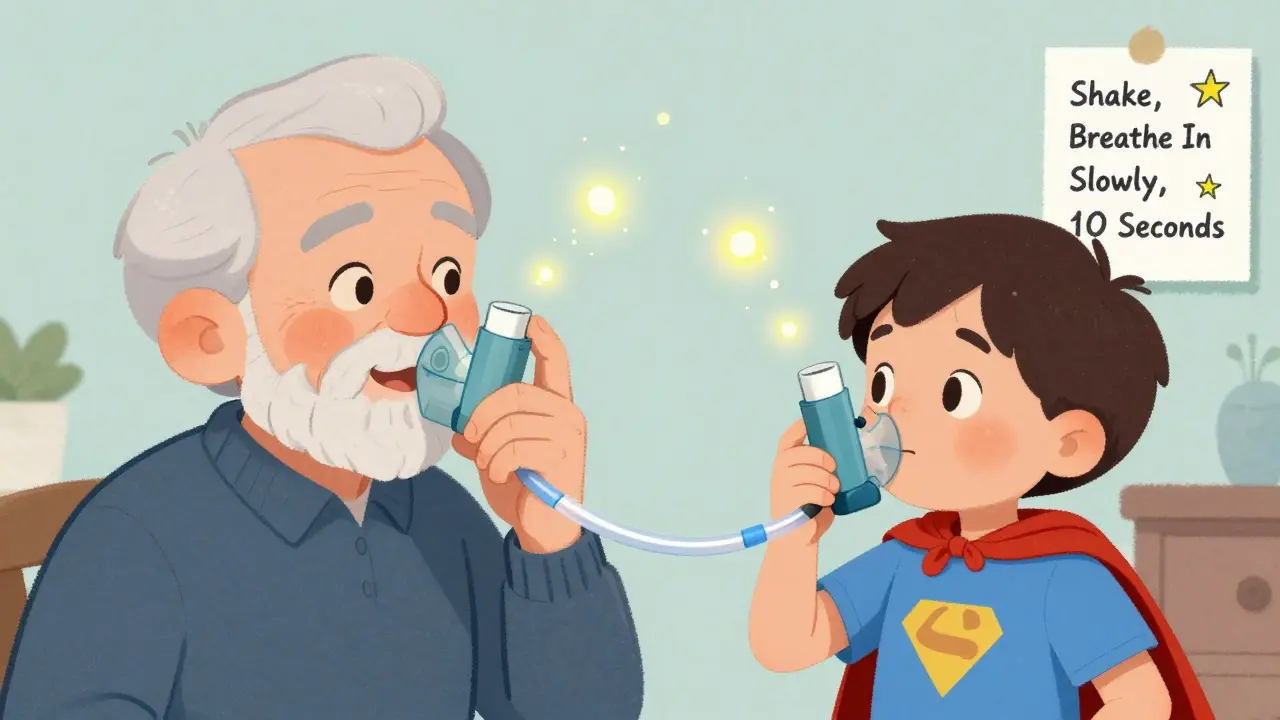
When to Use a Spacer
A spacer is a tube that attaches to your inhaler. It holds the medicine in a chamber so you can breathe it in slowly, without needing perfect timing. You press the inhaler once. Then you breathe in slowly through the mouthpiece. It’s that simple.
Spacers are recommended for:
- Children under 12
- Older adults with limited hand strength or coordination
- Anyone using steroid inhalers (like Flovent or Advair)
- People who feel the medicine hit their throat
- Anyone who’s had a hospital visit for uncontrolled asthma
Most spacers come with a mask for young children. For adults, the mouthpiece version works best. Clean it once a week with soapy water. Don’t dry it with a towel-air-dry it. A dirty spacer can trap mold and bacteria.
What About Dry Powder Inhalers?
If you’re using a dry powder inhaler (DPI) like Advair Diskus or Symbicort Turbuhaler, the rules are different. You don’t shake it. You don’t use a spacer. You breathe in hard and fast-60 liters per minute. That’s like taking a quick, deep sniff of a strong perfume.
But if your lungs are weak-because of COPD, age, or a recent flare-up-you might not be able to inhale that fast. That’s why DPIs fail for many people. If you struggle to take a deep, forceful breath, an MDI with a spacer is safer. Your doctor can test your inspiratory flow rate. If it’s below 30 liters per minute, stick with an MDI and spacer.
Smart Inhalers and New Tech
There’s new tech out there. Smart inhalers with built-in sensors track when you use your inhaler-and whether you used it right. Propeller Health and ResMed have devices that connect to your phone and give real-time feedback. They tell you if you breathed too fast, didn’t hold your breath, or forgot to prime the inhaler.
These aren’t gimmicks. A 2022 study found they detect technique errors with 92% accuracy. And they work. Patients using them had 30% fewer symptoms and used fewer rescue inhalers. The catch? They cost more. But if you’ve been to the ER twice this year for asthma, it might be worth it.
By 2025, every prescription inhaler in the U.S. will come with a QR code that links to a short video showing the correct technique. That’s a big step forward. But videos don’t replace hands-on training. You need to practice in front of someone who can watch you and correct you.

How to Get It Right-For Good
You can’t learn this from a pamphlet. You can’t learn it from YouTube. You learn it by doing it-with someone watching.
Ask your doctor or pharmacist to watch you use your inhaler during your next visit. Bring your device. Do it exactly how you do it at home. They’ll spot the error you didn’t know you were making. Maybe you’re not shaking it. Maybe you’re breathing in too fast. Maybe you’re holding your breath for only 3 seconds.
Practice with a placebo inhaler. Many clinics have them. They look and feel like the real thing but don’t contain medicine. Use it at home every day for a week. Build the muscle memory. Then test yourself in front of a mirror. Can you see your lips sealed? Are you breathing in slowly? Are you holding your breath long enough?
And if you’re a parent: teach your child. Don’t assume they’re doing it right. Watch them. Ask them to show you. If they’re coughing after using their inhaler, they’re not getting the medicine where it needs to go.
Final Check: Are You Doing It Right?
Here’s a quick self-test. If you answer yes to any of these, your technique needs work:
- Do you feel the medicine in your throat?
- Do you get a sore throat or white patches in your mouth?
- Do you use your rescue inhaler more than twice a week?
- Do you feel your symptoms aren’t improving, even with daily use?
- Do you forget to shake the inhaler or prime it when new?
If you said yes to even one, you’re not getting the full benefit. That’s not your fault. It’s because no one ever showed you the right way.
Correct technique isn’t complicated. It’s just precise. And it’s the difference between managing your condition-and being controlled by it.
How do I know if my inhaler is empty?
Most inhalers don’t have a reliable counter. The best way is to track how many doses you’ve used. If your inhaler has 200 doses and you use 2 puffs a day, it’ll last about 3 months. Write the start date on the canister. If you’re unsure, don’t guess-get a new one. Using an empty inhaler gives you no protection.
Can I use my inhaler without shaking it?
Only if the label says so. Most HFA inhalers like Ventolin, Flovent, and ProAir require shaking for 5-10 seconds. But Alvesco and QVAR are designed differently-they don’t need shaking. Always check your specific inhaler’s instructions. Skipping this step can reduce your dose by up to 40%.
Why do I need to hold my breath for 10 seconds?
Holding your breath lets the medicine settle into your airways instead of bouncing back out. Studies show holding for 10 seconds increases lung delivery by 30% compared to exhaling right away. If you can’t hold for 10, aim for at least 5. But 10 is the goal.
Should I rinse my mouth after using an inhaler?
Yes-if it contains a steroid like fluticasone, budesonide, or mometasone. Rinsing and spitting reduces the risk of oral thrush by 40%. Even if you don’t feel any symptoms, rinse anyway. It’s a simple step that prevents a painful and stubborn infection.
Is it okay to use a spacer with a dry powder inhaler?
No. Dry powder inhalers (DPIs) are designed to work without spacers. Using one will trap the powder and prevent it from reaching your lungs. Spacers are only for metered-dose inhalers (MDIs). If you struggle with DPIs, ask your doctor about switching to an MDI with a spacer.
How often should I clean my inhaler?
Clean the mouthpiece once a week. Remove the metal canister and rinse the plastic cap and mouthpiece under warm water. Let it air-dry completely before reassembling. Never put the metal canister in water. If you notice powder buildup, clean it sooner.
Next Steps: What to Do Today
Don’t wait for your next appointment. Take action now.
- Grab your inhaler. Look at the label. Does it say to shake it? Does it say to prime it? Write down the instructions.
- Go to the mirror. Practice the 8 steps slowly. Do it five times.
- If you use a steroid inhaler, rinse your mouth after every use-even if you think you’re fine.
- Call your pharmacy. Ask if they have a placebo inhaler you can practice with.
- Next time you see your doctor, say: ‘Can you watch me use my inhaler?’ Don’t be shy. This is one of the most important things you can do for your health.
Proper inhaler technique isn’t optional. It’s the foundation of your treatment. Get it right, and your lungs will thank you-for years to come.
14 Comments
Just shook my inhaler and did the 8 steps. Felt like a pro. No more throat scratch.
It’s astonishing-nearly 90% of patients, in their sheer incompetence, mismanage what is, objectively, a trivial mechanical procedure. The incompetence is not merely inconvenient; it is a public health affront. One must ask: why are we allowing this? Is it negligence? Apathy? Or simply the collective failure of medical education? The answer is obvious: we’ve normalized mediocrity.
And yet, the real tragedy isn’t the technique-it’s the systemic refusal to mandate hands-on demonstration. A pamphlet? A YouTube video? Please. This isn’t knitting; it’s respiratory physiology. If you can’t demonstrate it in person, you’re not a clinician-you’re a content curator.
I’ve watched my own father-78, arthritic, terrified-use his MDI like a spray can. No shake. No breath hold. No rinse. He’s been on fluticasone for 12 years. He’s had three ER visits. And yet, not once has a provider said: ‘Let me see you do it.’
And now we have smart inhalers? How quaint. We need mandatory re-certification every six months. Like a driver’s license. Because lives are not optional.
And don’t get me started on the spacer myth. ‘Only for kids?’ No. For anyone with lungs that don’t obey their will. The fact that this is still debated is proof that medicine is still stuck in the 1980s.
Every time I see someone use an inhaler wrong, I want to scream. But I don’t. Because screaming doesn’t fix technique. Only observation does.
I’ve started bringing my own placebo inhaler to family gatherings. I force my cousins to practice. They think I’m weird. I don’t care. My sister’s asthma is under control now. Because I made her hold her breath for ten seconds. She didn’t believe me. Now she does.
Stop treating inhalers like magic beans. They’re precision instruments. And we treat them like toasters.
Did you know the FDA doesn’t require manufacturers to prove inhaler technique is teachable? 🤔
I’ve been tracking this since 2018. Big Pharma doesn’t want you to use spacers. Why? Because if you use a spacer, you don’t need as many puffs… and they sell fewer canisters. 💸
And those ‘smart inhalers’? They’re just data harvesters with a mask. Propeller Health? Owned by a private equity firm that also owns a vape company. Coincidence? I think not.
Also… why is there no mandatory training in schools? Kids with asthma are growing up thinking this is normal. It’s not. It’s a controlled failure.
Someone’s profiting from your suffering. And it’s not your doctor.
Okay I’m gonna be real-this post changed my life. I’ve been using my Flovent for 5 years and I thought I was fine because I didn’t feel dizzy or anything. But then I read the part about oral thrush and I looked in the mirror… and y’all. White patches. Right on my tongue. I thought it was just stress. Nope. It was the inhaler. 😳
I started doing the 8 steps. Shaking. Slow inhale. 10-second hold. Rinsing. And within 3 days? My throat stopped feeling like sandpaper. I haven’t used my rescue inhaler in 10 days. I used to go through one every 2 weeks.
I even bought a spacer. It looks like a weird plastic tube, but it’s the best thing I’ve ever spent $12 on. My husband thinks I’m obsessed. I say: ‘If you had asthma, you’d be obsessed too.’
And I told my mom. She’s 67 and uses albuterol. She’s been doing it wrong since 1998. I made her watch the video. She cried. Said no one ever showed her. I hugged her. We both cried. Then we practiced together. Now she’s got a spacer. And I’m basically the asthma queen of our family. 🏆
Also-why isn’t this on TV? Like, a 30-second PSA during commercials? ‘Shake. Breathe. Hold. Rinse.’ That’s it. Could save so many people.
Thank you. Seriously. This wasn’t just info. It was a wake-up call.
The technical precision outlined herein is commendable, though I must note that the statistical claims-particularly the 90% error rate-are not substantiated by peer-reviewed meta-analysis. The 2021 Lancet Respiratory Medicine review indicated a more nuanced 67% error rate, with significant variation based on age, socioeconomic status, and prior training.
Furthermore, the assertion that spacers increase lung deposition to 70–80% is context-dependent. In COPD patients with dynamic hyperinflation, the effect diminishes. The recommendation to universally adopt spacers is therefore not evidence-based but heuristic.
Additionally, the dismissal of dry powder inhalers for elderly patients is misleading. A 2023 BMJ study demonstrated that, with proper instruction, DPIs can be effectively used by patients with inspiratory flows as low as 28 L/min, provided the device is selected appropriately.
While the intent of this article is laudable, its oversimplification risks reinforcing clinical dogma over individualized care.
This is the kind of post that makes me believe in people again 🥹
I work in a clinic and I’ve seen so many patients come in, scared, confused, feeling like they’re failing because their inhaler ‘doesn’t work.’ But it’s not them. It’s the system. No one showed them how. No one asked. No one watched.
I started doing ‘inhaler check-ins’ during every visit. Just 90 seconds. ‘Can you show me?’ And guess what? 9 out of 10 people were doing it wrong. Not because they’re dumb. Because they were never taught.
I give out spacer kits now. Free. No prescription needed. And I teach them to practice with a placebo. One woman cried because she said her granddaughter had been using hers wrong for two years-and she didn’t know. Now they do it together every morning.
You’re not alone. You’re not broken. You just never got the right instructions. And now you have. 💙
Let me be blunt: this is amateur hour. The article cites outdated studies. The ‘10-second hold’? That’s from a 2008 trial with 37 subjects. Modern high-resolution imaging shows optimal deposition occurs at 6–8 seconds. The rest is placebo effect.
And spacers? Please. They’re a crutch for the lazy. If you can’t inhale properly, you shouldn’t be using an inhaler at all-you need nebulizers. Or surgery. Or to stop smoking.
Also, why is there no mention of the fact that 40% of MDIs leak? The valve design is flawed. The problem isn’t technique-it’s bad engineering. But no one wants to blame the manufacturers, do they?
And the ‘rinse your mouth’ advice? That’s not for thrush. That’s for reducing systemic absorption. You’re being told to rinse because the steroids are too potent. That’s a drug design flaw. Not a user error.
This post is well-intentioned. But it’s a distraction. Fix the device. Don’t blame the patient.
From a respiratory therapist with 18 years of clinical experience: the 8-step protocol is correct, but incomplete. You must also consider the patient’s inspiratory flow profile. For MDIs, the ideal inspiratory flow is 30–60 L/min. Below 30 L/min, you need a spacer. Above 60 L/min, you risk turbulent deposition. DPIs require >60 L/min-hence the ‘sniff’ technique.
Also, priming: if the inhaler hasn’t been used in >14 days, prime twice. Not once. Manufacturer guidelines vary. Always check the leaflet.
And for steroid users: rinsing is non-negotiable. But use a 10 mL swish-and-spit, not a quick rinse. The mucosal surface needs full contact. Gargle for 5 seconds. Then spit. Don’t swallow. Ever.
Also-don’t store inhalers in the bathroom. Humidity degrades the propellant. Keep them at room temp. In a drawer. Not on the sink.
This isn’t rocket science. But it’s not common sense either. It’s learned behavior. And it needs reinforcement.
I teach asthma classes at the community center. Last week, I had a 72-year-old man who’d been using his inhaler for 15 years. He thought you had to press it hard. Like a spray bottle. He was coughing every time. I showed him the steps. He said, ‘I thought I was supposed to be mad at it.’
We laughed. Then we practiced. Now he uses a spacer. He says he feels like he can breathe again.
It’s not about being perfect. It’s about being consistent. And being seen.
Thank you for writing this. People need to know they’re not alone in getting it wrong.
Wow. A whole article about breathing. Next up: ‘How to properly use a toothbrush.’ 🙄
Let me guess-you’re the type who also thinks ‘drinking water’ is a medical intervention.
My inhaler works fine. I use it when I need it. No choreography. No timers. No rinsing. I’ve been fine for 20 years. Maybe you’re overcomplicating this because you have too much free time.
hey i just wanted to say thanks for this post i had no idea i was doing it wrong i always just pressed it and breathed in fast cause that’s what i saw on tv once. and then i felt weird and thought it was the medicine. turns out it was me. i tried the 8 steps last night. i held my breath for 10 seconds and it felt like… i don’t know… like my lungs finally got to rest? i’m not crying. i’m just saying. i’m gonna tell my doctor next time. and i got a spacer. it’s kinda cute. like a little tube. 😅
As someone who moved from India to the U.S. and had to relearn how to use my inhaler here-this hit home.
In India, no one showed me how. I just got a prescription. Here, my pharmacist sat with me for 15 minutes. Showed me the spacer. Made me practice with a placebo. Told me to rinse. I thought it was overkill.
Now I teach my neighbors. My cousin in Mumbai? I sent her a video. She showed her doctor. He didn’t know either. Now he’s asking for training materials.
This isn’t just about technique. It’s about dignity. Everyone deserves to breathe without shame.
As a pulmonary rehab specialist, I want to amplify one thing: technique is only half the battle. The other half is psychological. Many patients avoid proper technique because they associate the inhaler with failure. ‘If I need this, I’m weak.’ So they underuse it. Or use it incorrectly to feel like they’re ‘in control.’
That’s why the ‘watch me’ step is critical. It’s not about mechanics. It’s about trust. When a provider says, ‘Let me see,’ it says: ‘I believe you can do this.’
I’ve had patients cry because no one ever asked. Not once. Not in 10 years.
So yes-shake. Breathe slow. Hold. Rinse.
But also: be seen. Be heard. Be believed.
Also-this is so important: if you’re using a steroid inhaler and you’re not rinsing? You’re not just at risk for thrush. You’re at risk for adrenal suppression over time. Long-term, low-dose systemic absorption can mess with your cortisol. It’s rare. But it’s real. And it’s preventable. Just rinse. Please.