


When chemicals splash into your eye, damage starts within seconds. A Chemical Eye Injury is a serious eye injury caused by corrosive substances like acids or alkalis, requiring immediate flushing to prevent permanent damage. According to the American Academy of Ophthalmology, Ocular Trauma any injury to the eye, including chemical splashes, which account for 11.5-22.5% of emergency cases from chemical splashes accounts for 11.5-22.5% of emergency eye cases. Research shows flushing within 10 seconds cuts permanent vision loss risk by 76%. But most people make critical mistakes - like rubbing their eyes or stopping too soon. Here's exactly what to do.
Why Immediate Action Matters
Every second counts with chemical eye injuries. The American Academy of Ophthalmology states that alkali burns (from substances like drain cleaners) are more common than acid burns at a 3:2 ratio. Alkalis penetrate deeper into eye tissue, causing more severe damage. A 2017 meta-analysis in the British Journal of Ophthalmology found that starting irrigation within 10 seconds reduces permanent vision loss risk by 76%. Delays beyond 10 minutes significantly increase the chance of corneal perforation. The CDC's NIOSH guidelines emphasize that immediate copious irrigation is the cornerstone of management. For context, the average workplace chemical eye injury delay is 2 minutes and 17 seconds - enough time for irreversible damage.
Step-by-Step First Aid for Chemical Eye Splashes
Follow these steps exactly:
- Stop what you're doing and don't rub your eye. Rubbing makes damage worse. Studies show 68.2% of people rub their eyes, worsening corneal damage.
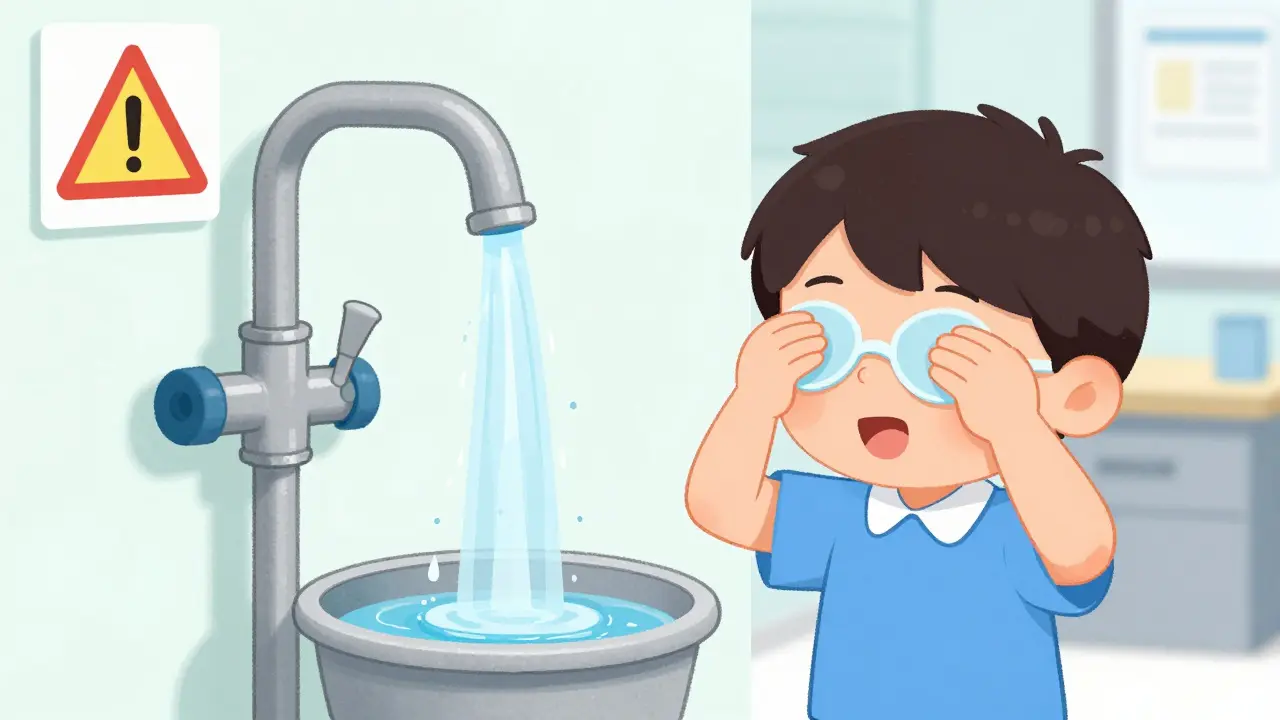
- Find running water - tap water works perfectly. Healthdirect Australia says cool water is best, but Unger Eye Wellness confirms tap water is sufficient. Saline solution offers no advantage over tap water for initial flushing, according to Dr. Reay Brown's 2020 study in JAMA Ophthalmology.
- Tilt your head so the affected eye is lower than the unaffected eye. This prevents chemicals from flowing into your good eye. Healthdirect Australia specifically recommends this positioning.
- Flush continuously for 15-20 minutes. Use your fingers to gently hold eyelids open. Keep water flowing steadily. Don't stop early - even if it stings. The CDC advises continuing until professional help arrives.
- Remove contact lenses only if you can do it safely. Healthdirect Australia (2023) advises attempting removal unless the eye surface is severely damaged. If it's too painful, skip this step and keep flushing.
- Get medical help immediately after flushing. Even if symptoms seem mild, internal damage may remain. Call 911 or visit an emergency room.
Top 5 Mistakes People Make During Chemical Eye First Aid
- Rubbing the eye: This is the most common mistake. A 2022 study in the Journal of Occupational and Environmental Medicine found 68.2% of victims rub their eyes, worsening damage. The American Red Cross reports this is the top error in chemical eye injuries.
- Stopping too soon: Many stop after 5 minutes. But Healthdirect Australia and Better Health Channel specify 15-20 minutes minimum. A CDC survey found 57.3% of workers stop irrigation prematurely.
- Using insufficient water: 82.6% of cases use too little water. You need a steady stream - not a trickle. ANSI Z358.1-2021 requires eyewash stations to deliver 0.4 gallons per minute for 15 minutes.
- Applying pressure: Pressing on the eye can cause perforation. The American Red Cross warns against this. Even slight pressure can worsen damage.
- Waiting for help before flushing: Every second counts. OSHA data shows average delays of 2 minutes 17 seconds in workplaces. A 2022 study found only 43.7% of victims started irrigation within 60 seconds.
Workplace vs Home: Different Protocols for Different Settings
ANSI Z358.1-2021 requires workplaces with chemicals to have Emergency Eyewash Station a device that delivers tepid water for emergency eye flushing, meeting specific flow rate and activation time standards that deliver tepid water (60-100°F) at 0.4 gallons per minute for 15 minutes minimum. These stations must activate within 1 second and be within 10 seconds of the hazard. However, OSHA's 2023 audits found 22.8% of facilities lacked compliant stations. For home use, Healthdirect Australia recommends cool tap water for 20 minutes. The American Academy of Ophthalmology notes that while saline is often recommended, Dr. Reay Brown's 2020 study in JAMA Ophthalmology found tap water works just as well for initial flushing. For alkali burns (from substances like sodium hydroxide), longer irrigation may be needed due to deeper tissue penetration. Acid burns (from substances like sulfuric acid) also require thorough flushing, but the initial steps are the same.
When to Seek Professional Help
Always see an eye doctor after a chemical splash, even if you flush properly. The CDC states that chemical injuries can cause hidden damage that worsens over time. A 2023 study in the Journal of Emergency Medicine found 63.2% of smartphone first aid apps provide incomplete or contradictory guidance. Never rely on home remedies or delayed care. Corneal transplants may be needed for severe cases - 18.7% of chemical eye injury patients require them within 5 years, according to 2023 Medicare data. Immediate medical attention is critical for the best outcome.
How long should I flush my eye after a chemical splash?
Flush for at least 15-20 minutes. Healthdirect Australia and Better Health Channel specify 20 minutes, while Unger Eye Wellness says 10 minutes minimum. However, the CDC and American Red Cross advise continuing until professional help arrives. Studies show shorter flushing times increase the risk of permanent damage. For alkali burns (like from drain cleaners), longer flushing may be needed - up to 30 minutes in severe cases.
Can I use saline solution instead of tap water?
No - tap water works just as well. Dr. Reay Brown, director of the Cornea Service at Bascom Palmer Eye Institute, published in JAMA Ophthalmology (2020) that saline offers no advantage over tap water for initial irrigation. The American Red Cross and CDC both state that clean tap water is sufficient. Using saline is unnecessary and may delay flushing.
Should I remove contact lenses during flushing?
Only if you can do it safely without causing more damage. Healthdirect Australia (2023) advises attempting removal unless the eye surface is severely damaged. If the eye is too painful or swollen, skip this step and keep flushing. Forcing lens removal can scratch the cornea. Remember, flushing comes first - contact lens removal is secondary.
What's the difference between alkali and acid burns?
Alkali burns (from substances like drain cleaners with pH >11.5) penetrate deeper into eye tissue than acid burns (from substances like sulfuric acid with pH <2.5). Alkalis cause liquefactive necrosis, while acids cause coagulative necrosis. However, Alkali Burns a type of chemical eye injury caused by alkaline substances that penetrate deeper into eye tissue and Acid Burns a type of chemical eye injury caused by acidic substances that typically cause surface damage both require immediate flushing. Initial first aid steps are the same for both types.
Is there a special device for chemical eye injuries?
Yes - Emergency Eyewash Station a device that delivers tepid water for emergency eye flushing, meeting specific flow rate and activation time standards is required in workplaces under ANSI Z358.1-2021. These stations deliver water at 0.4 gallons per minute for 15 minutes minimum. For home use, a simple water bottle or faucet is sufficient. The FDA approved a specialized solution called Diphoterine in 2022, but it's not widely available yet and requires professional application.
14 Comments
When it comes to chemical eye injuries, I've always been amazed at how crucial the first few seconds are.
The research is pretty clear: flushing within 10 seconds can cut the risk of permanent vision loss by 76%.
But most people panic and do the wrong thing-like rubbing their eyes or waiting too long to get water.
I remember reading a study where the average workplace delay was over two minutes, which is way too long.
It's scary to think about how much damage can happen in that time.
Tilt your head so the affected eye is lower than the other one-that way, the chemicals don't flow into your good eye.
And don't stop flushing too soon! Healthdirect Australia says 15-20 minutes minimum, but the CDC recommends keeping it going until help arrives.
Some folks think saline is better than tap water, but Dr. Reay Brown's study in JAMA Ophthalmology showed tap water works just as well.
I've seen too many people stop after a few minutes because it stings, but that's exactly when you need to keep going.
The American Red Cross also emphasizes that rubbing your eyes is the top mistake, and 68% of people do it.
It's important to stay calm and focus on flushing.
Contact lenses should only be removed if it's safe, otherwise keep flushing.
And even if you feel better after flushing, you still need to see a doctor because there could be hidden damage.
I've worked with people who had chemical splashes and saw how quickly things can escalate.
It's all about acting fast and not skipping steps.
Trust me, those few extra minutes of flushing could save your vision for good.
Always remember, immediate action is key.
Don't wait for help to arrive before starting to flush.
Every second counts.
Don't rub your eye! Seriously, it's the worst thing you can do.
Studies show 68% of people do it and it makes everything worse.
Just flush with tap water right away.
No need for saline or anything fancy.
Tap water works perfectly.
Keep it going for 15-20 minutes even if it stings.
And tilt your head so the bad eye is lower.
Trust me, this is basic stuff but people skip it.
I've seen too many accidents where people waited too long.
Just act fast. No time to waste.
Thanks for the detailed info Savannah
Really important to stress the flushing time
So many people stop too early because it hurts
But you gotta keep going
Even if it stings
Tilt your head
Don't let the good eye get contaminated
Contact lenses only remove if safe
Otherwise keep flushing
See a doctor even if you feel okay
Hidden damage is real
Good point about CDC saying to keep flushing until help arrives
Not just 15-20 mins
Every second counts
Thanks for sharing
flush 20 mins no exceptions alwys
Tap water is all you need. Don't overcomplicate it.
Exactly! Tap water is perfect 💯
Saline is useless for initial flushing
Dr. Reay Brown says so in JAMA
Don't waste time looking for saline
Just use what's available
Every second counts! 🚨
Oh, just rub your eyes and wait for help-classic move. 🙄
68% of people do it too, apparently.
Because clearly, making things worse is the best strategy.
But hey, maybe you'll get lucky.
Or maybe not.
Just flush with water already.
It's not rocket science.
Why is this so hard for people?
Yes but some people dont know better
Like if they have contacts
They should remove them but only if safe
Otherwise keep flushing
But most people dont know that
Its not their fault
But they need to be educated
Like i said before
Its all about the first few seconds
And not rubbing
Its so simple
But people still mess up
Its frustrating
Indian studies show that using tap water is better than saline for chemical burns.
Our healthcare system has known this for years.
Western countries are just catching up.
Always trust local knowledge.
Don't rely on American guidelines.
They're often outdated.
While it's important to recognize local expertise, the global medical consensus supports the use of tap water for initial flushing.
Dr. Reay Brown's study in JAMA Ophthalmology is internationally recognized.
It's crucial to base decisions on evidence rather than nationalism.
Every life saved matters, regardless of origin.
Let's focus on sharing knowledge universally.
Agreed with Ritu.
Science is universal.
Local knowledge is valuable but evidence-based guidelines should guide us.
Chemical injuries need immediate action, not politics.
Just flush and seek help.
Simple as that.
Let me break it down for you.
Step 1: Don't rub.
Step 2: Flush with tap water.
Step 3: Tilt head.
Step 4: Keep flushing 20 mins.
Step 5: See doctor.
That's it.
Why is this so complicated?
People overthink everything.
Just follow the steps.
Easy peasy.
Exactly.
Just do it.
No need for fancy stuff.
Flush and go to ER.
Done.
Yes, just do it.
Don't overcomplicate.
Flush for 20 minutes.
Even if it hurts.
Don't stop.
See a doctor immediately.
That's the only way.
Any delay is dangerous.
Stop listening to nonsense.
Just act.
Save your vision.
That's all that matters.