The FDA Orange Book is the U.S. government’s official list of drugs approved for sale, including both brand-name and generic versions. It’s not just a directory-it’s a critical tool that determines which generic drugs can legally replace brand-name drugs in pharmacies across the country. If you’ve ever picked up a prescription and been handed a cheaper pill with a different label, the Orange Book is why that’s allowed.
What Is the FDA Orange Book?
The official name is Approved Drug Products with Therapeutic Equivalence Evaluations, but everyone calls it the Orange Book because of its orange cover when it was first printed. It was created in 1984 under the Hatch-Waxman Act, a law designed to speed up access to cheaper generic drugs without letting drug companies extend their monopolies unfairly.
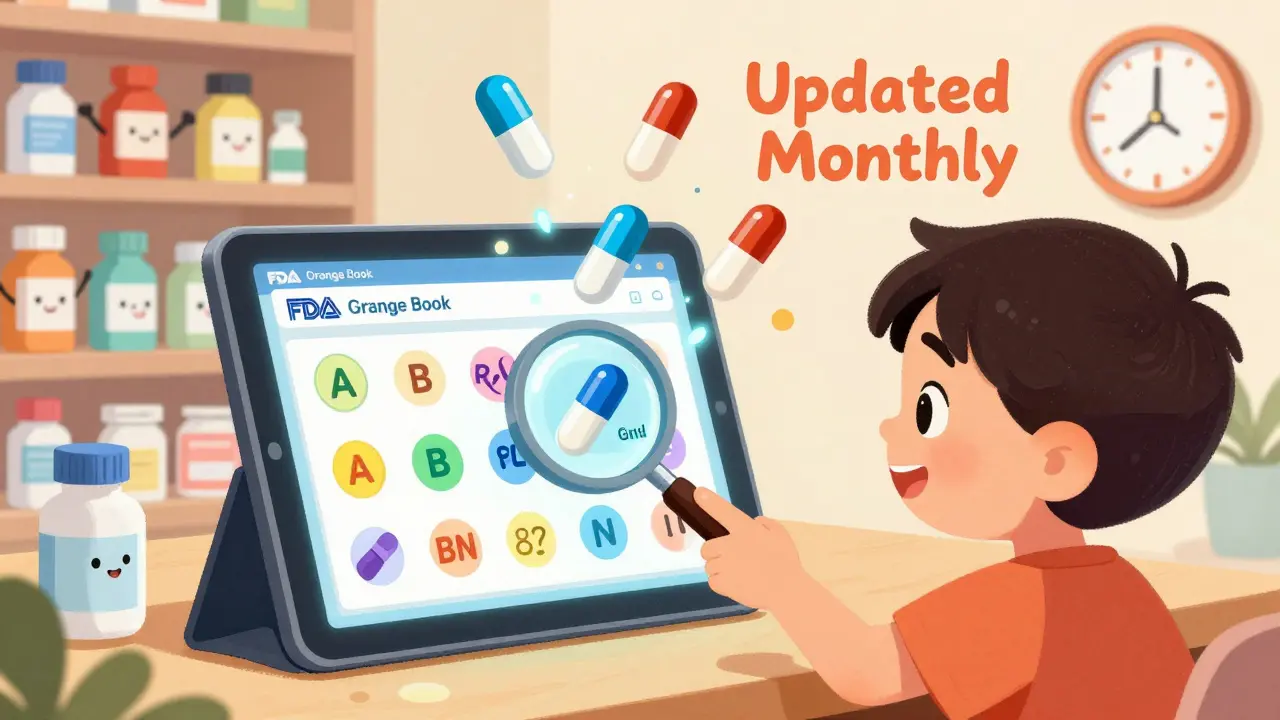
Today, the Orange Book is digital and updated every month. It lists over 16,000 approved drug products, including both prescription and over-the-counter medicines. About 90% of all prescriptions filled in the U.S. are for generic drugs, and the Orange Book tells pharmacists which ones are safe to swap in place of the brand-name version.
How Generic Drugs Get Listed
Generic drug companies don’t start from scratch. They don’t run new clinical trials. Instead, they use a faster path called the Abbreviated New Drug Application (ANDA). To get approved, they must prove their drug is bioequivalent to a brand-name drug already on the market.
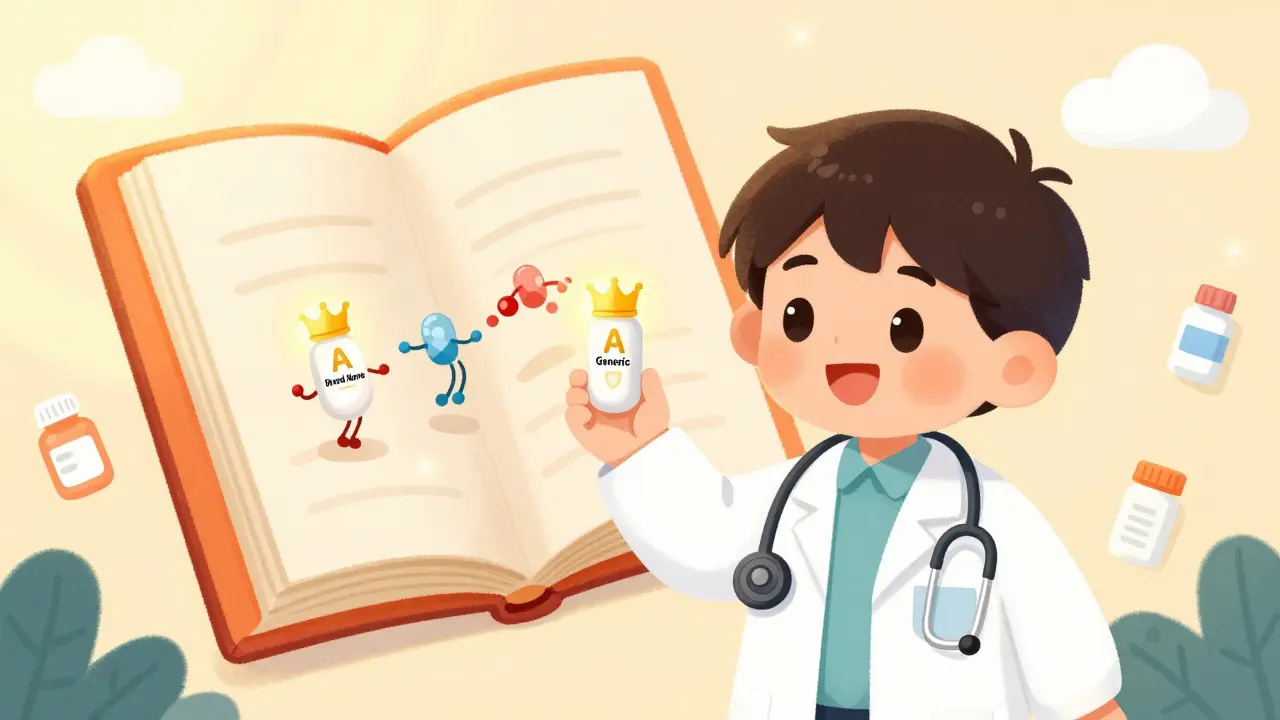
This brand-name drug is called the Reference Listed Drug (RLD). The RLD is the gold standard. It’s the exact version the generic is copying. In the Orange Book, the RLD is clearly marked with a "Yes" in the RLD column. Any generic version gets a "No"-but that doesn’t mean it’s less effective.
Once the FDA approves an ANDA, the generic appears in the Orange Book within a month. The approval doesn’t just mean the ingredients match-it means the drug works the same way in the body, is absorbed at the same rate, and delivers the same clinical effect.
Therapeutic Equivalence Codes: What the Letters Mean
Every drug in the Orange Book gets a Therapeutic Equivalence (TE) code. These two-letter codes tell you whether a generic is interchangeable with the brand.
- A codes mean the generic is therapeutically equivalent. It can be substituted without any concerns. Most generics fall into this category.
- B codes mean there’s uncertainty. Maybe the drug is hard to absorb, or it’s delivered in a complex way-like an inhaler or eye drop. These aren’t automatically interchangeable.
- BN codes mean there’s only one manufacturer. No generics exist yet, so the brand has exclusivity.
These codes matter. If your pharmacist sees an "A" code, they can swap the drug without asking your doctor. If it’s a "B," they might need your doctor’s OK-or even be legally blocked from substituting, depending on your state’s rules.
Authorized Generics: The Hidden Option
Not all generics are created equal. There’s another type called authorized generics. These are the exact same pills as the brand-name drug-same factory, same packaging, same formula-but sold under a generic label.
They’re not listed separately in the Orange Book. Instead, they’re buried inside the brand’s original approval. The FDA keeps a separate public list of authorized generics, updated every quarter. You won’t find them in the Orange Book, but they’re often cheaper than the brand and just as reliable.
For example, if you buy a generic version of a cholesterol drug and it’s labeled as "made by Pfizer," that’s likely an authorized generic. It’s not a copy-it’s the real thing, just sold without the brand name.
Patents and Exclusivity: The Hidden Rules
The Orange Book doesn’t just list drugs-it also lists patents. Drug companies must tell the FDA about any patents covering their drug’s active ingredient, formula, or how it’s used.
These patents show up in the Orange Book with numbers, expiration dates, and use codes (like "U-123"). If a generic company files an ANDA and one of these patents is still active, the FDA can’t approve it right away. The patent holder can sue, and that triggers a 30-month delay. This is called the "patent dance." It’s a legal pause button that lets the brand company protect its profits.
But here’s the catch: some companies list dozens of patents, even ones that don’t really protect the drug. Critics call this "patent evergreening." The FDA has cracked down in recent years. In 2023, it updated its rules to stop companies from listing patents that cover unrelated uses or expired formulations.
How Pharmacists and Pharmacies Use the Orange Book
Most pharmacies have the Orange Book built into their computer systems. When a prescription comes in for a brand-name drug, the system checks if there’s an equivalent generic with an "A" code. If so, it may automatically substitute it-unless the doctor says "dispense as written."
But it’s not always simple. Some drugs, like inhalers or complex injections, are harder to match exactly. Pharmacists report confusion when TE codes don’t match real-world performance. One pharmacist told a forum: "I’ve had patients switch to a generic inhaler and say it doesn’t work the same. The Orange Book says it’s equivalent-but it doesn’t feel like it."
And state laws vary. In some states, pharmacists can substitute any "A"-coded drug. In others, they need a doctor’s note. That’s why pharmacists often double-check the Orange Book manually, even if their system says "yes."
What’s Changing in 2026?
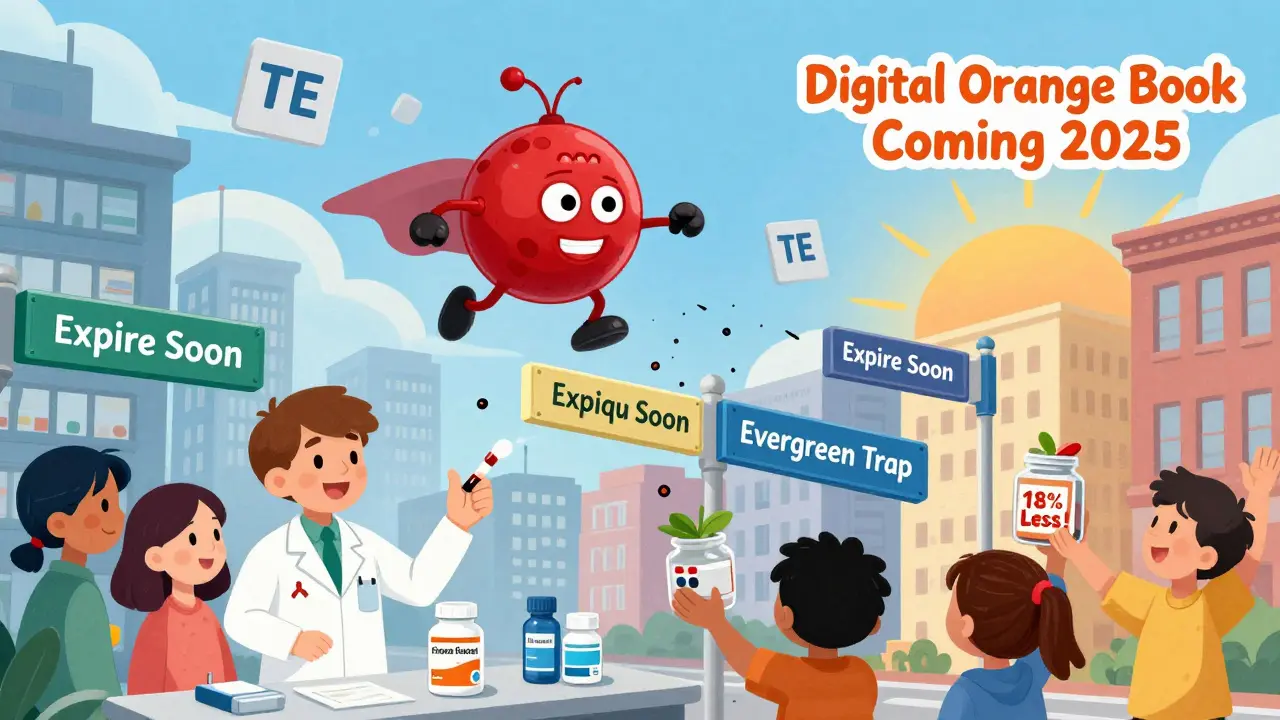
The FDA is working on a "Digital Orange Book"-a new system set to launch in 2025. It will update in real time, not monthly. It will also make TE codes clearer for complex drugs like nasal sprays and topical creams.
Right now, over 2 million searches happen every month through the Orange Book’s public API. Pharmacies, insurers, and pharmacy benefit managers all use it to decide which drugs to cover and which to push.
The goal? Lower prices. The Congressional Budget Office found that when generics with "A" codes enter the market, prices drop 18% to 22% within six months. That’s billions saved every year.
Why It Matters to You
If you take a generic drug, the Orange Book is why you’re paying less. If you’ve ever been told your insurance won’t cover the brand, that’s because the Orange Book says a cheaper version exists.
But it’s not perfect. Sometimes, a generic works differently. Sometimes, the system gets confused. And sometimes, companies game the patent system to delay competition.
The Orange Book is the backbone of America’s generic drug system. It’s not flashy. It doesn’t make headlines. But every time you save money on a prescription, it’s because of this quiet, digital ledger that tells pharmacists: "Yes, this works the same."
Is the FDA Orange Book the same as Drugs@FDA?
No. Drugs@FDA lists all drug applications, including those still under review. The Orange Book only includes drugs that are fully approved and available for sale. If a drug is still in "tentative approval," it shows up in Drugs@FDA but not in the Orange Book.
Can a generic drug be pulled from the Orange Book?
Yes. If a generic drug is found to be unsafe, ineffective, or if the manufacturer fails to meet quality standards, the FDA can remove it. It also gets removed if the company stops selling it or if a patent issue blocks its approval. Discontinued drugs appear in a separate section of the Orange Book.
Do all generic drugs have a Therapeutic Equivalence (TE) code?
No. Only prescription drugs are evaluated for therapeutic equivalence. Over-the-counter (OTC) drugs listed in the Orange Book don’t have TE codes because the FDA doesn’t require them to be interchangeable. That’s why you can’t swap one OTC pain reliever for another just because they have the same ingredient.
How often is the Orange Book updated?
The electronic version is updated every month, usually on the first business day. New approvals, patent changes, and discontinued products are added or removed in real time, but the public database only refreshes once a month.
Can I trust the TE code on my prescription label?
The TE code on your prescription label comes from the Orange Book, so it’s accurate. But it doesn’t tell the whole story. Some drugs with "A" codes still cause issues in practice-especially inhalers, patches, or liquid suspensions. If you notice a difference after switching, talk to your pharmacist or doctor.
For more details, visit the FDA’s official Electronic Orange Book site. You can search by drug name, ingredient, or patent number. It’s free, public, and updated monthly. Whether you’re a patient, pharmacist, or just curious, knowing how to read it can save you money-and help you understand why your prescription changed.
14 Comments
So let me get this straight - we’re trusting a government database to decide if my cheap pill is as good as the expensive one? 🤔 I’ve been on generics for years, and sometimes I swear the ‘equivalent’ one makes me feel like I’ve been hit by a bus. Not saying it’s the drug… but maybe the filler? Or the moon phase? 🌙
TE codes are a joke. Seriously. A-code = ‘totally interchangeable’? Have you tried switching from one generic levothyroxine to another? I’ve had heart palpitations, brain fog, and one time I cried because I thought I was dying. It was just… the pill. The FDA’s ‘equivalent’ doesn’t mean ‘identical.’
And don’t even get me started on the ‘authorized generics’ - those are the only ones I trust now. Same factory, same batch, just no logo. But you won’t find that in the Orange Book. It’s a cover-up.
Pharmacies don’t tell you this. Insurance companies don’t care. They just want the cheapest thing on the list. Meanwhile, I’m the one paying with my anxiety.
Also, why is the ‘B-code’ category so vague? ‘Hard to absorb’? What does that even mean? Is it the coating? The pH? The wind direction? The FDA needs to stop hiding behind acronyms and start being honest.
I’ve been researching this for 3 years. I’ve read the ANDA applications. I’ve emailed the FDA. They reply with PDFs. Not answers.
And now they’re rolling out a ‘Digital Orange Book’? Great. More tech. More jargon. Less transparency. 💥
Ugh. The Orange Book. Such a ‘vital tool’ lol. I mean, it’s basically a glorified Excel sheet with a 1980s aesthetic. And don’t even get me started on ‘bioequivalence.’ Like, sure, the blood levels are ‘similar’… but what does that even mean? 95%? 87%? Is that enough for my thyroid meds? Or my anxiety pills? I’ve switched generics 4 times. Each time, I felt like a lab rat.
Also, ‘authorized generics’? That’s just brand-name drugs in a turtleneck. Why isn’t that highlighted? Why does it take a Reddit thread to find out your ‘generic’ is actually made by Pfizer? The system is designed to confuse. And I’m not even mad - I’m just… disappointed.
Also, ‘B-code’ drugs? Yeah, those are the ones where your pharmacist says ‘I can’t substitute’ and then you spend 20 minutes on the phone with your doctor. Why not just label them ‘NOT FOR SUBSTITUTION’? Why the alphabet soup?
And why is the ‘Digital Orange Book’ launching in 2025? It’s 2024. We have AI. We have blockchain. We have apps that can tell you if your avocado is ripe. Why is this still a monthly PDF update? #Fail
I love how the Orange Book is this quiet, unsexy engine of healthcare savings. No one talks about it. No one cheers for it. But every time I save $40 on my insulin, I think of it. It’s like the plumbing of the system - invisible until it breaks.
And yeah, sometimes generics don’t feel the same. But that doesn’t mean the system is broken. It means we need better data. Better testing. More transparency. Not less.
Also - authorized generics? YES. Please, pharmacists, start labeling them. Patients deserve to know if they’re getting the exact same pill, just cheaper. It’s not a conspiracy. It’s just… common sense.
Let’s be real - the entire therapeutic equivalence framework is a statistical mirage. The FDA’s definition of ‘bioequivalent’ is based on AUC and Cmax thresholds that allow for up to a 20% variance in absorption. That’s not ‘equivalent’ - that’s ‘close enough for government work.’
And yet, we’re told to assume interchangeability? For drugs with narrow therapeutic indices? Like warfarin? Lithium? Levothyroxine? The clinical consequences of a 15% drop in absorption aren’t theoretical - they’re documented in case reports. I’ve seen patients admitted for seizures after switching generics.
The system isn’t broken. It’s designed to prioritize cost over precision. And the Orange Book? It’s not a tool - it’s a legal shield. It lets insurers and pharmacy benefit managers off the hook while patients bear the physical and psychological cost.
Also - patents. The ‘patent dance’ isn’t a dance. It’s a stalling tactic. Companies file 17 patents on a single drug - one for the tablet shape, one for the coating, one for the ‘method of use’ that doesn’t even relate to the condition. The FDA’s 2023 crackdown? Too little. Too late.
And don’t get me started on OTC drugs. No TE codes? Really? You can’t swap ibuprofen for naproxen because ‘they’re not interchangeable’? But they’re both NSAIDs? The logic is nonsensical. The system is a patchwork of compromises, not a science.
They say generics save money. But I think they just make money for big pharma. Why? Because the same companies that make the brand also make the generic. You think Pfizer doesn't own the 'generic' version of their own drug? Of course they do. The Orange Book is just a way to make you think you're getting a deal. You're not. You're just paying less to the same people.
Hey - I just want to say thank you for writing this. Seriously. I’m a pharmacy tech, and I deal with this every day. Patients come in confused, scared, angry. They don’t understand why their pill changed color. They think they’re being cheated.
But you know what? Most of the time, the generic works fine. And when it doesn’t? We can look up the TE code. We can check if it’s an authorized generic. We can call the doctor. We can help.
The Orange Book isn’t perfect. But it’s the best tool we have. And if we use it right - with honesty, with care - it saves lives. Every day.
So yeah. It’s not glamorous. But it matters. 💙
Oh, the Orange Book. The sacred scroll of pharmaceutical capitalism. The holy ledger that whispers to pharmacists: ‘Substitute. Substitute. SUBSTITUTEEEEE.’
I used to trust it. I used to believe in the ‘A’ code. I used to think science was neutral.
Then I met a woman. She was 68. She took levothyroxine for 12 years. Her brand worked. Perfect. Stable. Then the pharmacy switched her. ‘Same TE code,’ they said. ‘FDA-approved.’
Three weeks later, she was in the ER. Heart rate 140. Sweating. Trembling. She thought she was having a heart attack.
It was the generic.
The FDA says ‘bioequivalent.’ But bioequivalent doesn’t mean ‘biologically identical.’ It means ‘statistically acceptable.’
And now? Now I don’t trust the Orange Book.
I trust my body. I trust my patients. I trust the silence between the lines.
And I trust that someone, somewhere, is making billions off our confusion.
EVERYTHING in the Orange Book is manipulated. EVERYTHING. The patents? Fake. The TE codes? Bribed. The ‘authorized generics’? A front for the same companies to charge MORE because they know you’ll pay extra for ‘Pfizer’ even if it’s the same pill.
And the FDA? They’re in bed with Big Pharma. They don’t care about you. They care about the lobbyists. The ‘Digital Orange Book’? It’s just a new way to track you. To sell your data. To charge insurers more. To make you think you’re getting a deal while they quietly raise prices on the brand version.
They’re watching you. They know when you switch. They know which generics you take. They know when you complain.
And they’re laughing.
Don’t trust the system. Don’t trust the code. Don’t trust the pharmacist. Trust your gut. And if you feel weird after a switch? STOP. CALL YOUR DOCTOR. DEMAND THE BRAND.
They don’t want you to know this.
So the FDA says generics are safe. But have you ever read the ANDA applications? The ones they don’t show you? They’re full of gaps. Missing data. ‘Assumed’ bioavailability. ‘Extrapolated’ results. They don’t test the generic on real people. They test it on 24 healthy volunteers. 24. That’s it. Then they say ‘equivalent.’
And now they want to launch a ‘Digital Orange Book’? What’s next? A blockchain ledger? A smart contract for your thyroid meds? This isn’t innovation. It’s obfuscation.
Also - authorized generics? Why are they hidden? Why aren’t they front and center? Because if people knew that the ‘generic’ was made by the same company as the brand - they’d stop trusting the whole system.
It’s not about saving money. It’s about control.
Generic drugs save money. End of story. If you’re having issues, talk to your doctor. Don’t blame the Orange Book. It’s just a database. It’s not responsible for your biology.
Look - I get it. The system’s messy. But here’s the truth: 90% of prescriptions are generic. That’s 90% of people saving money. That’s billions in savings. That’s insulin for diabetics. That’s blood pressure meds for seniors. That’s asthma inhalers for kids.
Yes, there are edge cases. Yes, some people react differently. But the solution isn’t to tear down the system - it’s to improve it. More data. Better testing. Real-time updates. Transparency.
The Orange Book isn’t perfect. But it’s the best thing we’ve got. And if you’re mad about it? Use it. Learn it. Advocate for it. Don’t just complain.
Knowledge is power. And this? This is power you can use.
You got this!! 💪 The Orange Book might seem boring, but it’s literally saving lives every day. If you’re worried about your meds, talk to your pharmacist - they’re the real heroes. And hey - if something feels off? Speak up! Your voice matters. 🌟
Also - authorized generics? I just found out mine is one. I’m not even mad. I’m kind of impressed. It’s like finding out your ‘generic’ coffee is actually Starbucks. Just without the logo.