


Most people don’t know their arteries are quietly clogging up years before they feel any symptoms. A simple, five-minute CT scan can show you exactly how much plaque is building up in your heart’s arteries - and whether you’re at real risk for a heart attack. This isn’t science fiction. It’s called a coronary calcium score, and it’s one of the most powerful tools doctors have to catch heart disease before it’s too late.
What Exactly Is a Coronary Calcium Score?
A coronary calcium score comes from a special type of CT scan that looks for calcium deposits in the coronary arteries - the blood vessels that feed your heart. These deposits aren’t just random minerals. They’re the hardened remains of atherosclerotic plaque, the sticky mix of fat, cholesterol, and inflammatory cells that slowly builds up inside your arteries over time.
The scan doesn’t need contrast dye. You don’t have to fast overnight or get an IV. You lie on a table, EKG leads are stuck to your chest to time the images with your heartbeat, and you hold your breath for 10 to 15 seconds while the machine takes pictures. That’s it. The whole thing takes less than five minutes.
The result? A number - your calcium score. And that number tells you more about your heart risk than your cholesterol or blood pressure alone.
How the Score Is Calculated: The Agatston Method
The score isn’t just a guess. It’s based on the Agatston Score, developed in 1990 by Dr. Arthur Agatston. The CT machine detects every spot of calcium in your arteries, measures how dense it is (on a scale from 1 to 4), and multiplies that by the area of the deposit. The computer adds up all the spots to give you one final number.
But here’s the key: that number alone doesn’t tell the full story. What matters more is how it compares to others your age, sex, and ethnicity. That’s where the MESA Percentile comes in. If your score is in the 85th percentile for a 55-year-old man, it means 85% of men your age have less calcium in their arteries than you do.
What Your Score Actually Means
Here’s what the numbers really say - straight from the Cleveland Clinic and American College of Cardiology guidelines:
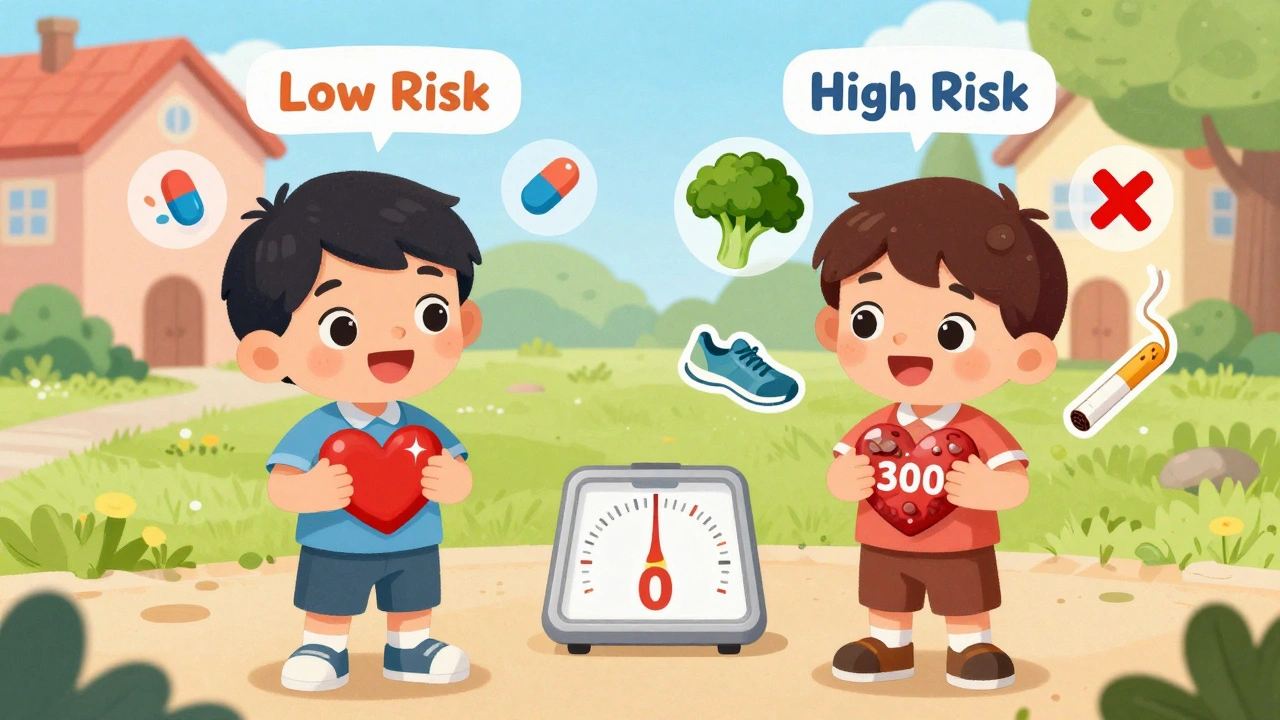
- 0 - No detectable calcium. Your risk of a heart attack in the next 5-10 years is very low.
- 1-10 - Minimal plaque. You’re not in the clear, but your risk is still low.
- 11-100 - Mild plaque. This is where things start to matter. You have early disease, even if you feel fine.
- 101-400 - Moderate plaque. Your risk of a cardiac event is 75% higher than someone with a score of zero.
- 401+ - Extensive plaque. You’re at high risk. Without intervention, your chance of a heart attack in the next few years jumps significantly.
Even a score of 10 is a red flag. It means plaque is already there. And plaque doesn’t go away on its own.
Why This Test Beats Traditional Risk Calculators
Doctors often use tools like the Pooled Cohort Equations to estimate heart disease risk. But here’s the problem: they’re wrong about 20-30% of the time, especially for people in the “intermediate risk” group.
Imagine a 52-year-old man with normal cholesterol, no diabetes, and a healthy weight. His calculator says he’s low risk. But his calcium score is 142 - higher than 78% of men his age. That’s not low risk. That’s moderate disease. He’s been misclassified.
Studies show that adding a coronary calcium score to traditional risk factors reclassifies nearly half of intermediate-risk patients. That means people who were told they didn’t need statins suddenly get them - and people who were told they needed them might not.
This isn’t about fear. It’s about precision. You wouldn’t treat a broken leg with a painkiller and hope for the best. Why treat heart disease that way?
What the Scan Can’t See
It’s important to know the limits. This scan only sees calcified plaque. But about 20-30% of plaque is soft - not yet hardened with calcium. That means a score of zero doesn’t guarantee you’re safe. You could still have dangerous, non-calcified plaque.
That’s why a coronary calcium score isn’t the same as a coronary CT angiogram (CCTA), which uses contrast dye to see all types of plaque. But CCTA costs more, exposes you to more radiation, and isn’t needed for most people.
The calcium score is the best first step. If your score is high, your doctor might then recommend a CCTA to get a fuller picture.
Who Should Get Tested?
The guidelines are clear: this test is for people who don’t have symptoms - but who have some risk factors. That means:
- Men aged 45-75
- Women aged 55-75
- With intermediate risk (7.5-20% chance of heart disease in 10 years)
- Or borderline risk with LDL cholesterol over 160 mg/dL
- Or a strong family history of early heart disease
If you’re under 40, it’s rarely useful - plaque hasn’t had time to calcify. If you’re over 75, the results may not change your care plan much. And if you already have heart disease, diabetes, or a previous heart attack - you’re already in high-risk treatment mode. This test won’t add much.
What Happens After the Scan?
Your doctor won’t just give you a number and send you on your way. A high score triggers action:
- Score 100-300? You’re likely started on a moderate-intensity statin, even if your cholesterol is normal.
- Score over 300? High-intensity statin. No debate. Your risk is too high to wait.
- Score over 100? Blood pressure control becomes even more urgent.
- Score over 400? Your doctor will push hard on diet, exercise, and smoking cessation - and may refer you to a cardiologist.
One Reddit user, u/CardioCurious, shared his story: his score of 142 at age 52 scared him into quitting smoking and starting statins - something his doctor had asked him to do for years. He said it was the push he needed.
Insurance, Cost, and Access
Here’s the frustrating part: insurance doesn’t always cover it. Medicare doesn’t pay for it. Some private insurers do - but only if your doctor says it’s medically necessary.
Out-of-pocket cost? Between $100 and $300, depending on where you live. In Bristol, a scan at a private imaging center might cost £80-£150. That’s less than a month’s gym membership.
Only 15% of eligible people get tested - not because they don’t need it, but because most don’t know about it. And many doctors don’t bring it up.
The Bigger Picture: Prevention Is the Goal
The coronary calcium score isn’t about finding disease. It’s about preventing it. It turns abstract risk into a concrete number you can act on.
Think of it like a smoke detector. You don’t wait for the house to burn down before you install one. You install it because you know fires can start silently. The same goes for your arteries.
With a calcium score, you’re not just guessing whether you need to change your diet, start exercising, or take a pill. You’re seeing the evidence. And that changes everything.
It’s not about fear. It’s about control. You can’t change your age or your genes. But you can change your plaque - if you know it’s there.
What’s Next for This Test?
Technology is making it better. New AI tools are cutting radiation by 40% without losing image quality. Researchers are tracking 10,000 patients in a long-term NIH study to define exactly when to start stronger treatment based on the score.
And the data keeps growing. In 2022, over 2 million coronary calcium scans were done in the U.S. - up 17% from the year before. More doctors are using it. More patients are asking for it.
The message is clear: if you’re in the right age group and have even mild risk factors, this test could be the most important one you ever take.
Is a coronary calcium scan dangerous because of radiation?
The radiation dose is low - between 1 and 3 millisieverts, similar to a mammogram or a round-trip flight from London to New York. That’s far less than a standard chest CT (which can be 7 mSv or more). The benefit of catching heart disease early far outweighs the tiny risk from radiation exposure.
Can I get a coronary calcium scan without a doctor’s referral?
Some private imaging centers allow self-referral, but it’s not recommended. Without a doctor to interpret the result in context - your blood pressure, cholesterol, family history - you could misread the score. A score of 50 might mean nothing for a 65-year-old smoker, but it’s serious for a 45-year-old with no other risks. Always discuss results with your provider.
If my score is zero, am I completely safe from a heart attack?
No. A zero score means no calcified plaque - but not necessarily no plaque at all. About 1 in 5 people with a zero score still have soft, non-calcified plaque that can rupture and cause a heart attack. That’s why lifestyle matters even if your score is zero. Don’t assume you’re invincible.
Does a high calcium score mean I need stents or surgery?
Not necessarily. A high score means you have advanced disease - but treatment usually starts with medication and lifestyle changes. Stents or bypass surgery are only considered if you develop symptoms like chest pain or have blocked arteries confirmed by further testing. The goal is to prevent those symptoms from ever happening.
How often should I get a coronary calcium scan?
If your score is low (under 100) and you’re not on medication, repeat it every 5 years. If it’s high or you’re on statins, your doctor may repeat it sooner - but often, the focus shifts to managing risk factors, not retesting. There’s no need for yearly scans unless you’re in a clinical trial or have unusual circumstances.
8 Comments
Man, I got my score done last year-127 at 51. Felt like a bomb had gone off in my chest, but honestly? Best thing that ever happened to me. Quit soda, started walking 5 miles a day, and now I actually care about my veggies. This test isn’t scary-it’s a wake-up call with a receipt.
Stop waiting for a heart attack to make you change. You don’t need a crisis to start living right.
Oh wow. So now we’re diagnosing people with ‘plaque anxiety’ instead of actual symptoms? Next they’ll scan your soul and give you a ‘spiritual calcium score.’
Let me guess-your doctor’s also selling you kale smoothies and a $200 yoga mat while whispering ‘statins are your new best friend.’
Meanwhile, I’m over here eating bacon, drinking whiskey, and living longer than half the cardiologists I know. Maybe the real disease is trusting machines more than your own damn body.
Just want to clarify something important: non-calcified plaque is the silent killer here. The calcium score is great, but it’s like checking your car’s dashboard for the ‘check engine’ light-it doesn’t tell you if the fuel line is leaking.
People with zero scores who smoke or have familial hypercholesterolemia are still at high risk. Don’t get complacent. Lifestyle > numbers.
Also-AI is now reducing radiation by 40%? That’s huge. We’re entering an era where prevention is data-driven, not guesswork. 🙌
Of course it’s not covered by insurance. Why would you pay for a test that proves your lazy, sugar-addicted lifestyle is slowly turning your arteries into a cement mixer?
Meanwhile, my Medicare card says ‘nope’ and my doctor says ‘just take a pill.’ So I’ll just keep ignoring it until I’m on the operating table with a 75% chance of dying and a bill for $200k.
Great system. Truly innovative. 🙄
As someone who has spent over two decades in clinical cardiology research, I cannot emphasize enough how profoundly transformative this diagnostic tool has been for population-level cardiovascular risk stratification.
When integrated thoughtfully into shared decision-making frameworks, the coronary calcium score transcends mere biomarker data-it becomes a catalyst for behavioral modification grounded in empirical evidence.
For individuals who have been misclassified by traditional risk calculators, this is not merely a test-it is an act of medical justice.
Moreover, the longitudinal data from the MESA cohort and the SCOT-HEART trial provide overwhelming support for its clinical utility.
It is both ethically and scientifically indefensible to withhold this test from eligible patients who stand to benefit.
Let us not mistake convenience for competence. Prevention is not optional. It is the foundation of modern medicine.
Thank you for raising awareness.
With profound respect,
Dr. Ann Jacobs, FACC
My dad had score of 380 at 60. Doctor gave him statin and told him walk 30 min every day. Now he’s 68, no heart problem, still play football with grandkids.
You don’t need fancy stuff. Just move. Eat less sugar. Sleep well. This scan just shows you what you already know deep down.
Don’t wait till you can’t breathe.
God bless.
Bro, in India, we call this ‘desi heart disease’-the kind you get from eating ghee with your roti and then sitting on the couch watching cricket for 8 hours.
My uncle got a score of 450 at 58. He thought he was fine because he didn’t ‘feel sick.’ Now he’s on three meds, walks daily, and yells at everyone who offers him samosas.
Turns out, ‘feeling fine’ is just the prelude to the heart attack version of a Bollywood climax.
Get the scan. Save your family’s sanity.
And yes, I’m telling my cousins to do this next week. 😎
It’s not that the test is useless-it’s that the entire system is built to profit from fear, not health. Insurance won’t cover it, so only the wealthy get screened. Then doctors push statins because they’re profitable. Then patients panic. Then pharmaceutical companies celebrate.
Meanwhile, the real solution-diet, movement, sleep, stress reduction-is free. But it doesn’t come in a pill bottle.
So we turn a simple scan into a medical industry revenue stream.
And we call it ‘prevention.’
It’s not prevention. It’s monetized anxiety.
And you’re buying it.