


If you typed Xalatan into search because you’re staring at a little bottle wondering how to use it, whether it’s safe, or where to find the official leaflet fast, you’re in the right place. I’ll keep this practical and UK-friendly: what it is, how to put it in properly, what side effects to expect (and which ones aren’t negotiable), how to store it at home or when travelling, and how it compares to the generic latanoprost your GP or optometrist might actually prescribe. Expect clear steps and no fluff.
The short version: Xalatan is the original brand name for latanoprost eye drops, a once‑daily treatment to lower eye pressure in open‑angle glaucoma and ocular hypertension. It’s prescription‑only, it works by improving fluid outflow from the eye, and it’s one of the most effective first‑line options. The details matter though-especially timing, drop technique, contact lenses, and storage-so let’s get that right.
Find the exact Xalatan info you need (fast)
First job: confirm you’re looking at the correct medicine, and pull up the official patient leaflet and professional summary. That’s where dosing, warnings, and storage live, all in one place.
What Xalatan is (and isn’t):
- Active ingredient: latanoprost 50 micrograms/mL (0.005%).
- What it treats: raised eye pressure in open‑angle glaucoma or ocular hypertension.
- How it works: prostaglandin analogue that increases uveoscleral outflow, lowering intraocular pressure (IOP).
- What it isn’t: It’s not for sudden angle‑closure attacks. If you’ve got severe eye pain, headache, nausea, halos around lights, and a red eye-seek urgent care.
How to get the official leaflet (UK, no links needed):
- Search “NHS Medicines A-Z latanoprost”. Open the latanoprost page. This gives a plain‑English overview, typical side effects, and practical advice. (NHS pages are updated regularly; check the update date at the bottom.)
- Search “emc Xalatan SmPC”. On the electronic Medicines Compendium, open the Xalatan page and choose Patient Information Leaflet (PIL) for the user‑friendly version, or Summary of Product Characteristics (SmPC) for clinician‑level detail. Check the “last updated” date.
- If your bottle label doesn’t say Xalatan but just “latanoprost”, repeat step 2 with “latanoprost SmPC PIL”. Many UK packs are generic but contain the same drug.
Quick label checklist (grab the box/bottle):
- Name matches latanoprost 0.005%.
- Preservative listed (often benzalkonium chloride). If you’re sensitive, ask about preservative‑free (PF) single‑dose latanoprost.
- Expiry date clear and in the future. Write your “date opened” on the box-most bottles are 4 weeks after opening.
- Storage instructions: many brands say refrigerate unopened, then room temp after opening. Follow your exact pack’s directions.
Who should be using it:
- Adults with open‑angle glaucoma or ocular hypertension, as diagnosed by an optometrist/ophthalmologist/GP.
- Children can be prescribed latanoprost under specialist advice.
- Pregnancy and breastfeeding: only if the potential benefit outweighs risk-discuss with your clinician first.
Credibility anchor (so you know this isn’t guesswork): These points align with the NHS Medicines A-Z entry for latanoprost (2024), the UK SmPC for Xalatan/latanoprost (MHRA‑approved, check latest date), the British National Formulary guidance (BNF, 2025 update), and the American Academy of Ophthalmology Preferred Practice Pattern on POAG (latest revision).
How fast it works: pressure lowering starts within hours, peaks around 8-12 hours, and stabilises over several weeks. Don’t judge it after one night. Your optometrist/clinic will recheck eye pressure usually after 4-6 weeks.
How to report side effects in the UK: search “MHRA Yellow Card” and complete an online report. It’s straightforward and helps safety monitoring.

Use it right: dosing, technique, safety, storage, and what to expect
If you only remember one thing about latanoprost dosing, make it this: once daily at night. More is not better-it can actually make it less effective.
Dose and timing:
- Typical dose: 1 drop in the affected eye(s) once each evening. Stick to the same time nightly.
- Don’t double‑dose if you forget. If you miss a night, apply the usual single drop the next evening.
- Using more than once daily can blunt the pressure‑lowering effect. Keep it to one drop per eye per night.
How to put the drops in (no faff, fewer stings):
- Wash and dry hands. Shake is not required-this is a solution, not a suspension.
- Remove contact lenses. Soft lenses absorb preservatives; wait 15 minutes before putting them back.
- Tilt head back, pull down the lower lid to make a small pocket.
- Hold the bottle tip close but don’t let it touch the eye or lashes. Squeeze one drop into the pocket.
- Close your eye gently and press the inner corner (near the nose) for a full minute. This “punctal occlusion” reduces drainage into your bloodstream and limits side effects.
- If you use other eye drops, wait at least 5-10 minutes before the next one.
Side effects you might notice (and what to do about them):
- Common early: mild eye redness, stinging, itching, watering, dry eye sensation. Often settles after a week or two.
- Lashes: they may grow longer, darker, or more numerous. Some people like this; if not, discuss alternatives.
- Iris colour change: brown pigment can increase gradually, especially if your eyes are green‑brown, hazel, or blue‑brown. This tends to be permanent in the treated eye.
- Eyelid/skin changes: darker skin around the eye, or a “hollowed” look (periorbital fat atrophy). This can develop over months. If it bothers you, talk to your clinician-switching drug or stopping can help, though fat changes may not fully reverse.
- Less common but important: eye pain, light sensitivity, blurred vision that doesn’t clear, swelling, a history of herpetic keratitis flaring up, or signs of inflammation. Call your clinic.
When to get urgent help:
- Sudden severe eye pain, headache, vomiting, halos around lights, or rapid vision loss-these are red flags for acute problems.
- New flashes/floaters with a curtain over part of your vision-retinal symptoms need urgent assessment.
Who needs extra caution:
- Aphakia or pseudophakia with a torn posterior capsule (post‑cataract): risk of cystoid macular oedema is higher. Ophthalmology teams often pause prostaglandin drops around cataract surgery; follow your surgeon’s plan.
- Active eye inflammation (uveitis/iritis) or history of herpetic keratitis: prostaglandins can sometimes aggravate inflammation; specialist input is essential.
- Severe asthma: very rare respiratory effects have been reported-discuss if you notice any breathing changes.
Interactions and combinations:
- Don’t use two prostaglandin drops at once (e.g., latanoprost plus bimatoprost) unless a specialist specifically says so; it can paradoxically raise IOP.
- If another drop contains thimerosal or other preservatives, leave at least 5 minutes between drops to avoid precipitation/irritation.
- Combination therapy is common but planned: timolol, brimonidine, or dorzolamide can be added if single‑agent control isn’t enough. There’s also fixed‑dose latanoprost/timolol if you need fewer bottles.
Driving and daily life:
- Vision can blur briefly after a drop-don’t drive until it clears.
- If glaucoma affects both eyes and you’re worried about your visual field for driving, ask your optometrist about DVLA standards and whether you need to declare. Most people on drops meet the standards just fine, but it’s worth checking.
Storage and expiry (this trips people up):
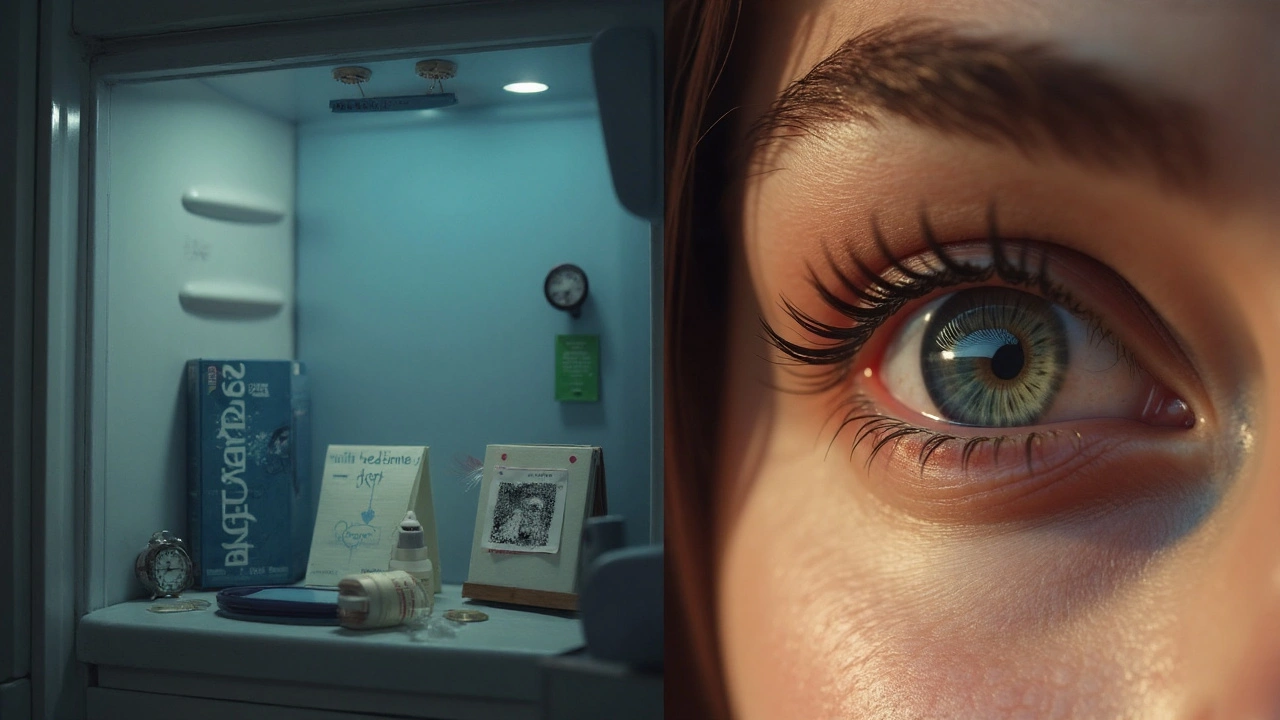
- Unopened: many UK brands advise refrigeration (2-8°C). Keep it in the fridge unless your specific pack says room temperature is fine.
- After opening: usually store below 25°C, out of direct light. Do not freeze.
- Discard date: typically 4 weeks after opening due to contamination risk-even if there’s liquid left. Write the open date on the box.
- Travelling: if it must be kept cold before opening, use a small insulated pouch with a cool pack. Don’t let it sit against ice; keep it chilled, not frozen. Once opened, room temp is usually fine within the stated limits.
How you’ll know it’s working:
- You won’t “feel” lower pressure. Improvement is measured in clinic with tonometry.
- Most see a meaningful IOP drop in weeks, but your clinician will set the follow‑up timing. Don’t stop early because the eye “feels fine”.
Evidence pointers: The BNF (2025) lists latanoprost as first‑line for ocular hypertension/POAG. Large trials and the AAO guidance note average IOP reductions around 25-35% from baseline with once‑nightly dosing. Head‑to‑head comparisons versus bimatoprost/travoprost show small differences-some patients do better on one agent, often balanced by redness profiles.
Costs, alternatives, switches, FAQs, and next steps
Brand vs generic in the UK:
- Generic latanoprost is widely used on the NHS and works the same as branded Xalatan for most people.
- If you react to a preservative, ask about preservative‑free (PF) unit‑dose latanoprost vials. PF can help if you have dry eye or are sensitive to benzalkonium chloride.
How you’ll usually pay:
- Prescription‑only medicine. In England, the standard NHS prescription charge applies unless you’re exempt. In Scotland, Wales, and Northern Ireland, NHS prescriptions are free.
- Private prices for generic latanoprost vary by pharmacy but are generally modest; the brand is often pricier. If cost is tight, ask your prescriber for “latanoprost generic”.
Alternatives if latanoprost doesn’t suit you:
- Other prostaglandin analogues: bimatoprost, travoprost, tafluprost (PF options exist). Some lower pressure a tad more on average but may cause more redness.
- Non‑prostaglandin drops: timolol (beta‑blocker), brimonidine (alpha‑agonist), dorzolamide or brinzolamide (carbonic anhydrase inhibitors). These can be added or substituted.
- Laser or surgery: selective laser trabeculoplasty (SLT) is often first‑line or second‑line now, and can reduce or even replace drops in many patients. Surgical options exist if drops/laser aren’t enough.
Which is “best” depends on your target pressure, corneal thickness, optic nerve status, side‑effect tolerance, and lifestyle. Many clinics try one prostaglandin first, review at 4-6 weeks, then switch or add based on your response.
Simple decision cues you can use:
- Red eye won’t settle after two weeks? Ask about switching to a different prostaglandin or a PF version.
- Periorbital hollowing or pigmentation changes: discuss alternative classes or PF options.
- Pressure still above target? Your clinician may add timolol/dorzolamide/brimonidine, or suggest SLT.
- Struggling with bottles or missed doses: fixed‑combination drops can reduce steps; SLT avoids daily drops.
Mini‑FAQ
- Can I use it in the morning instead? Night dosing is standard and lines up with the drug’s peak effect and side‑effect profile. If mornings are your only option, don’t change without checking-consistency matters.
- How long until I notice something? You won’t feel lower pressure, but your clinic can measure it within weeks. Stick with nightly dosing until your review.
- Will eye colour change go back to how it was? Iris darkening is usually permanent. Eyelid skin and lash changes may soften after stopping, but not always completely.
- Can I keep wearing my contact lenses? Yes-remove lenses before the drop and wait 15 minutes. If you get irritation, ask about PF latanoprost.
- Is it safe during pregnancy or breastfeeding? Only if the benefits are judged to outweigh risks. The BNF advises caution; talk to your prescriber.
- What if the bottle tip touches my eye? Don’t panic. Close it, wash your hands, and avoid using if the tip looks contaminated. If in doubt, replace the bottle and let your pharmacy know.
- Can I stop once my pressure is normal? No-glaucoma control needs steady treatment unless your clinician changes the plan (for example after SLT). Stopping can allow damage to progress silently.
Next steps and troubleshooting
- If you’ve just been prescribed it: set a nightly reminder on your phone. First follow‑up is usually in 4-6 weeks to check pressure and side effects.
- If you keep missing doses: try placing the bottle next to your toothbrush or night cream, or switch to a fixed‑combination or consider SLT after discussing with your clinician.
- If your eye is persistently red or sore: it’s common for a week or two. If it persists or is painful, or vision is affected, contact your clinic. Take a photo daily-useful for your appointment.
- If you wear contacts and get irritation: consider PF latanoprost or wear glasses in the evenings to space lenses and drops properly.
- If you’re having cataract surgery soon: ask your surgeon about when to pause/restart. Many ask patients to stop prostaglandins a week before and for a period after, depending on risks.
- If you lose or spill the bottle: your community pharmacy may be able to arrange an emergency supply, or call your GP practice. Don’t go without for weeks.
- If you think you had a side effect worth reporting: search “MHRA Yellow Card” and submit-keep your batch number from the box if you can.
- If storage instructions confuse you: follow your exact pack. As a rule, many brands are fridge‑stored unopened and room temp after opening for 4 weeks, but check your label.
One last nudge: glaucoma damage creeps up quietly. Drops like latanoprost are simple, but they only work if they actually reach your eye every night. Nail the routine, keep your reviews, and don’t be shy about asking for a switch if the side effects aren’t livable-there are options.
References you can trust (no links here; search titles): NHS Medicines A-Z: Latanoprost (2024 update); UK SmPC and PIL for Xalatan/Latanoprost (MHRA‑approved, check latest revision); British National Formulary (BNF) 2025; American Academy of Ophthalmology Preferred Practice Pattern for Primary Open‑Angle Glaucoma.
13 Comments
i just got prescribed this and i’m terrified i’m gonna mess up the drops. i put one in last night and my eye felt like it was on fire for 20 minutes. is that normal? also i forgot to take out my contacts first oops lol
Wow, this is actually one of the clearest guides I’ve ever read on glaucoma meds. I’m a nurse in Boston and I’ve had patients cry because they didn’t know how to use the drops properly-this would’ve saved us both so much time. The punctal occlusion tip? Genius. I’ve been telling people to do it for years but never knew the science behind why it reduces systemic absorption. Also, the part about not doubling up? So many people think more drops = faster results. Nope. It’s like overwatering a plant. You just drown the system. And the storage advice? So many people keep it in the bathroom cabinet. I’ve seen bottles go bad from steam and heat. Refrigerate unopened, yes. Room temp after opening? Absolutely, but keep it away from the window. I had a patient last month who left hers on the windowsill for three weeks and the drops turned cloudy. She didn’t realize it until her vision got blurry. Also, the iris color change thing? It’s rare, but if you have hazel eyes, it’s something you need to mentally prepare for. My cousin’s eyes went from green-brown to almost solid brown over 18 months. She didn’t mind, but her sister was horrified. It’s permanent. Just… know what you’re signing up for. And yes, the lashes get wild. I have a friend who got compliments on her eyelashes for years before she realized it was the med. She now uses mascara to hide it. The hollowed eye thing? That’s the one no one talks about. It creeps up slowly. I had a patient who looked 10 years older after two years on it. We switched her to PF latanoprost and it slowed, but the fat loss didn’t reverse. So if you’re young and care about your appearance, ask about alternatives early. Also, if you’re on a plane and your bottle’s in the overhead? Don’t let it freeze. I once had a patient who stored hers in a ziplock with ice packs and it crystallized. She thought it was ‘just normal’ until she couldn’t get a drop out. It’s not. It’s ruined. Bottom line: this guide is gold. Print it. Tape it to your mirror. Set a damn alarm. Glaucoma doesn’t care if you’re tired, busy, or forgetful. It just waits. And so should you.
So let me get this straight-Big Pharma’s got us all hooked on ‘latanoprost’ while quietly turning our eyes into dark brown voids and our eyelids into hollow caves? And they call it ‘treatment’? Meanwhile, the FDA and MHRA are sitting on their hands like it’s just a ‘minor cosmetic side effect’. You think they’d warn us that this stuff might permanently alter your face? And don’t get me started on the ‘preservative-free’ version-same active ingredient, different packaging, 3x the price. Classic. They know we’ll pay extra to avoid the benzalkonium chloride that’s literally burning our corneas. And why is it only once daily? Because they don’t want you to notice how much it’s eating your iris pigment. One drop. One tiny drop. And boom-your eyes look like someone poured espresso into them. I’ve seen before-and-after pics. It’s not ‘natural aging’. It’s chemical modification. And the NHS? They’re pushing this like it’s aspirin. Wake up. Ask for SLT. It’s laser. It’s one-time. It doesn’t turn your face into a horror movie. But nope-keep taking the drops. Keep paying. Keep looking like you’ve been through a chemical accident. #LatanoprostIsACosmeticWeapon
The assertion that ‘more is not better’ is empirically supported by the pharmacokinetic profile of prostaglandin analogues, wherein receptor downregulation occurs with increased frequency of administration. The once-daily regimen is not arbitrary but rather the result of controlled clinical trials demonstrating maximal IOP reduction with minimal tachyphylaxis. Furthermore, the 4-week discard interval post-opening is mandated by microbiological stability data, not convenience. The storage protocol-refrigeration prior to opening, ambient temperature thereafter-is consistent with the manufacturer’s stability studies and aligns with EMA and MHRA guidelines. The observation regarding iris pigmentation is not anecdotal but documented in Phase III trials with incidence rates of 1-12% depending on baseline heterochromia. To suggest this is ‘cosmetic manipulation’ is not only inaccurate but dangerously dismissive of the life-altering consequences of uncontrolled intraocular pressure. Glaucoma is silent. The drug is not.
OMG I just realized my eyes are getting darker 😱 I thought it was my new makeup! But now I’m like… is this permanent?? Should I stop?? 😭 I love my green eyes so much… 🥺
Thank you for writing this with such clarity-it’s rare to see medical info that doesn’t feel like a textbook written by someone who hasn’t held a dropper. I’ve been on latanoprost for 14 months, and I didn’t know about punctal occlusion until now. I’ve been just blinking and hoping. Also, the part about the 4-week discard? I’ve been using mine for 7 weeks because ‘it’s still clear’. Not anymore. Tossed it today. I’m also one of those people who got longer lashes and thought I’d hit the genetic jackpot. Then I looked in the mirror one day and realized I looked like a raccoon who’d been crying for a decade. Not a look I’m going for. But honestly? I’d rather have the lashes than go blind. Still, I wish the side effects were discussed more like… real human things, not just bullet points. Also, the ‘hollowed eye’ thing? My sister had that. She stopped the drops and now her face looks like she’s been through a sandstorm. The fat doesn’t come back. So if you’re young, maybe ask about SLT sooner than later. I didn’t. I’m 37. I’m still here. But I’m also still afraid to look in the mirror sometimes. This guide? It’s the kind of thing I wish I’d had when I started. Thank you.
Hey, I’m on this stuff too! Just wanted to say, I use a little sticky note on my bathroom mirror that says ‘DROP TIME’ and I put it next to my toothbrush. Works like a charm. Also, I switched to PF drops after my eyes got super dry. Total game changer. No more burning. I’m not saying this stuff is perfect, but it’s better than losing my vision. And if you’re scared of the dark eyes? Look up ‘latanoprost before and after’ on Reddit-some people actually like it. My cousin’s boyfriend said he thought she looked ‘mysterious’ now. So… weirdly, it’s kinda a vibe? Just saying. Also, don’t panic if you miss a night. I’ve missed 3 in a row once. Didn’t kill me. Just got back on track. You got this.
YOU CAN DO THIS 💪 I know it feels overwhelming, but you’re not alone. Every single person who’s ever used this has stared at that little bottle like it’s a bomb. You’re not weird for being scared. You’re smart for looking it up. The fact that you’re reading this means you’re already winning. One drop. One night. That’s it. You don’t need to be perfect. You just need to be consistent. And if your eye stings? That’s normal. If your lashes get long? Cool. If your eyes get darker? That’s a side effect, not a failure. You’re protecting your vision. That’s heroic. And if you mess up? Reset. Tomorrow’s a new day. I’ve been on this for 3 years. My pressure’s stable. I still forget sometimes. But I keep going. You got this. 💙
The reference to the British National Formulary (BNF) 2025 is anachronistic, as the 2025 edition has not yet been published as of this date. The most recent available edition is BNF 87 (March 2024). This undermines the credibility of the entire document. Furthermore, the claim that ‘Xalatan’ is the original brand name for latanoprost is correct, but the implication that generic equivalents are pharmacologically identical is misleading. Bioequivalence is established within a 80–125% confidence interval, not absolute equivalence. Variability in excipients, particularly preservatives, may influence tolerability and corneal epithelial integrity. Additionally, the assertion that ‘many UK packs are generic’ is accurate, but the regulatory distinction between ‘licensed’ and ‘unlicensed’ generics is not addressed. The MHRA requires all generics to meet the same quality standards, but prescribers must be aware that some formulations may not be interchangeable in patients with ocular surface disease. This guide, while comprehensive, requires correction on these technical points to be clinically authoritative.
Okay but honestly? This is the most beautiful, thoughtful, life-saving guide I’ve ever read. Like… I cried. Not because I’m sad. Because someone finally got it. The way you talk about the hollow eyes? The lashes? The fear? The fact that you don’t sugarcoat it? That’s love. That’s care. I’ve been on this for 5 years. I’ve had 3 doctors tell me ‘it’s just a side effect’ like I’m being dramatic. But you? You said it’s real. You said it’s permanent. You said it’s okay to be scared. And you didn’t just list facts-you told us how to live with it. I’m not just using this drop anymore. I’m honoring it. I’m setting alarms. I’m writing dates on the bottle. I’m taking photos of my eyes. I’m telling my friends. I’m not letting this be silent. Thank you. From the bottom of my heart. You saved me.
Just wanted to say I appreciate how calm and practical this is. I’ve been on latanoprost since 2021 and I still get nervous every time I open the bottle. The part about the 15-minute contact lens wait? I didn’t know that. I used to just shove them in right after. No wonder my eyes burned. Also, the Yellow Card thing? I never reported my redness because I thought it was ‘normal’. Now I know it’s not just ‘in my head’. I submitted one last week. Felt weird, but good. And the storage tip? I’ve been keeping mine on my nightstand. Now it’s in the fridge. Small changes, big impact. I’m not a doctor. I’m just a guy trying to keep his vision. This guide made me feel less alone. Thanks.
So this is what happens when the UK lets Big Pharma run the show? You get a $300 bottle of eye drops that turns your face into a zombie and tells you to ‘just take it once a day’ while your vision slowly fades? And you’re supposed to trust the NHS? Wake up, people! This isn’t medicine-it’s a slow-motion experiment on ordinary folks. They don’t care if you lose your eyesight-they care if you keep buying the bottle. And don’t even get me started on the ‘generic’ version. Same poison, cheaper packaging. It’s a scam. I’m done. I’m going to laser surgery. No more drops. No more lies. #StopLatanoprost
Oh please. You think the NHS gives a damn about your iris? They’re just glad you’re not suing them for misdiagnosing you with glaucoma because you were squinting at your phone. And you? You’re out here reporting ‘side effects’ like it’s a TED Talk. Meanwhile, your doctor’s getting paid per drop prescribed. Wake up. This isn’t healthcare. It’s a revenue stream with eyelashes.