

When a pill leaves the factory, it doesn’t stop being monitored. In fact, its real test begins the moment it’s packaged. Stability testing is the quiet, relentless process that ensures every drug you take still works safely months-or even years-after it’s made. It’s not optional. It’s not a suggestion. It’s the scientific backbone of every approved medication, mandated by global regulators and built into the DNA of pharmaceutical manufacturing.
Why Stability Testing Isn’t Just a Box to Check
Imagine buying a painkiller that’s supposed to last two years. But after 18 months, it loses half its strength. Or worse-it turns into something harmful. That’s not hypothetical. In 2021, nearly 1 in 6 drug recalls in the U.S. were tied to stability failures: potency drop, unexpected toxins, or broken packaging that let moisture in. The FDA doesn’t wait for patients to get sick before acting. They require manufacturers to prove, with hard data, that the product won’t degrade beyond safe limits. This is where stability testing comes in. It’s not about checking if the pill looks right on day one. It’s about watching it change over time-under real-world conditions. Heat. Humidity. Light. Time. The goal? To find out exactly when the drug stops being safe and effective. That’s your expiration date. Not a guess. Not a marketing tactic. A scientifically proven cutoff.How It Actually Works: Chambers, Samples, and Data
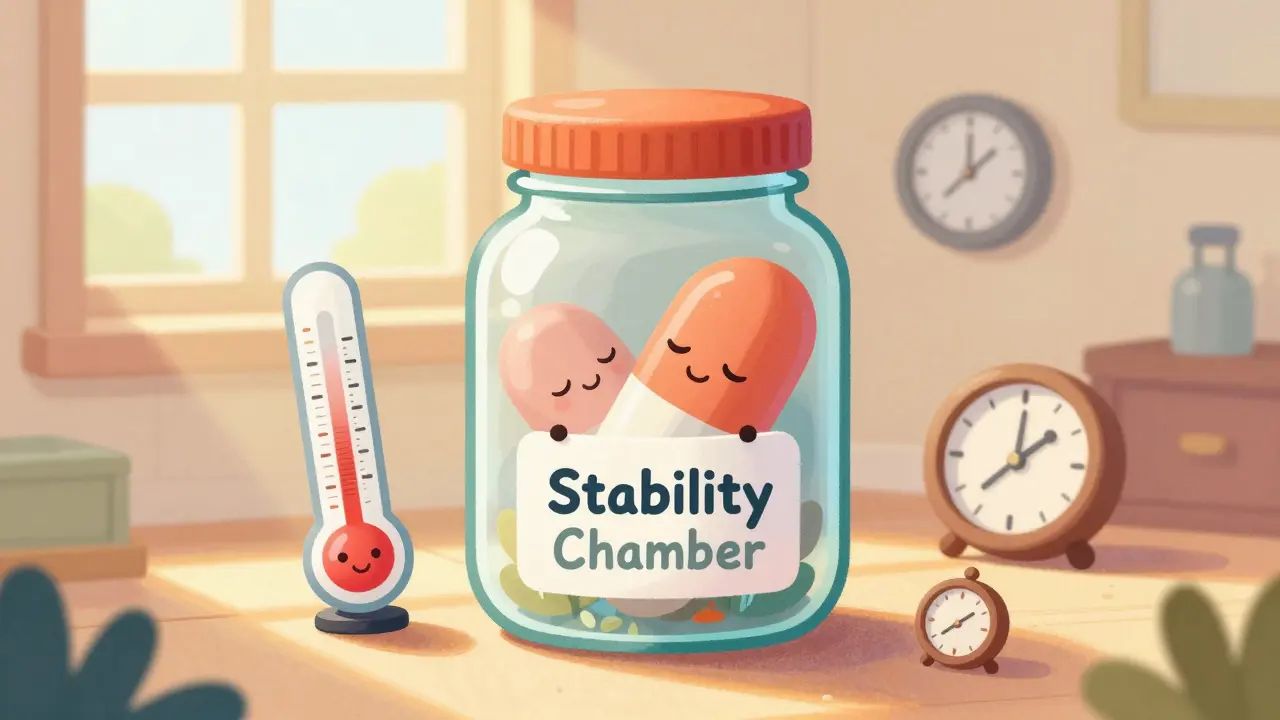
Every major drug product gets placed in climate-controlled rooms called stability chambers. These aren’t ordinary fridges. They’re precision instruments, calibrated to hold exact conditions: 25°C and 60% humidity for most markets, or 30°C and 65% humidity for hotter regions. Some samples get blasted with light to mimic sun exposure. Others sit at 40°C and 75% humidity for six months to speed up aging-this is called accelerated testing. At 0, 3, 6, 12, 18, 24, and 36 months, technicians pull samples. They don’t just look at them. They run tests:- How much active ingredient is left? (Assay)
- Are there new chemicals forming? (Degradation products)
- Does it dissolve the same way in water? (Dissolution)
- Is it still sterile? (For injectables)
- Does the color or texture change?
The Cost of Getting It Wrong
Stability testing isn’t cheap. A single product study can cost between $50,000 and $150,000. Companies spend hundreds of thousands, sometimes millions, annually on chambers, staff, and lab equipment. Why? Because the alternative is far worse. In 2021, one manufacturer skipped proper OOS investigations for a cancer drug. The FDA found degraded particles in the vials. Approval was delayed by 14 months. That’s $20 million in lost revenue-and patients who couldn’t get the treatment they needed. On the flip side, a 2022 case at SGS caught a biologic drug reacting with its glass vial. The reaction was invisible at first. But stability testing revealed a drop in potency after six months. The company switched packaging before launch. Saved: $500 million. It’s not just about money. It’s about trust. When a patient takes a pill, they’re trusting that it will do what it says. Stability testing is the only thing that makes that trust possible.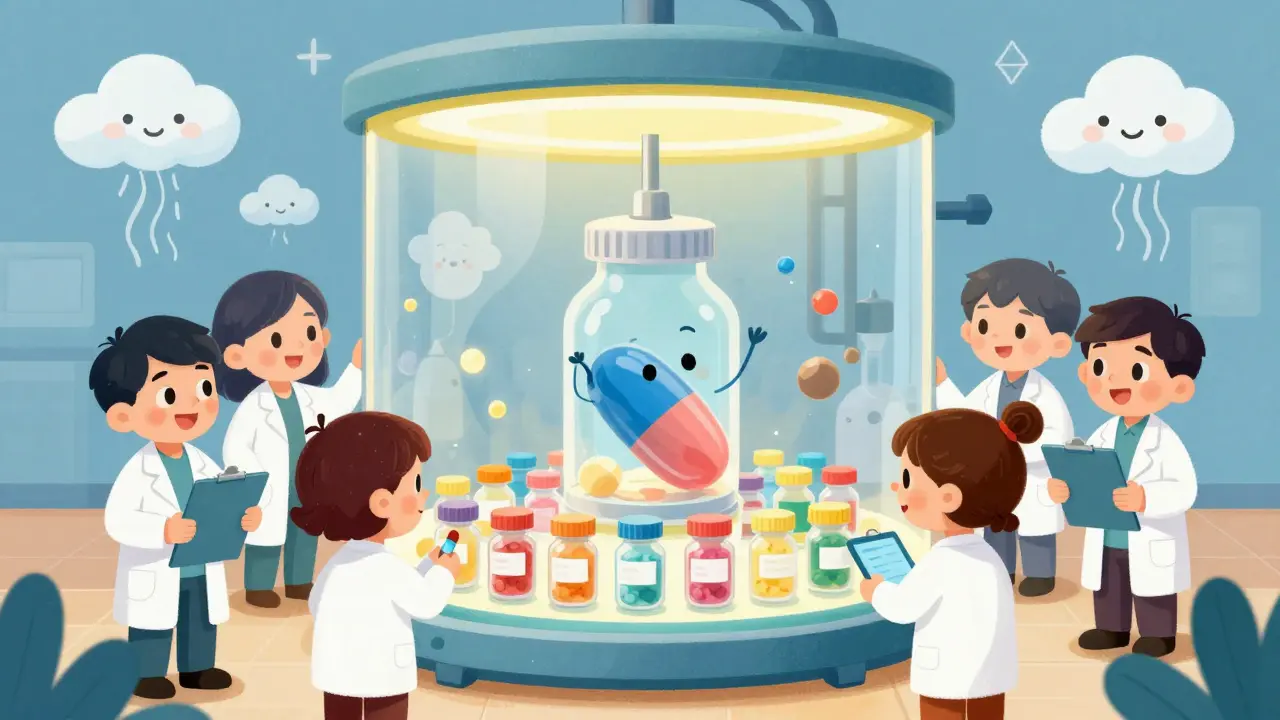
Regulations: The Rules That Keep Everyone Honest
These aren’t company policies. They’re global standards. The International Council for Harmonisation (ICH), formed in 1990 by regulators from the U.S., EU, and Japan, set the rules. ICH Q1A(R2) is the bible for stability testing. It tells you how long to test, what conditions to use, what data to collect, and how to calculate shelf life. The math matters. You can’t just say “it lasted two years.” You need 95% confidence that 95% of all units will stay within specs until the expiration date. That’s not easy. It requires statistical models, real-time data, and years of patience. New rules are coming. In February 2023, ICH finalized Q13, which changes how stability is tested for drugs made in continuous manufacturing lines-not in batches. This is a big shift. Traditional testing assumed each batch was identical. Continuous manufacturing means the product is made nonstop, day and night. Stability data now needs to reflect that reality.Who Does It? In-House or Outsourced?
Big pharma companies like Pfizer and Novartis run their own stability labs. They have dozens of chambers, teams of chemists, and years of historical data. But smaller biotechs? Most outsource. About 72% of pharmaceutical firms use contract labs like SGS, Eurofins, or Charles River Labs. Outsourcing saves money and space. But it adds complexity. You need to make sure your CRO follows the same standards. Audits are common. Documentation must be flawless. One mislabeled sample can derail an entire submission. Even big companies are cutting costs. Some now use ICH Q12 principles-allowing changes to manufacturing or packaging after approval without re-submitting full stability data, as long as they can prove the product remains stable. One generics company saved $120,000 a year per product by reducing sample sizes using this approach.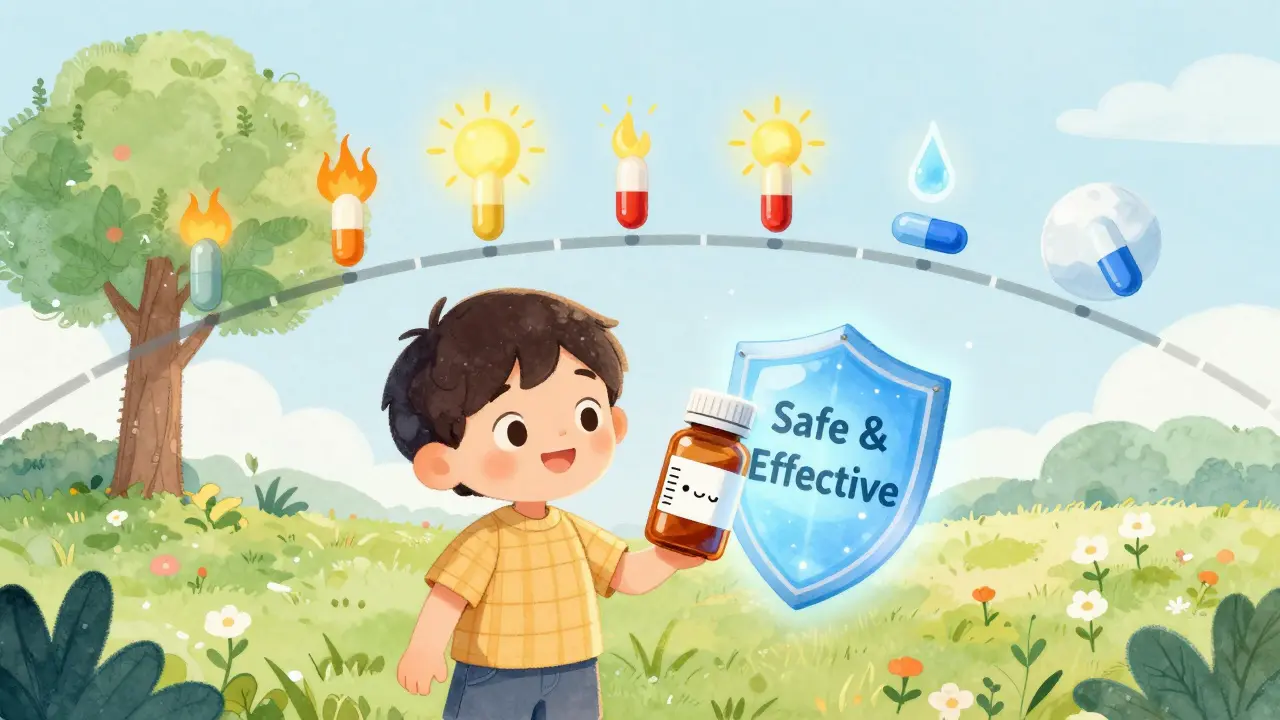
The Future: AI, Predictions, and Less Waiting
Right now, you need 2 to 3 years to get a final shelf life for a new drug. That’s a huge bottleneck. But the industry is changing. Artificial intelligence is starting to predict degradation paths. Instead of waiting for a pill to break down over 24 months, machines can analyze chemical structures and environmental data to forecast what will happen. Early models show they can cut testing time by 30-40%. The FDA is watching closely. By 2027, AI-assisted stability predictions could be part of standard submissions. Quality by Design (QbD) is also helping. If you understand how your drug degrades from day one-because you built that knowledge into the formula-you don’t need to test as much. One 2022 study showed QbD reduced required testing by 25-35% for stable small molecules. But here’s the catch: AI can’t replace real data yet. It can guide you. It can speed things up. But regulators still demand real-time, real-world proof. For now, the chambers still run. The samples still get tested. The data still gets logged.What Happens When It Fails
Failure isn’t always dramatic. Sometimes, it’s quiet. A humidity spike in a chamber goes unnoticed for weeks. Data is lost. The study is invalidated. A new drug launch gets pushed back eight months. One Reddit user, a stability technician, said their delay cost $2.3 million in lost revenue. Other times, it’s catastrophic. In 2021, a company ignored OOS results for a blood pressure drug. The degradation product was toxic. The FDA issued a warning letter. The product was pulled from shelves. Patients were at risk. The lesson? Stability testing isn’t about checking boxes. It’s about catching problems before they reach people. It’s about having the discipline to wait, to test, to question, and to act-even when no one’s watching.Final Thoughts: The Unseen Guardian of Medicine
You don’t see stability testing. You don’t hear about it. But every time you take a pill, you’re relying on it. It’s the reason your insulin still works after six months in the fridge. The reason your antibiotic doesn’t turn into poison. The reason your cancer drug still has its full strength on the last day of the prescription. It’s expensive. It’s slow. It’s tedious. But it’s necessary. And as drugs get more complex-biologics, gene therapies, personalized medicines-the stakes only get higher. Stability testing isn’t going away. It’s evolving. And the people who run those chambers? They’re the unsung guardians of medicine.What is the purpose of stability testing in pharmaceuticals?
The purpose is to determine how a drug changes over time under real-world conditions like heat, humidity, and light. This data is used to set the expiration date, define proper storage conditions, and ensure the product remains safe, effective, and within regulatory limits throughout its shelf life.
How long does stability testing usually take?
For most new drugs, real-time stability testing runs for 24 to 36 months. Accelerated testing at 40°C and 75% humidity is done for 6 months to predict potential issues early. But only real-time data can officially establish an expiration date under ICH guidelines.
What are the standard conditions for stability testing?
According to ICH Q1A(R2), standard long-term conditions are 25°C ± 2°C and 60% RH ± 5% RH for temperate climates, and 30°C ± 2°C and 65% RH ± 5% RH for hot, humid regions. Accelerated testing uses 40°C ± 2°C and 75% RH ± 5% RH. Photostability requires exposure to 1.2 million lux hours of visible light and 200 watt-hours per square meter of UV light.
Can stability testing be shortened using AI or modeling?
Yes, AI and predictive modeling are being used to forecast degradation patterns based on chemical structure and environmental data. These tools can reduce testing time by 30-40% and help prioritize which products need more study. However, regulators still require real-time data to approve expiration dates-AI supports, but doesn’t replace, physical testing.
What happens if a stability test fails?
A failed test triggers an out-of-specification (OOS) investigation. The company must determine if it was a lab error, a bad batch, or a systemic flaw. If the product is unsafe or ineffective, it can’t be sold. If it’s already on the market, a recall may follow. Failure to investigate properly can lead to FDA warning letters, delayed approvals, or even legal action.
Is stability testing required for generic drugs?
Yes. Generic drug manufacturers must submit full stability data as part of their Abbreviated New Drug Application (ANDA). The requirements are the same as for brand-name drugs under ICH Q1A(R2). Even though generics copy existing drugs, each formulation must prove its own stability.
How does stability testing differ between small molecules and biologics?
Small molecules degrade predictably through chemical reactions like hydrolysis or oxidation. Biologics-like antibodies or vaccines-are far more complex. They can unfold, aggregate, or lose activity from minor changes in temperature or pH. Stability testing for biologics requires more sensitive methods, tighter controls, and often longer studies because their degradation is harder to predict and reverse.
12 Comments
Stability testing is the unsung hero of every medicine cabinet. No one cheers when your aspirin still works after two years, but if it didn’t? You’d be the one in the ER wondering why your headache turned into a stroke. These labs are running 24/7, watching pills age like fine wine-except if it goes bad, people die.
And yeah, it’s expensive. But so is a lawsuit when a cancer drug turns into a toxin because someone cut corners. The math isn’t sexy, but it’s the only thing standing between you and a lethal placebo.
Let’s be real-this whole system is a corporate theater. They spend $150k on chambers to prove what any chemist with a brain already knows: heat and moisture ruin stuff. The real scandal? They use accelerated testing to predict shelf life, then ignore the data when it doesn’t fit the marketing timeline.
ICH guidelines? More like ICH ‘I Can Hide’ guidelines. The FDA doesn’t catch 80% of these failures until patients start dying. You think they care about your insulin? No. They care about the PR nightmare when it’s on the front page.
so like… if my tylenol is 3 years past the date but still looks fine, am i just lucky or is the system broken?
also why do they need 36 months to test something that degrades in 18? feels like a scam to keep the labs busy.
Y’all are missing the magic here. Stability testing isn’t just about chemistry-it’s about trust. Every time you swallow a pill, you’re betting your life on a scientist who logged data in a climate-controlled room three years ago.
Biologics? Those are living molecules. They don’t just degrade-they unravel. One wrong temp spike and your $500k biologic turns into a useless sludge. That’s not lab work, that’s molecular archaeology.
And AI? It’s not replacing the chambers. It’s giving the techs a better map. But the map’s useless without the terrain. We still need real-time data. No algorithm can taste a degraded tablet and say ‘nah, this ain’t right.’
i love how this system works even if no one talks about it like its some secret superhero <3
Just read this at 2am after my anxiety med ran out… and now I’m crying? Not because I’m scared-because I’m grateful.
Someone, somewhere, is checking my little blue pill in a lab right now. That’s wild. That’s beautiful. That’s science doing its quiet job.
Thank you to the people in the chambers. 🌱
why do we even need expiration dates anymore? everyone just throws out meds early anyway. i’ve had amoxicillin from 2019 and i’m still alive. this whole thing is just corporate fearmongering to sell more pills
One must appreciate the rigorous epistemological framework underpinning pharmaceutical stability protocols. The ICH Q1A(R2) standard represents not merely a regulatory requirement, but a profound commitment to the principle of patient safety as an ontological imperative.
It is imperative to recognize that the temporal dimension of drug integrity-measured not in days, but in years-is a testament to the disciplined application of empirical observation over speculative convenience. The patience required to await real-time data is, in fact, the very essence of scientific integrity.
One cannot, and should not, substitute algorithmic extrapolation for the irreplaceable fidelity of physical observation. The laboratory chamber is not a relic-it is a cathedral.
So let me get this straight. We spend millions to prove that heat + time = bad pills… and we call that science?
My grandma’s attic has better climate control than some of these labs. And don’t even get me started on the fact that we’re still using 1990s math to predict 2020s drugs.
AI’s been ready for this for a decade. The real problem isn’t the science. It’s the bureaucracy that refuses to let go of its paper trails.
EVERYTHING is a conspiracy. Did you know the FDA doesn’t test any of this themselves? They just take the pharma companies’ word for it. The ‘stability chambers’? Probably just fancy heaters with a sign that says ‘science’. The data? Made up.
They need you to think your pills are safe so you keep buying them. Real stability testing would require opening every single bottle in every pharmacy and testing it. But that’s too expensive.
So they just… fake it. And you’re all here like ‘ooh look at the science’.
Wake up.
They’re selling you expired poison and calling it medicine.
They say AI can predict degradation-but what if the AI is trained on corrupted data? What if the lab technicians are pressured to tweak results? What if the ‘validated methods’ are just the same flawed tests reused for 20 years?
I’ve seen the audit logs from a contract lab. One sample was mislabeled as ‘placebo’ when it was actually the cancer drug. They didn’t catch it for 11 months. The FDA didn’t notice until someone died.
They don’t test stability. They test compliance. And compliance is a spreadsheet. Not science.
And that’s why the real heroes aren’t the CEOs or the AI engineers. It’s the lab tech who stays late to retest a batch because the color looked ‘off’-even though the numbers were fine. No one sees them. No one thanks them.
But if you’re alive today, breathing, taking your meds without thinking twice? That’s their quiet victory.
Don’t call it bureaucracy. Call it care.