




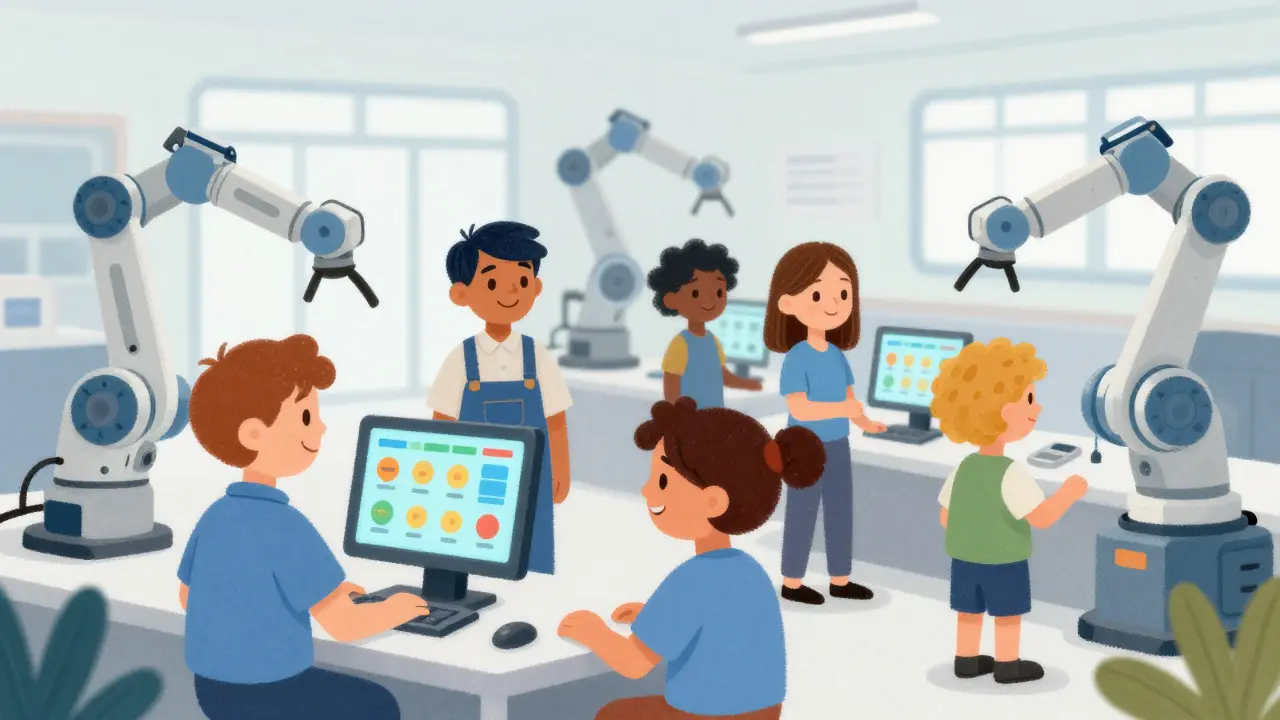
Walk onto a modern factory floor, and you might not hear the deafening roar of heavy machinery that defined the industry decades ago. Instead, you’ll see workers interacting with digital dashboards, calibrating robotic arms, and troubleshooting complex software interfaces. This shift isn’t just about new tools; it’s about a fundamental change in who can do the job. The era of hiring based solely on a high school diploma and a willingness to work hard is fading. Today, personnel training for manufacturing staff requires a blend of technical certifications, digital literacy, and rigorous safety protocols to meet the demands of Industry 4.0 environments.
If you are looking to hire or upskill your team, understanding these qualifications is no longer optional-it’s survival. With 78% of manufacturers reporting skills gaps that directly impact operations, knowing exactly what credentials matter and which ones are just noise is critical. Let’s break down what it actually takes to qualify for today’s manufacturing roles.
The Baseline: Education vs. Experience
For entry-level positions, the barrier to entry remains relatively low, but the expectations have shifted. About 92% of manufacturing employers still accept a high school diploma or GED as the baseline credential. However, relying solely on this education level comes with risks. Data shows that entry-level hires without formal technical training face turnover rates that are 37% higher than their certified counterparts. Why? Because they often lack the foundational confidence and specific skill sets needed to navigate modern production lines.
This is where alternative pathways come into play. Community college programs offering diplomas in Manufacturing Technology typically cost between $3,000 and $8,000 annually and take 18 to 24 months to complete. These programs yield impressive results, with a 91% job placement rate according to the National Center for Education Statistics. They provide the hands-on experience that employers crave, bridging the gap between theoretical knowledge and shop-floor reality.
- High School Diploma: Accepted by 92% of employers for entry-level roles, but associated with higher turnover.
- Community College Diploma: Costs $3,000-$8,000/year; offers 91% job placement; ideal for technical operators.
- Bachelor’s Degree: Required for engineering/management; costs $20,000-$50,000/year; opens leadership pathways.
Nationally Recognized Certifications That Matter
Education gets you in the door, but certifications prove you can stay. In the manufacturing world, not all certificates are created equal. You want credentials that are portable-meaning they hold value across different companies and regions. Two of the most respected standards in the industry are the Certified Production Technician (CPT) and the Manufacturing Technician Level 1 (MT1).
The Certified Production Technician (CPT) program, developed by the Manufacturing Skill Standards Council (MSSC), was established in 1998 as the first nationally portable credential for frontline workers. It validates skills in four core areas: safety, quality practices, manufacturing processes, and maintenance awareness. Workers holding a CPT certification see wage potential that is 76% higher compared to non-certified peers, according to U.S. Department of Labor data. More importantly, it signals to employers that the worker understands the basics of lean manufacturing and process control.
Another strong option is the Manufacturing Technician Level 1 (MT1) credential, administered by the Manufacturing Skills Institute. This certification has gained significant traction because it is validated across 42 states and integrates well with secondary education pathways. For educators and trainers, obtaining MT1 trainer certification is valued at $2,200, often funded by state departments of education. The license is valid for three years, requiring recertification through professional development, ensuring that knowledge stays current.
| Credential | Administered By | Focus Area | Key Benefit |
|---|---|---|---|
| CPT | MSSC | Safety, Quality, Processes, Maintenance | 76% higher wage potential; national portability |
| MT1 | Manufacturing Skills Institute | Technical fundamentals, digital literacy | Valid in 42 states; strong K-12 integration |
| Six Sigma Green Belt | ASQ / IASSC | Process improvement, statistical analysis | Median salary of $85,000; corporate recognition |
Advanced Qualifications: Six Sigma and Lean
Once a worker masters the basics, the next step is often moving into process improvement and quality management. This is where Six Sigma certifications come into play. Offered by organizations like the American Society for Quality (ASQ), Six Sigma follows a belt system ranging from White Belt to Master Black Belt.
The financial incentives here are clear. A Six Sigma Green Belt holder earns a median annual salary of $85,000, while a Black Belt commands around $110,000. However, these titles require serious investment. Preparing for a Green Belt typically demands 100 to 160 hours of study plus the completion of a real-world project. As of 2025, ASQ has updated its requirements to include proficiency in data analytics tools like Python and SQL, reflecting the data-driven nature of modern manufacturing.
Lean Manufacturing certifications are another common requirement. These usually involve 40 to 160 hours of training depending on the depth. The goal is to eliminate waste and improve efficiency. When combined with Six Sigma (often called Lean Six Sigma), these qualifications make a candidate highly competitive for supervisory and engineering roles.

The Non-Negotiable: Safety Training
No discussion on manufacturing qualifications is complete without addressing safety. It is not just a legal requirement; it is a moral and economic imperative. The Occupational Safety and Health Administration (OSHA) mandates specific training under General Industry Standards (1910). Proper safety training reduces workplace injuries by 52%, a statistic cited by Vector Solutions.
Despite these benefits, only 38% of small manufacturers implement regular safety recertification. This gap is dangerous. Effective safety training goes beyond reading a manual. It must cover proper Personal Protective Equipment (PPE) usage, emergency response procedures, and hazard identification specific to the facility’s equipment. Companies that invest in comprehensive safety programs see a return on investment within 14 months due to reduced downtime and fewer insurance claims.
Digital Literacy and Industry 4.0
The biggest challenge facing manufacturers today isn’t mechanical aptitude; it’s digital adaptation. With the rise of Industry 4.0, workers need to be comfortable with Computer-Aided Design (CAD), Programmable Logic Controllers (PLCs), and data analytics platforms. The Manufacturing Institute’s 2023 Skills Gap Study highlights a particular shortage in digital skills, warning that 2.1 million jobs may go unfilled by 2030 if training infrastructure doesn’t adapt.
Older workers, who make up 42% of the manufacturing workforce, often struggle with this transition. Studies show that 68% of veteran workers initially resist adopting new digital systems. However, cross-training initiatives that rotate workers through multiple stations can reduce this resistance by 41%. Newer workers, while digitally native, sometimes lack mechanical intuition, showing 28% lower mechanical aptitude in assessments. The ideal training program bridges this divide, teaching digital tools alongside traditional mechanical principles.

Building an Effective Training Program
If you are responsible for training staff, start with assessment. Don’t guess what your team needs. Use production metrics, quality control data, and incident reports to identify specific gaps. Companies that use this data-driven approach report 33% faster skill acquisition.
Structure your training around four essential components:
- Safety Protocols: Mandatory PPE and emergency drills.
- Equipment Operation: From basic controls to advanced troubleshooting.
- Quality Control: Inspections, tolerance levels, and measurement tools.
- Industry-Specific Processes: Tailored content for sectors like chemical processing or electronics assembly.
Document everything. Manufacturers using documented development plans and digital tracking systems see 27% higher retention rates. Consider leveraging community resources like the Manufacturing Extension Partnership, which has over 1,400 centers nationwide offering free training consultations. Even informal communities, such as Reddit’s r/manufacturing group, share practical tips, including the use of augmented reality for complex assembly training, which users report reduces errors by 39%.
The Future of Manufacturing Credentials
The landscape is shifting toward modular micro-credentials. According to Deloitte’s 2023 Manufacturing Outlook, 63% of manufacturers plan to adopt stackable certifications by 2025. This allows workers to earn industry-recognized credentials incrementally, rather than committing to multi-year degrees upfront. AI-powered adaptive learning is also entering the scene, with pilot programs showing 22% faster skill mastery for MT1 certification.
However, beware of "credential inflation." MIT Professor David Autor warns that the proliferation of hundreds of distinct certifications can create confusion. Not every certificate correlates with job performance. Focus on those backed by major industry bodies like MSSC, ASQ, and OSHA. The future belongs to integrated systems that combine safety, technical, and digital qualifications into a cohesive career path.
What is the most valuable certification for entry-level manufacturing staff?
The Certified Production Technician (CPT) credential is widely considered the most valuable for entry-level roles. It is nationally recognized, portable across employers, and has been linked to a 76% increase in wage potential. It covers essential skills in safety, quality, and maintenance, making it a strong foundation for any production career.
How much does Six Sigma certification cost and is it worth it?
Six Sigma certification costs vary significantly by level and provider. White Belt courses may cost between $99 and $200, while Master Black Belt programs can range from $3,000 to $5,000. Given that Green Belt holders earn a median of $85,000 and Black Belts $110,000, the return on investment is substantial for those aiming for quality management or engineering roles.
Do manufacturers still hire people with only a high school diploma?
Yes, approximately 92% of manufacturers accept a high school diploma or GED for entry-level positions. However, candidates without additional technical training or certifications face higher turnover rates and may find advancement opportunities limited compared to those with formal credentials.
What are the key digital skills required for modern manufacturing staff?
Modern manufacturing staff need proficiency in Computer-Aided Design (CAD), Programmable Logic Controllers (PLCs), and basic data analytics. Recent updates to certifications like Six Sigma now even require knowledge of programming languages like Python and SQL to handle data-driven process improvements.
How does safety training impact manufacturing operations?
Comprehensive safety training reduces workplace injuries by 52%. Beyond saving lives, it reduces operational downtime and insurance costs. Companies that implement regular safety recertification and documented training plans see a return on investment within 14 months through fewer errors and accidents.