

Reading a prescription label for a pill is one thing. But when your medication comes in an inhaler, a patch, or an injectable, the rules change. These aren’t just different shapes-they’re different systems with different risks. A wrong turn on the label can mean too much medicine, too little, or even a dangerous overdose. And it’s not rare. In 2022, over 1,400 serious adverse events in the U.S. were tied directly to people misreading or misunderstanding these labels. You’re not alone if you’ve stared at a patch and wondered, "Do I really need to change it every 72 hours? Or is that just a rough guess?" Or if you’ve shaken your inhaler like a soda can, only to realize later that the instructions said "do not shake" for your specific type. This isn’t about being careless. It’s about labels that are confusing, inconsistent, and often assume you already know how these devices work.
What’s on an Inhaler Label-and Why It Matters
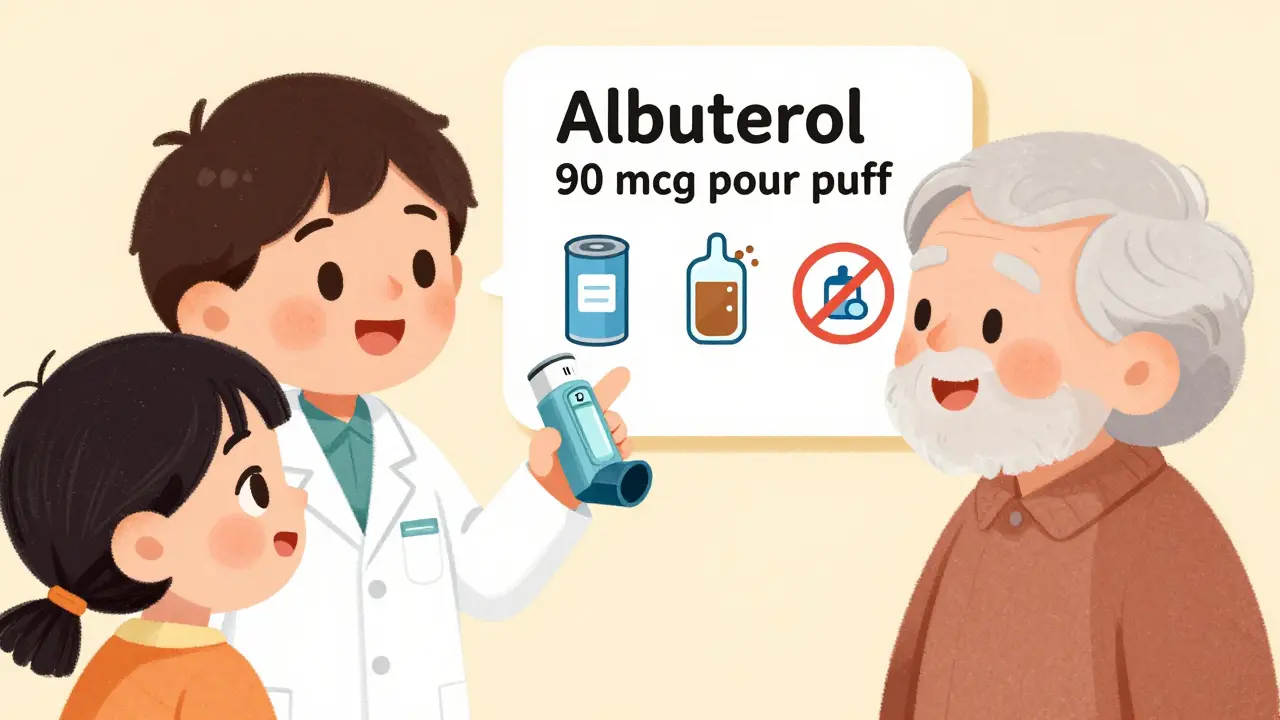
Inhalers look simple: a metal canister, a plastic mouthpiece. But inside? Precision engineering. The label tells you exactly how much medicine each puff delivers. For example, "albuterol sulfate 90 mcg per actuation" means each spray releases 90 micrograms. That number isn’t decorative. If you think it’s "about 100" and use two puffs instead of one, you’re doubling your dose. And if you don’t know how many puffs are left? You might run out mid-attack. That’s why FDA rules now require all inhalers to have a dose counter-a little window that shows you how many doses remain. If yours doesn’t have one, ask your pharmacist for a replacement.Another hidden trap: priming. New inhalers or ones that haven’t been used in weeks need to be "primed"-usually four test sprays into the air before you inhale. Skip this, and the first few puffs you take might be air, not medicine. The label will say "prime before first use," but many people forget. A 2023 Cleveland Clinic study found that nearly 28% of inhaler errors happened because patients didn’t realize the canister could feel full even when empty. That’s why the label also says "shake well"-but only for suspension inhalers. Solution inhalers don’t need shaking. Confusing the two? That’s how some patients end up with shaky hands and no relief.
Transdermal Patches: More Than Just Stick and Go
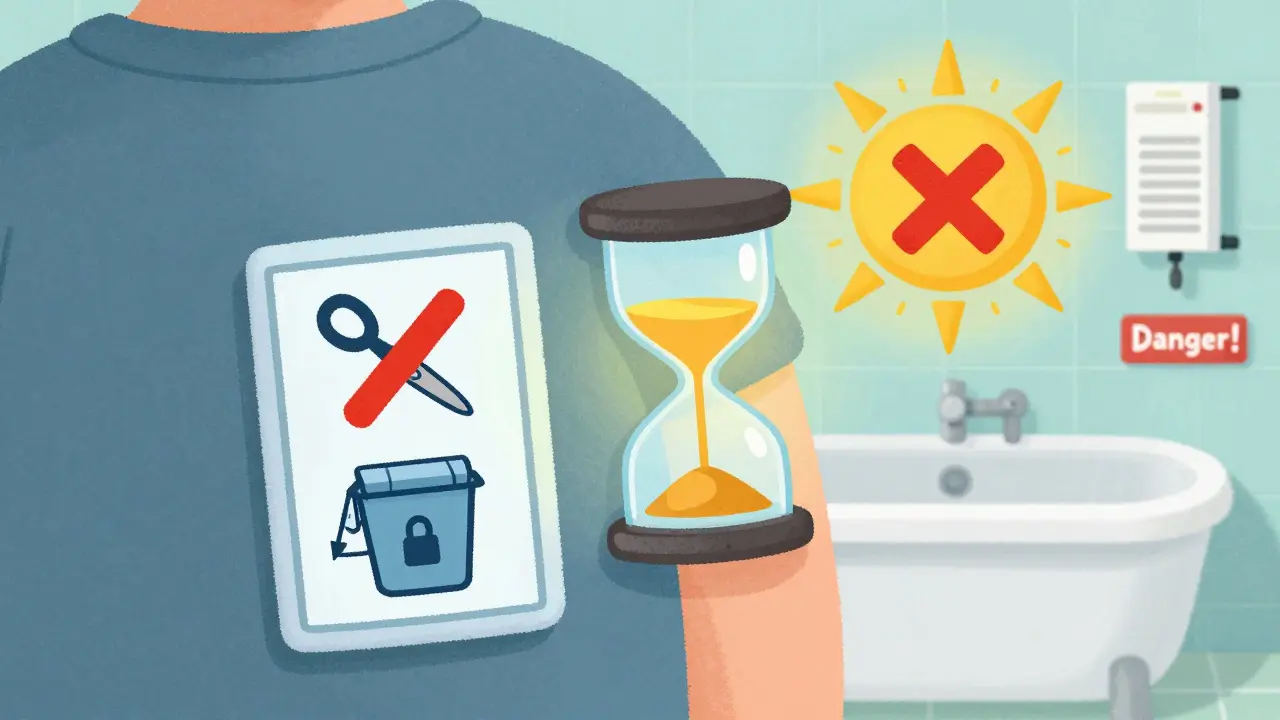
Patches seem foolproof. Stick it on, wait, feel better. But the label holds critical details most people ignore. First, the dose isn’t "how strong it feels." It’s written as a rate: "fentanyl 25 mcg/hour." That means every hour, your body absorbs 25 micrograms. If you cut the patch-something 89% of fentanyl patches warn against-you’re not cutting the dose in half. You’re creating a dangerous, uncontrolled leak. One FDA analysis found cutting increases overdose risk by nearly five times.Then there’s timing. "Change every 72 hours" means exactly 72 hours-not "about three days." If you wait until Monday because "I didn’t feel like it on Saturday," you’re underdosing. If you change it every 48 hours because you’re worried about side effects, you might be overdosing. A 2023 Consumer Reports survey found that 63% of patch users didn’t understand this. And heat? That’s a silent danger. Wearing a patch under a heating pad, in a hot tub, or even in direct sunlight can increase absorption by up to 50%. The label should warn you. If it doesn’t, ask your pharmacist. Also, disposal matters. Used patches still contain half their original dose. The FDA issued a safety alert in 2022 after 147 cases of accidental exposure, mostly from kids finding discarded patches in trash cans. Always fold the sticky side onto itself and throw it in a secure container.
Injectables: The Most Dangerous Labels
Injectables are where labels get serious. One mistake here can be fatal. The biggest pitfall? Concentration. Insulin is the classic example. You’ll see "U-100" on the label. That means 100 units per milliliter. But some insulin is U-500-five times stronger. If you grab the wrong vial, thinking they’re the same, you could inject five times your dose. In 2023, the American Diabetes Association reported that nearly one in five insulin errors came from misreading concentration. The label doesn’t just say "insulin." It says insulin glargine U-100. Every word matters.Reconstitution is another trap. Some injectables come as powder and need mixing with liquid before use. The label will say exactly how much diluent to add and how to mix it. Skip steps, and you get uneven doses. A 2023 study found that 68% of injectable errors happen during preparation-not injection. And don’t assume the syringe you’re given matches the dose. Some vials are labeled in micrograms (mcg), others in milligrams (mg). One zero off, and you’re in trouble. Always double-check: "Is this 200 mcg/mL or 200 mg/mL?" If you’re unsure, ask your pharmacist to show you the math.
Visuals, QR Codes, and the New Rules
Labels are getting smarter. Since 2020, 78% of inhaler labels now include step-by-step pictograms: a little drawing showing how to breathe in, hold your breath, and wait. A 2023 study found these pictograms cut technique errors by over 22%. The same goes for patches and injectables. QR codes on packaging now link to short videos showing how to apply a patch or draw up a dose. In 2021, only 12% of these products had QR codes. By 2023, that jumped to 67%. Patients who used them had 29% fewer errors. If your label has a QR code, scan it. Don’t just ignore it.By 2025, the FDA will require all new specialized delivery systems to include standardized pictograms. That means no more guessing. The same symbol for "shake" will appear on every inhaler. The same icon for "do not cut" will be on every patch. This standardization is already reducing errors. In 15 countries that adopted these rules in 2023, administration mistakes dropped by 33.7%. The goal? A global standard by 2030, cutting 2.1 million errors a year.

What to Do If You’re Confused
You don’t have to figure this out alone. Pharmacists are trained to explain these labels. But here’s the catch: only 38% of patients get a full 15- to 20-minute counseling session when picking up these medications. Don’t wait for them to ask. When you get your prescription, say: "Can you walk me through how to use this? I want to make sure I’m doing it right." Ask to see the dose counter. Ask about the concentration. Ask if there’s a video. If they say no, ask for another pharmacist. You have the right to understand your medicine.Keep a simple log: write down the name, the dose, the frequency, and any special instructions. If you’re using more than one device-say, an inhaler and a patch-keep them separate. Label your storage bins. Use different colored caps or bags. Confusion between devices is one of the top reasons people accidentally apply a patch meant for inhalers. It’s happened. And it’s deadly.
Final Check: Your Label Reading Checklist
Before you use any of these devices, ask yourself:- Is the dose written as "per actuation," "per hour," or "per mL"? Not just "take once daily"?
- Does the inhaler have a dose counter? If not, ask for a replacement.
- Does the patch say "do not cut," "avoid heat," or "fold sticky side in"?
- For injectables: Is the concentration clearly labeled (U-100, 200 mcg/mL)? Did I check the vial against the prescription?
- Did I prime the inhaler? Did I shake it (if required)?
- Did I scan the QR code if there is one?
- Did I dispose of the used patch or syringe safely?
If you can answer "yes" to all of these, you’re ahead of most. If not, don’t guess. Ask. Your life depends on it.
What should I do if I can’t read the label because it’s too small?
Ask your pharmacist for a large-print version or a magnifying label. Many pharmacies offer this service for free. You can also request a digital version via email or text. Some manufacturers now provide QR codes that link to audio instructions. If you have vision issues, your doctor can also prescribe a device with a built-in voice assistant or a dose counter with large numbers.
Can I use an inhaler without shaking it?
It depends on the type. Suspension inhalers-like most asthma inhalers-require shaking to mix the medicine with the propellant. Solution inhalers, used for some COPD treatments, don’t. The label will say "shake well" if needed. If it doesn’t, don’t shake. Shaking a solution inhaler won’t help and might damage the device. When in doubt, ask your pharmacist to identify the type.
Why does my patch label say "apply to clean, dry skin"?
Oils, sweat, or lotion on your skin can block the patch from sticking properly or slow how the medicine gets into your body. Applying it to clean, dry skin ensures consistent absorption. If you apply it over a hairy area, the label may say "shave the area"-don’t skip this step. A patch that doesn’t stick well might fall off or deliver too little medicine.
I’m using two different injectables. How do I avoid mixing them up?
Store them in separate containers with clear labels. Use different colored syringes or caps. Write the name, dose, and time on a sticky note and attach it to the vial. Never carry them in the same bag without separation. If they look similar, ask your pharmacist for a visual aid or a medication organizer designed for injectables. Many pharmacies now offer pre-filled syringes with color-coded labels for multiple medications.
Are there apps or tools that help me understand my prescription labels?
Yes. Apps like MyTherapy, Medisafe, and the FDA’s Medication Guide app can scan barcodes on your prescription and pull up detailed instructions, including videos for inhalers and injectables. Some pharmacies also send reminders with step-by-step animations. If your medication has a QR code, scanning it with your phone often opens a short video showing exactly how to use it. These tools reduce errors by up to 40% according to a 2024 study in Patient Education and Counseling.
15 Comments
They're lying about the dose counters. The FDA doesn't care. Big Pharma owns the algorithm that decides what gets printed. I've seen the same inhaler with two different counters on identical batches. It's not a mistake. It's a control mechanism. You think you're safe? You're not. They want you dependent. And scared. And buying more. Always more. 🤫
I used to cut my fentanyl patch because I thought it was "too strong". Then I passed out in Walmart. Now I don't touch it. But honestly? I still don't trust the label. 😅
This is one of those posts that actually saves lives. I'm a nurse, and I see people mess up inhalers every week. The shaking thing? So many get it wrong. I always show patients the pictograms on the box. They're not just decoration. They're your lifeline. And yes-scan the QR code. It's 30 seconds and it might save you from a trip to the ER. You got this. 💪
I didn't know patches could be affected by heat. I wear a heating pad for my back and had my fentanyl patch right on top. I thought I was being smart. Turns out I was being dumb. I called my pharmacist and they gave me a new one with better instructions. Honestly? I wish all meds came with a little chat with a real person. Just one. That's all I ask.
This article is so basic. Like, I'm from India and even my cousin who works at a chai stall knows this. You're telling me Americans don't know how to read a label? 🤦♀️ The real issue is the healthcare system. Not the label. The label is fine. You're just lazy. Also, "dose counter"? We call it "remaining puffs". Stop Americanizing everything.
We're all just atoms floating in a quantum field of pharmaceutical intent. The label is a metaphor. The real medicine is the trust you place in the system. Or don't. Either way, the universe doesn't care if you shake or don't shake. The inhaler is just a tool. The power is in your breath. And your belief. 🌌
I'm from the Philippines and we have this thing called "pahingi ng tulong"-ask for help. No shame. My auntie used to take her insulin without checking the concentration. She almost died. Now she scans the QR code, calls her daughter, and writes everything down on a sticky note. It's not about being smart. It's about being humble. And asking. That's all. ❤️
If you can't read the label, get glasses. Or hire someone. This isn't rocket science. The FDA didn't make this complicated. You did. Stop whining and take responsibility. Your life isn't a Netflix documentary. It's a responsibility. And you're failing.
OMG I JUST REALIZED I WAS SHAKING MY SOLUTION INHALER LIKE A SODA CAN 😭 I THOUGHT IT WAS A RULE FOR ALL OF THEM. I'VE BEEN DOING THIS FOR 3 YEARS. MY LUNGS ARE PROBABLY DEAD. I'M GOING TO CALL MY PHARMACIST RIGHT NOW. THANK YOU FOR THIS POST. I LOVE YOU INTERNET.
Thank you for this meticulously researched and clinically accurate overview. The standardization of pictograms and QR code integration represents a significant advancement in patient safety and medication adherence. I would like to respectfully suggest that future iterations consider incorporating multilingual visual aids, particularly for non-native English speakers, as this demographic continues to grow significantly in the United States. Your work is commendable and deeply appreciated.
They want you scared. That's why they make labels so confusing. So you keep buying. So you keep coming back. So they keep making money. It's not about your health. It's about profit. Wake up.
I live in Winnipeg and we get -40°C in winter. My patch fell off three times last month. I started taping it with medical tape and now it sticks like a dream. Also, I use a little plastic pill organizer to keep my inhalers separate. Red for asthma, blue for COPD. Simple. Works. Don't overthink it. Just do the thing. And yes, scan the QR code. I watched the video while eating my poutine. It was helpful. 🥔
I wonder if the real issue isn't the label, but the fact that we're taught to distrust our own bodies. We're told to follow instructions perfectly, but never taught how to listen to what our body is telling us. Maybe the label is just a bandage on a deeper wound. What if the medicine isn't the thing we need? Maybe we need rest. Or love. Or silence. Just a thought.
i didnt even know patches had qr codes lmao i just stuck mine on and forgot about it. guess im gonna scan mine tonight. also my inhaler has no counter?? what do i do??
I read this while sitting in my mother's hospital room. She's 82, has three inhalers, two patches, and an insulin pen. She doesn't read. She trusts. And that's the real danger. I'm printing out the checklist. Laminating it. Taping it to her fridge. I wish someone had done this for her 20 years ago. Thank you. Not just for the info. For reminding me that caring is an action. Not a feeling.