




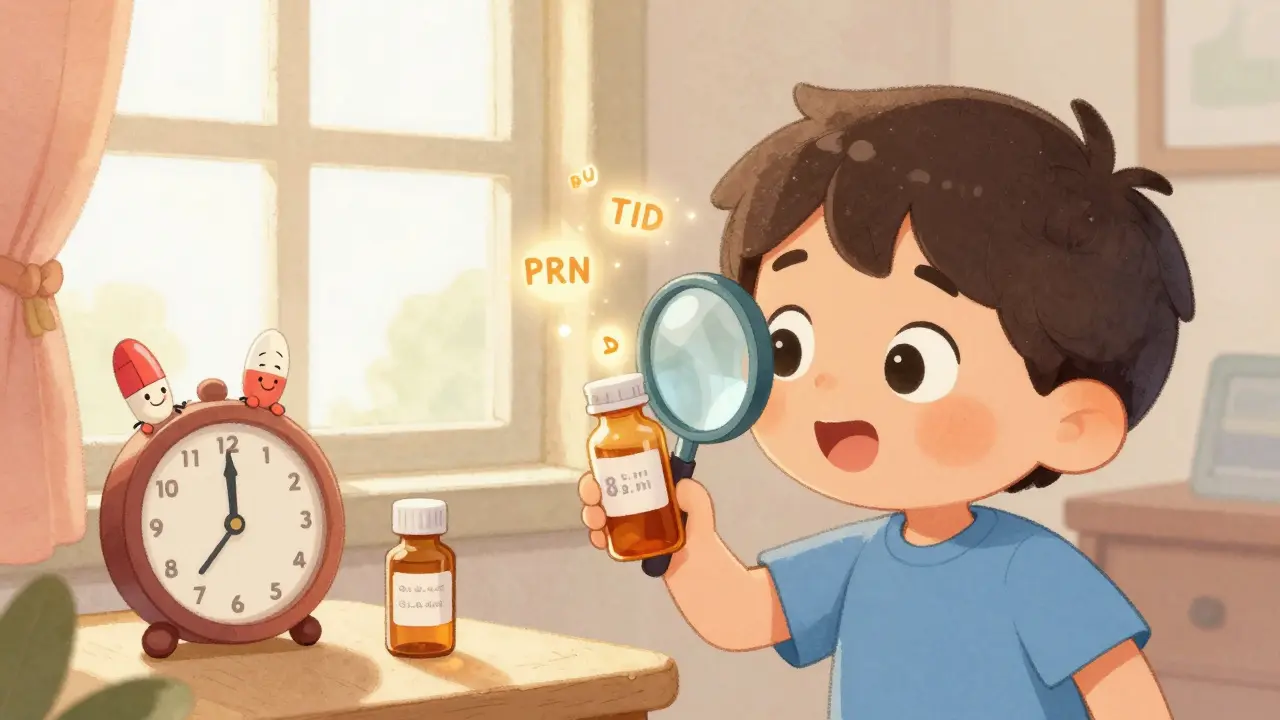
Ever looked at your prescription bottle and felt like you’re decoding a secret code? You’re not alone. Those tiny letters-BID, TID, PRN-might look like random jargon, but they’re actually Latin abbreviations that tell you exactly how and when to take your medicine. Misreading them can mean your treatment doesn’t work, or worse, it could hurt you. A 2023 Kaiser Family Foundation survey found that 68% of U.S. adults don’t fully understand what these abbreviations mean. That’s more than two out of every three people. And it’s not just older adults-people of all ages get confused. But here’s the good news: once you know what they stand for, reading your prescription becomes simple.
What BID, TID, and PRN Really Mean
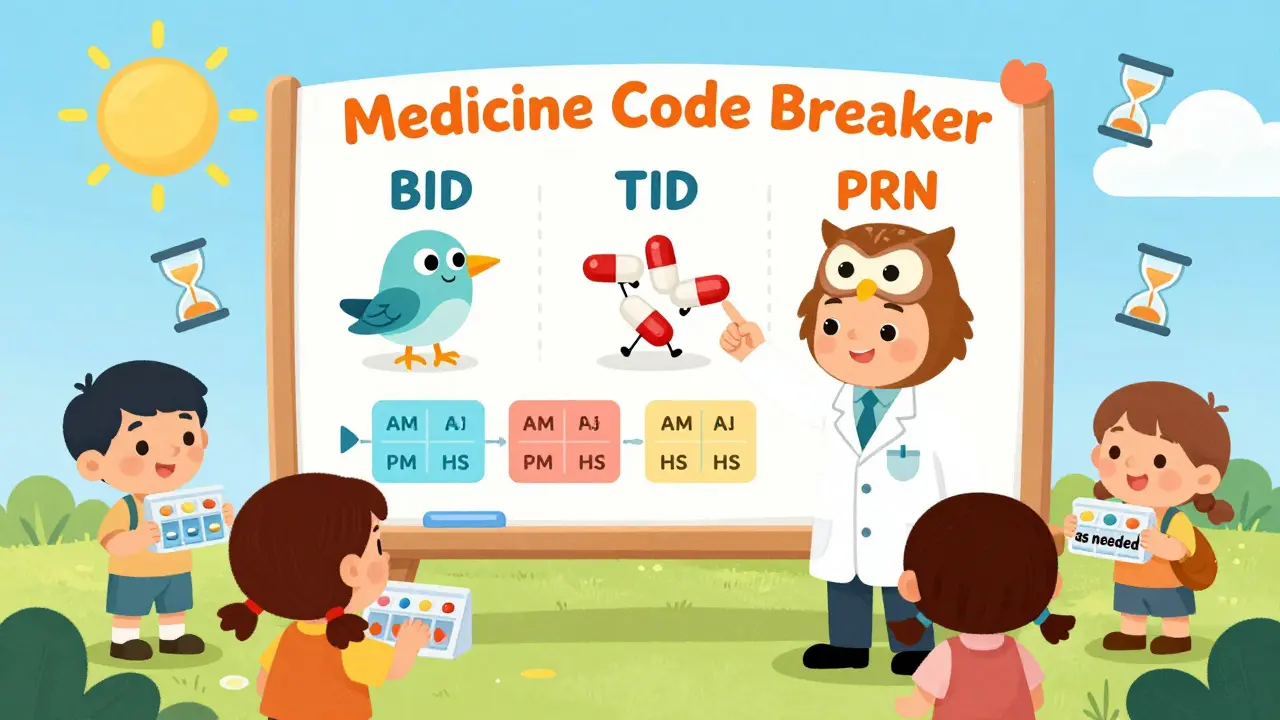
BID means twice a day. It comes from the Latin phrase bis in die. That doesn’t mean “morning and night,” though. It means roughly every 12 hours. So if your doctor writes BID, take your pill at 8 a.m. and 8 p.m., not just when you eat breakfast and dinner. Skipping the evening dose can drop your medication levels too low, especially with antibiotics or blood pressure drugs. A 2020 Mayo Clinic study showed that when TID or BID doses were taken with uneven spacing, drug effectiveness dropped by up to 38%.
TID stands for three times a day, from ter in die. This isn’t “breakfast, lunch, dinner.” It’s about evenly spaced doses-every 8 hours. So 6 a.m., 2 p.m., and 10 p.m. That’s the sweet spot for keeping a steady level of medicine in your bloodstream. If you take your antibiotic only at breakfast and dinner, you’re leaving an 18-hour gap. That’s enough time for bacteria to bounce back. Johns Hopkins researchers found that inconsistent TID timing reduced antibiotic effectiveness by 27%.
PRN is short for pro re nata, which means “as needed.” This one trips up the most people. It doesn’t mean “take it whenever you feel like it.” It means take it only when you have a specific symptom-and only up to a certain number of times per day. For example, “ibuprofen 400mg PRN for pain, max 3 doses in 24 hours.” That means you can take it for pain, but no more than three pills in a full day. Taking it every two hours because you’re in discomfort? That’s dangerous. The FDA says PRN medications cause 31% of all dosing errors because people misunderstand the limits.
Other Common Abbreviations You’ll See
There are more than 40 standard pharmacy abbreviations, but here are the ones you’re most likely to run into:
- QD - Once daily. Take it at the same time each day, like 8 a.m. Consistency matters more than the exact hour.
- QID - Four times daily. That’s every 6 hours: 6 a.m., 12 p.m., 6 p.m., 12 a.m. Hard to stick to, but critical for some antibiotics.
- Q4H - Every 4 hours. This is often used for pain meds. It means every 4 hours while you’re awake, not through the night unless specified.
- AC - Before meals. Take it 30 to 60 minutes before eating. Some meds need an empty stomach to work right.
- PC - After meals. Take it within 30 minutes of eating. This helps reduce stomach upset.
- HS - At bedtime. Take it right before you go to sleep.
- PO - By mouth. This just means it’s an oral pill or liquid, not a shot or patch.
Some labels say “INR weekly” or “check blood pressure daily.” Those aren’t abbreviations-they’re instructions for monitoring. Don’t mix them up with dosing instructions. One patient on Drugs.com spent three phone calls figuring out that “PRN” on their blood thinner label didn’t mean “take when INR is high”-it meant “take the pill as needed for symptoms,” while INR checks were separate.
Why These Abbreviations Still Exist
You’d think in 2026, with electronic prescriptions everywhere, we’d have ditched Latin by now. But we haven’t. Why? Tradition. Many doctors were trained to write “BID” and “TID” in medical school. Even though electronic systems like Epic and Cerner can auto-convert them to plain English, some still type them in manually. A 2022 FDA report showed 68% of U.S. prescriptions still use these abbreviations. And handwritten prescriptions-still 17% of all prescriptions-have error rates 3.7 times higher than digital ones.
It’s not just about laziness. Some doctors believe Latin abbreviations are more precise. But that’s a myth. A 2023 University of California, San Francisco study found that patients who got plain English instructions were 45% more likely to take their meds correctly. The Joint Commission has banned dangerous abbreviations like “U” for units (which can be mistaken for “0”) since 2004. But BID, TID, and PRN? They’re still allowed. That’s changing fast. The USP General Chapter <17> standard requires all Latin abbreviations to be gone by December 31, 2025. Kaiser Permanente already switched in 2022-and saw a 29% drop in pharmacy calls asking for clarification.
How to Avoid Mistakes
Here’s what you can do right now to stay safe:
- Ask your pharmacist to explain it in plain English. They’re trained to do this. A 2022 Pharmacy Times survey found 89% of patients felt more confident after a pharmacist walked them through their label. Don’t be shy. They expect this question.
- Use a pill organizer with time labels. Buy one with AM, PM, and bedtime slots. A 2021 study in the Annals of Internal Medicine showed pill organizers improved adherence by 52%.
- Download a medication app. Apps like Medisafe (used by over 18 million people) let you input your prescription and automatically convert BID to “Take at 8 a.m. and 8 p.m.” They send reminders and even warn you if you’re about to overdose.
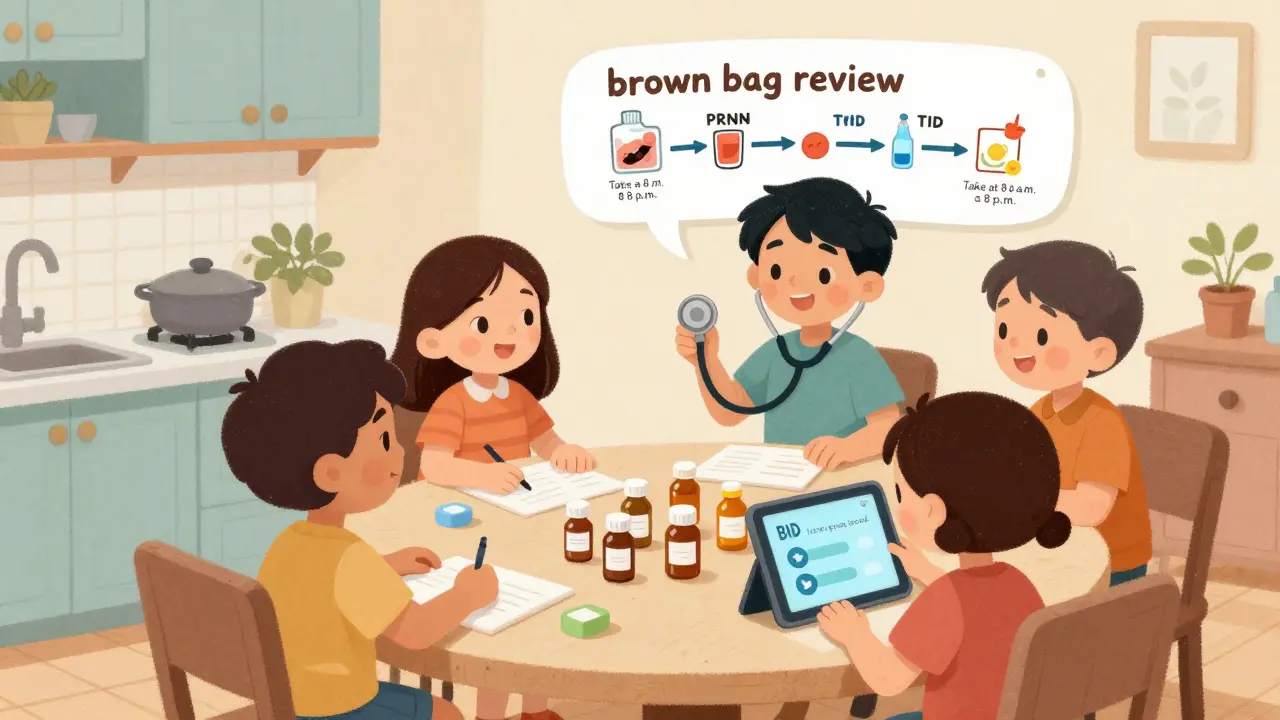
- Do a “brown bag review.” Every six months, bring all your pills-bottles, boxes, even old ones-to your doctor or pharmacist. They’ll spot conflicts, duplicates, or misinterpretations.
- Use the teach-back method. After your pharmacist explains, say it back in your own words. “So you’re saying I take this pill at 8 a.m. and 8 p.m., not just with meals?” If you can explain it clearly, you’re less likely to mess up.
What’s Changing in 2025 and Beyond
By the end of 2025, U.S. pharmacies will be required to stop using Latin abbreviations on all prescription labels. The FDA is pushing for digital systems to include automatic dosing calculators that suggest exact times based on your daily schedule. Imagine typing in “TID” and the app says: “Based on your wake-up time of 7 a.m., take doses at 7 a.m., 3 p.m., and 11 p.m.” That’s coming soon.
Walmart and CVS already lead the way, with 78% and 74% of their prescriptions using plain English. Independent pharmacies? Only 41% do. That gap is shrinking fast. By 2027, experts predict less than 5% of prescriptions will use Latin abbreviations. The real challenge isn’t the technology-it’s the doctors who still write “BID” out of habit.
What to Do If You’re Still Confused
If your label says “TID” and you’re not sure what time to take it, don’t guess. Don’t rely on memory. Don’t assume it means “with meals.” Call your pharmacy. Text your doctor’s office. Use a telehealth app to ask. The cost of getting it wrong? Higher hospital bills, longer illness, or even a trip to the ER. A 2022 Milken Institute report says medication errors cost the U.S. healthcare system $318 billion a year. Nearly a quarter of those errors come from patients not understanding their instructions.
One Reddit user shared how their grandmother took her TID antibiotic only twice a day because she thought “TID” meant “three days.” The infection came back worse. Another user said their parent took PRN painkillers every 2 hours for a week, thinking “as needed” meant “whenever it hurts.” They ended up with stomach bleeding. These aren’t rare stories. They’re preventable.
You don’t need to memorize all 47 pharmacy abbreviations. You just need to know the big three: BID, TID, PRN. And you need to know that if you’re unsure, asking is the smartest thing you can do. Pharmacists don’t judge. They’re there to help. And in a world where medicine is getting more complex, clarity is your best defense.
What does BID mean on a prescription?
BID means twice a day, from the Latin bis in die. It doesn’t mean morning and night-it means every 12 hours, such as 8 a.m. and 8 p.m. Taking it at uneven times can reduce the medicine’s effectiveness, especially for antibiotics or blood pressure drugs.
Is TID the same as three times a day?
Yes, TID means three times a day, from ter in die. But timing matters. The doses should be spaced about 8 hours apart-like 6 a.m., 2 p.m., and 10 p.m.-to keep steady drug levels in your blood. Taking it only at breakfast and dinner creates a dangerous 18-hour gap.
Can I take PRN medicine whenever I want?
No. PRN means “as needed,” but it always comes with limits. For example, “ibuprofen 400mg PRN for pain, max 3 doses in 24 hours” means you can take it only when you have pain-and only up to three times a day. Taking it more often can cause liver or stomach damage.
Why do pharmacies still use Latin abbreviations?
Many doctors still use them out of habit, even though electronic systems can convert them to plain English. Handwritten prescriptions (still 17% of all U.S. prescriptions) are especially prone to errors. But by the end of 2025, U.S. pharmacies will be required to stop using Latin abbreviations entirely under new USP standards.
What should I do if I don’t understand my prescription label?
Ask your pharmacist. They’re trained to explain labels in simple terms. You can also use apps like Medisafe to convert abbreviations, or do a “brown bag review” by bringing all your meds to your doctor. Never guess-mistakes can lead to serious health risks.
13 Comments
I swear I took my blood pressure med at 8am and 8pm like it said BID, but my doctor acted like I was trying to kill myself. Turns out I was supposed to do it every 12 hours, not with meals. Now I set alarms. 🙃
i always thought tid meant 3 times a day like breakfast lunch dinner... until my mom ended up in the er bc she took her antibiotic only twice. turns out the gap was like 18 hours?? i still get nervous reading labels.
The persistence of Latin abbreviations is a systemic failure of medical education. BID, TID, PRN - these are archaic relics that persist due to cognitive inertia among clinicians who refuse to adapt to patient-centered communication paradigms. It's not tradition; it's negligence dressed up as convention.
You missed QHS - that’s 'quaque hora somni' - which is not 'at bedtime' as commonly misstated, but literally 'each hour of sleep.' Most pharmacists get this wrong. If you're on a beta-blocker with QHS dosing, you’re supposed to take it *during* the night if waking up, not just before lights out. The FDA’s 2023 guidelines clarified this, but no one updated their EHR templates.
lol i used to take my prn pain meds every 2 hours like it was candy. then i got a stomach ulcer. now i use medisafe. it even tells me when i'm about to hit the max dose. thank god for apps. also, why do doctors still write 'b.i.d.'? just say 'twice a day'. it's 2026.
I remember my grandmother reading 'TID' as 'three days' and only taking her antibiotics on day 1, 2, and 3 - then stopping. The infection came back worse. She didn’t even know what 'daily' meant. We need more than labels - we need someone to sit with people and explain it. Not just hand them a bottle and walk away.
i just called my pharmacy and asked them to print the instructions in plain english. they did it for free. no judgment. they even drew me a little chart. i cried a little. you don’t have to be smart to be safe.
PRN isn’t 'as needed' - it’s 'as clinically indicated.' If your label says 'ibuprofen PRN' without a max dose, that’s a prescribing error. You should be getting a second label with the limit. If you don’t, the pharmacist is failing their duty. Don’t just assume - demand clarity.
To everyone who says 'just ask your pharmacist' - YES. Do it. They are your secret weapon. I used to be too shy. Now I bring my meds in every time I refill. I say, 'Can you explain this like I’m five?' They smile. They explain. I leave smarter. We all deserve to understand our own health.
This is why America is falling apart. We let doctors use Latin like it’s 1850. Meanwhile, other countries switched to plain language 20 years ago. We’re still clinging to this archaic nonsense because 'tradition.' I’m so tired of our healthcare system pretending it’s above modernity. #MedicineIsNotAMystery #JustUseEnglish
I’ve been tracking this for years. The FDA knows this kills people. But the AMA won’t force doctors to change because it would mean retraining 800,000 physicians. And guess who pays? The patient. The ER. The family. This isn’t negligence - it’s a silent epidemic. And no one’s talking about it except the people who almost died.
I used to think BID meant morning and night. Then I missed my night dose once and felt like crap. Now I set two alarms. One for 8am, one for 8pm. Simple. No Latin. No guesswork. If your doctor still writes BID, just ask them to write 'twice daily' - they’ll do it.
I just took my first pill today and I already forgot what it was for. But I know it’s TID. So I put it in the little box with the 3 slots. That’s enough for me. I don’t need to know Latin. I just need to not die.