


Key Takeaways
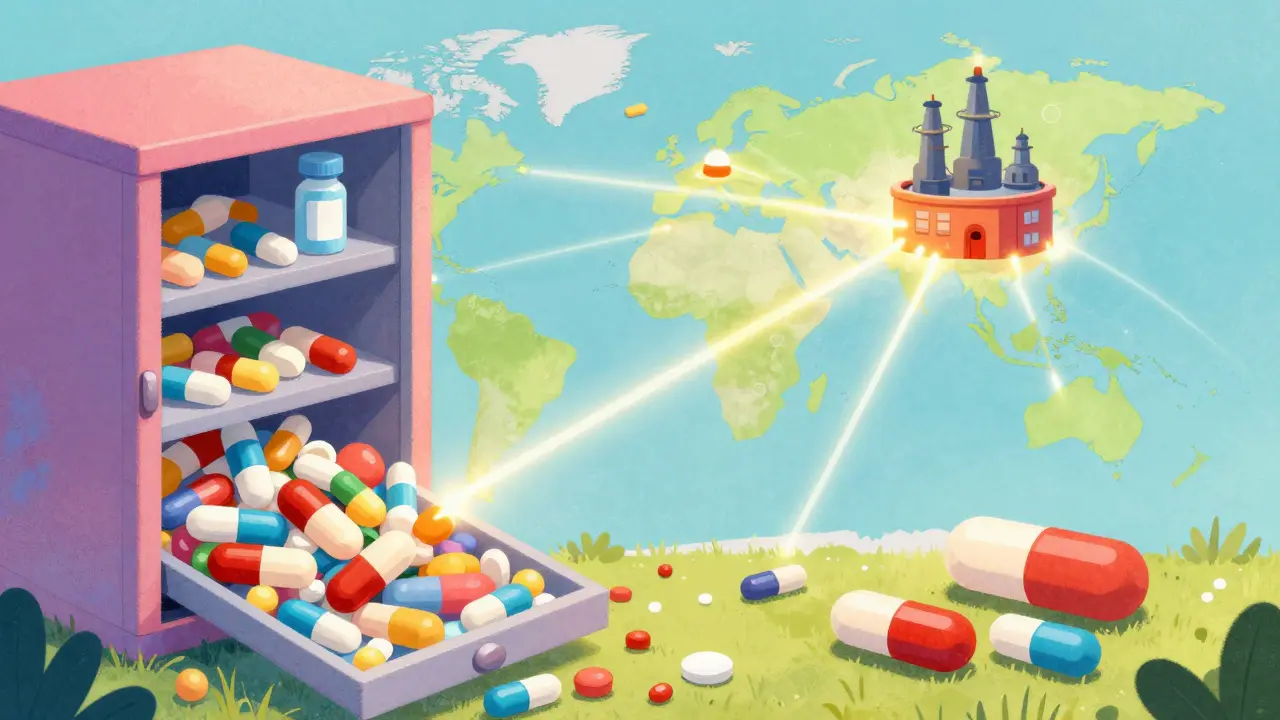
- China dominates the global API market, controlling about 80% of the supply for small molecule drugs.
- Cost advantages are huge (30-40% cheaper than Western options), but purity failures are more common.
- The 2016 Generic Consistency Evaluation program is cleaning up the industry, though only 35% of drugs have finished the process.
- Geopolitical tensions are pushing the US and EU to move production away from China to avoid "single point of failure" risks.
The Engine of Global Generics
China didn't become a pharma powerhouse overnight. After joining the World Trade Organization in 2001, the government poured state-backed funding into industrial expansion. They focused on what they do best: high-volume, low-complexity chemical synthesis. Today, companies like Sinopharm and Shijiazhuang Pharma Group run plants that pump out thousands of metric tons of APIs annually. Their real secret weapon is vertical integration. Chinese firms often control 60-70% of the production chain, from the raw starting materials to the final API. Because they handle the most hazardous steps-like fluorination-that Western companies avoid due to strict environmental laws, they've effectively cornered the market. If you're a drug maker in India or the US, you're likely buying your raw materials from a Chinese factory because it's simply too expensive to do it anywhere else.
The Quality Gap: Why the Concern?
Low prices usually come with a trade-off. In the case of Chinese generic production, that trade-off is often found in the lab reports. Data from the U.S. Food and Drug Administration (FDA) shows a worrying trend. In some studies, nearly 13% of Chinese API samples failed purity tests, compared to just around 2% for US and European samples. When inspectors actually get inside these factories, they find a pattern of failures. We're talking about inadequate lab controls, poor process validation, and-most concerningly-data integrity issues. This isn't just a theoretical problem; it has real-world consequences. For example, Zydus Pharmaceuticals had to recall 1.2 million bottles of blood pressure medication in 2023 because the API supplied by Huahai Pharmaceutical was sub-potent. When the raw material is off, the final pill doesn't work, which is a terrifying prospect for a patient with chronic hypertension.
| Attribute | Chinese Suppliers | European Suppliers | US Suppliers |
|---|---|---|---|
| Avg. Purity Failure Rate | 12.7% | 2.3% | 1.8% |
| Price per kg (Avg) | $50 - $150 | $200 - $400 | $200 - $400 |
| Production Cost Advantage | 30-40% Lower | Baseline | Baseline |
| Quality Consistency Score | 3.2 / 5 | 4.1 / 5 | 4.0 / 5 |
Cleaning Up the Act: The GCE Program
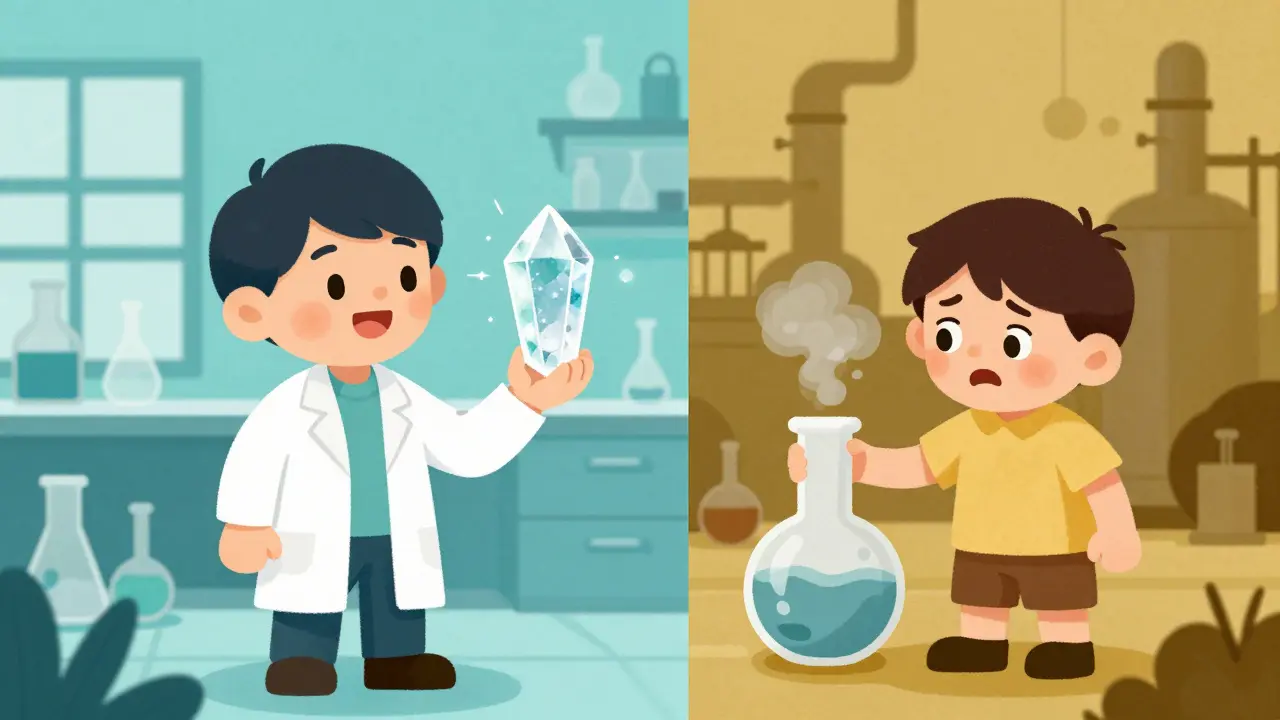
China knows that "cheap and risky" isn't a sustainable long-term business model. To fix this, the National Medical Products Administration (NMPA) launched the Generic Consistency Evaluation (GCE) in 2016. The goal was simple: every generic drug must prove it is bioequivalent to the original brand-name version. This wasn't just a paperwork exercise. It led to a massive shakeout. Since 2018, about 4,500 non-compliant manufacturers have been wiped off the map. The industry shrunk from 7,000 facilities to about 2,500, leaving only the players who could actually meet the standards. However, the progress is slow. As of 2024, only about 35% of approved generics have actually completed this evaluation. It's a slow climb toward credibility.
The Supply Chain Trap
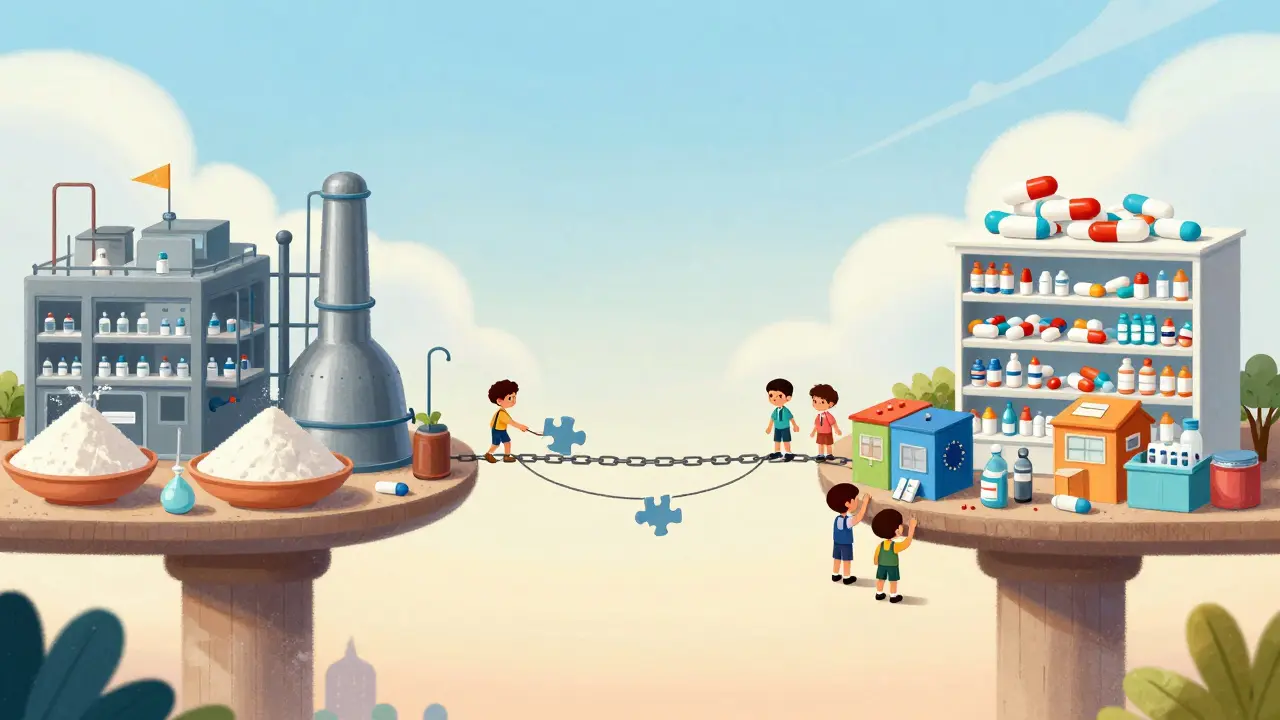
Here is where it gets complicated for the rest of us. While China produces the bulk of the raw APIs, they aren't great at making the final pills (finished dosage forms). That's where India comes in. Indian manufacturers control about 20% of the global generic finished drug market, but they import roughly 65% of their APIs from China. This creates a dangerous dependency. If a trade war hits or a pandemic shuts down Chinese ports, the entire global medicine supply chain could snap. We saw a glimpse of this vulnerability recently, and it's why the US and EU are now pouring billions into "onshoring" or "friend-shoring" production. The US CHIPS and Science Act, for instance, has allocated $500 million specifically to bring API production back home. They want to eliminate the "single point of failure" that currently exists.
The Road to 2035
China isn't just sitting back. Their "Pharma 2035" initiative is a $22 billion bet on upgrading technology. They are moving away from old-school batch processing-which 65% of their plants still use-toward continuous manufacturing. If they can shift to modern, automated systems, they can cut down the human error that leads to those purity failures. But the hurdle isn't just technical; it's cultural. Many Western firms struggle with documentation styles in China. A PwC survey found that 63% of companies faced challenges with how quality data is recorded and reported. Bridging that gap requires more than just new machines; it requires a total overhaul of how quality is managed on the factory floor. Even a giant like Pfizer spent $22 million and three years just to harmonize processes with a Chinese partner before they could trust the supply for the US market.
Why is China so dominant in API production?
China dominates because of massive state subsidies, vertical integration of raw materials, and a willingness to handle hazardous chemical synthesis steps that are too expensive or legally restricted in the West. This allows them to produce APIs 30-40% cheaper than their competitors.
What are the main quality risks with Chinese generics?
The primary risks include inconsistent purity levels, inadequate laboratory controls, and data integrity issues (such as falsified documentation). FDA inspections have historically shown higher failure rates in Chinese facilities compared to domestic US or European sites.
Does the GCE program actually work?
Yes, it has significantly cleaned up the industry by eliminating thousands of non-compliant factories. However, the rollout is slow, with only about 35% of approved generics having completed the bioequivalence evaluation as of 2024.
How does India fit into this supply chain?
India is the "finisher." They take the raw APIs produced in China and turn them into the final tablets or capsules. This makes the Indian pharma industry heavily dependent on Chinese raw materials, creating a global vulnerability.
What is "continuous manufacturing"?
Unlike batch processing, where a drug is made in separate steps, continuous manufacturing is a non-stop flow of materials through a system. It is more efficient, reduces waste, and significantly lowers the chance of human error in quality control.
Next Steps for Industry Players
If you're sourcing from this region, don't rely on a piece of paper saying a plant is GMP-certified. Real due diligence requires on-site audits and third-party purity testing of every batch. For those looking to diversify, explore emerging hubs in Vietnam or Mexico, though be aware that their capacity is still a fraction of China's. The goal isn't necessarily to stop buying from China entirely-that's nearly impossible-but to ensure that no single factory in one single city holds the key to your entire product line.
10 Comments
Wake up people!!! This isn't just about "quality risks"-it's a strategic stranglehold. China hasn't "cornered the market," they've weaponized it. They've spent decades making us dependent so they can flip the switch whenever they want. The US government's $500 million is a drop in the bucket compared to the scale of this infiltration. We're basically paying our enemies to poison our medicine cabinets. Get your production back on US soil NOW or we're just puppets to their Pharma 2035 agenda.
Interesting read! 💊 I think it's great that the US and EU are looking at friend-shoring. It's a learning curve for everyone involved, but diversification is always the way to go. Let's hope the transition happens smoothly so patients don't feel the pinch! 😊
The sheer lack of sophistication in batch processing is practically prehistoric. I find it amusing that anyone is shocked by the "cultural gap" in documentation. It's not a gap; it's a chasm of competence. If you're still relying on a system where 65% of plants use batch processing in the age of AI, you're not running a pharmacy, you're running a chemistry set from the 1950s. Truly pathetic.
The paradigm shift toward continuous manufacturing is the only way to achieve true homeostasis in the supply chain 🌀. We're seeing a fundamental ontological clash between legacy batching and the flow state of modern API synthesis. It's all about that synergy, man. ✌️
Typical. They tell us the GCE program is "cleaning up" the industry but only 35% is done? 🙄 That's just a cover story. They're probably just hiding the bad batches better now. Don't trust the official numbers, man. The globalists love these "evaluations" because it makes us think something is changing while they keep the monopoly tight. 🤡
its just greed plain and simple. a few billionaires get richer while the poor get sub-potent pills. funny how we call it a supply chain risk when its actually just a morality failure in capitalism
Too risky!!! Who's auditing this??? Terrible!!!
The API-sourcing metrics are quite concerning... definitely a systemic failure in the GMP-standards... those purity gaps are huge!!!
I feel that we must approach this not as a conflict between nations but as a collective human endeavor to improve the safety of our shared medicinal resources, and while it is certainly tempting to simply move factories across borders, we must consider if the underlying philosophy of quality and transparency can be cultivated globally through collaboration rather than just shifting the geography of production to places that might eventually succumb to the same profit-driven pressures that compromised the current system in the first place.
This is really scary to think about. I hope everyone is staying safe and double-checking their meds.