





Ever wonder why you're told to use SPF 30 when SPF 15 seems like it should be enough? Or why some sunscreens leave you looking like a ghost while others disappear into your skin? Most of us slap on some lotion before a beach trip, but the actual science of how these products stop your skin from aging or developing cancer is far more interesting than a bottle of cream. If you've ever been confused by the labels, you're not alone. The truth is, the numbers on the bottle aren't a simple linear scale, and "broad spectrum" isn't just a marketing buzzword-it's the difference between protecting your skin and just delaying a sunburn.
The Real Meaning of SPF
When you see SPF is a numerical measure of a sunscreen's ability to protect against UVB radiation, it's easy to assume that SPF 30 is twice as strong as SPF 15. Unfortunately, that's not how the math works. SPF, or Sun Protection Factor, specifically measures how well a product blocks UVB rays, which are the ones responsible for those painful red burns.
The protection doesn't increase linearly. For example, SPF 15 blocks about 93.3% of UVB rays, while SPF 30 jumps to 96.7%. By the time you hit SPF 50, you're blocking 98%. That's only a 1% increase in protection from SPF 30 to SPF 50. Why bother with the higher number then? Because most of us are terrible at applying it. Research shows that about 90% of people only apply half the recommended amount of sunscreen. When you under-apply, an SPF 30 product might actually only provide SPF 7.5 to 15 of real-world protection. Using a higher SPF acts as a safety net for those of us who don't use a measuring spoon on our faces.
UVA vs. UVB: Knowing Your Enemy
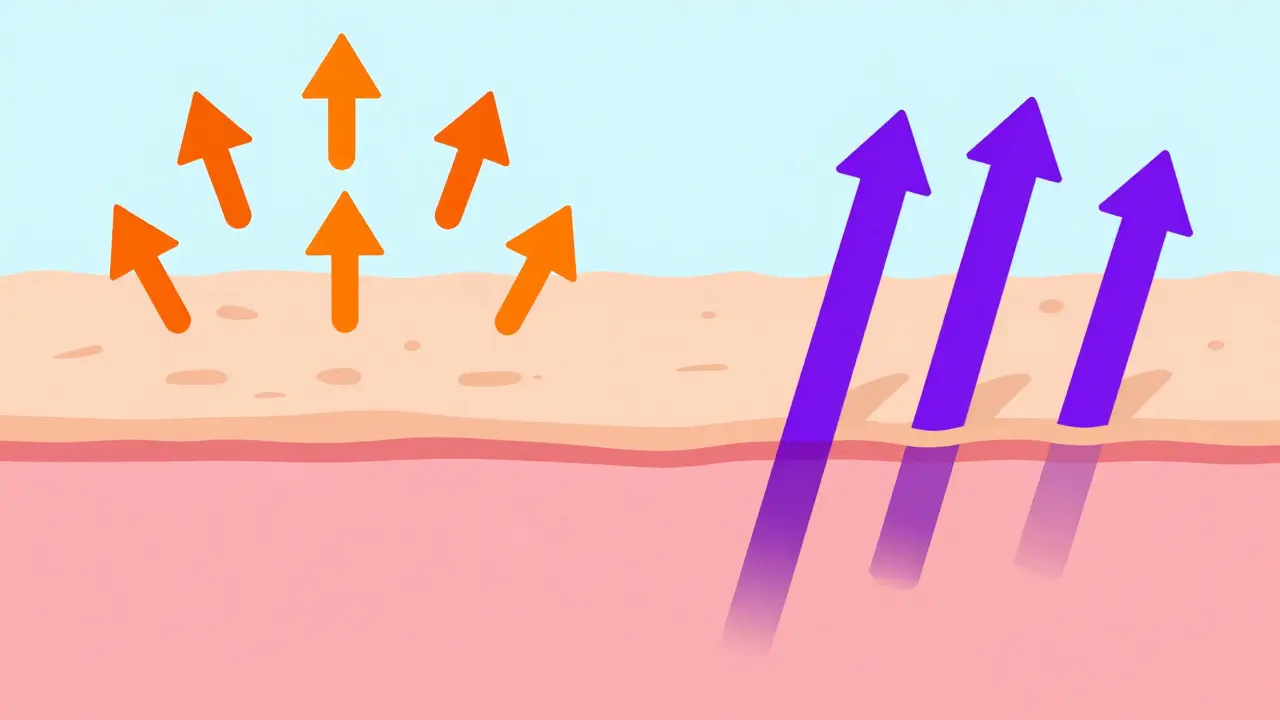
To pick the right protection, you have to understand that the sun hits you with different types of radiation. Think of UVB radiation as the "burning" rays. These shorter wavelengths (290-320 nm) hit the surface of your skin, causing DNA mutations and immediate sunburns. They are the primary culprits behind skin cancer.
On the other hand, UVA radiation is the "aging" ray. These longer wavelengths (320-400 nm) are much sneakier. While UVB is blocked by clouds or windows, UVA penetrates deep into the dermis layer of your skin. It destroys collagen and elastin, leading to wrinkles and leathery skin. Because UVA is present at pretty much the same intensity all day, every day, regardless of the weather, it's the main reason dermatologists insist on daily protection even in the middle of winter.
| Feature | UVB Rays | UVA Rays |
|---|---|---|
| Primary Effect | Sunburn & DNA damage | Photoaging & Wrinkles |
| Wavelength | Short (290-320 nm) | Long (320-400 nm) |
| Penetration | Epidermis (Surface) | Dermis (Deep) |
| Glass Penetration | Blocked | Passes through |
Mineral vs. Chemical: Which One Wins?
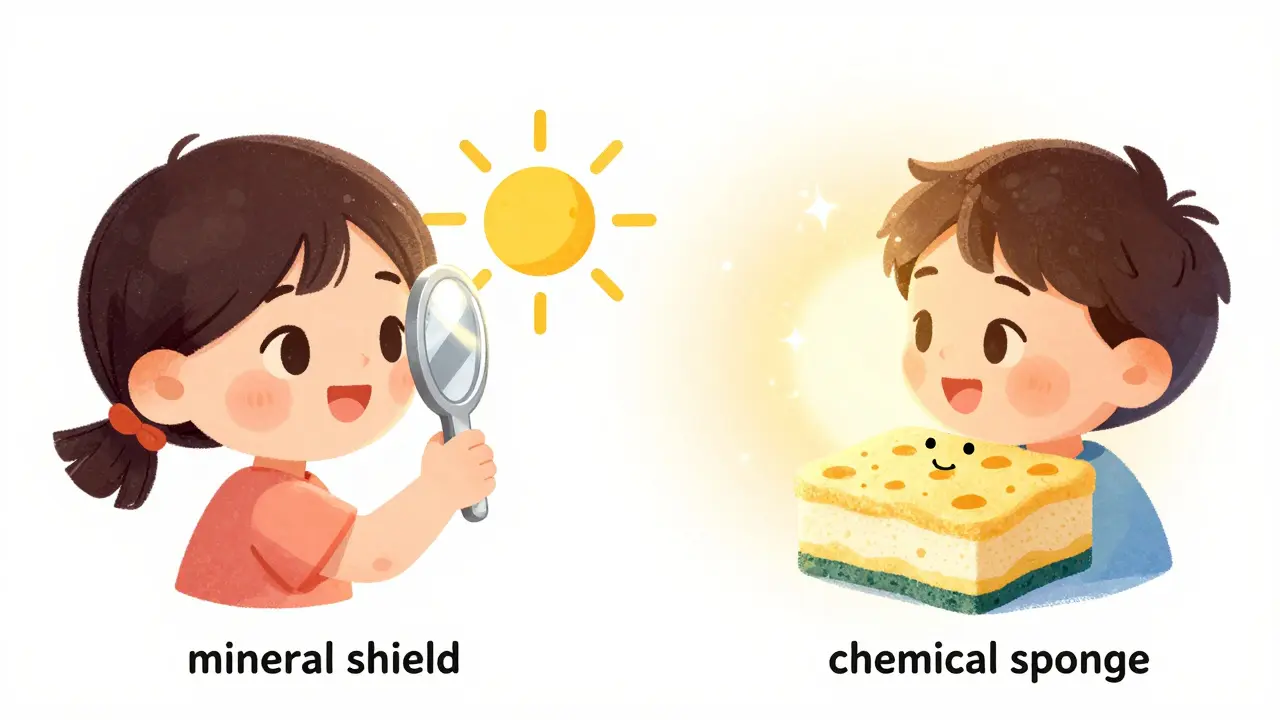
This is where the Great Sunscreen Debate happens. Essentially, you're choosing between a shield and a sponge. Mineral Sunscreens (also called physical sunscreens) use active ingredients like zinc oxide or titanium dioxide. These sit on top of your skin and physically reflect UV rays away. They are generally safer for sensitive skin and babies, but they often leave a "white cast," which can be frustrating for people with darker skin tones.
Then you have Chemical Sunscreens. These use ingredients like avobenzone or octisalate that absorb into the skin. Instead of reflecting the rays, they absorb the UV radiation, convert it into heat, and release it from the skin. They are much easier to rub in and leave no residue, but some people find they cause breakouts or stinging eyes, especially those with ingredients like oxybenzone.
If you have acne-prone skin, you might find that mineral versions work better. Many users report that switching to zinc-based formulas helps clear up breakouts because they don't penetrate the skin as deeply as chemical filters. However, if you're heading to the gym or the pool, a chemical formula is often more "cosmetically elegant" and less likely to run into your eyes.
The "Broad Spectrum" Requirement
If a bottle doesn't say "broad spectrum," put it back. This term means the product has been tested to protect against both UVA and UVB rays. To qualify, a sunscreen must meet specific standards, such as having a critical wavelength of at least 370 nanometers. Without this, you might be protected from a sunburn, but your skin is still taking a beating from those aging UVA rays.
The standards are actually getting stricter. The Skin Cancer Foundation recently raised its requirements, now demanding at least SPF 30 for daily use and SPF 50 for active outdoors lifestyles. They've also shifted focus toward "breadth of coverage," ensuring that as the SPF number goes up, the UVA protection increases proportionally. It's not just about the number on the front; it's about the quality of the filter inside.
How to Actually Apply Sunscreen (The Right Way)
Most of us apply sunscreen like we're putting on a light moisturizer. That's the problem. To get the actual SPF listed on the bottle, you need to use about 2 mg of product per square centimeter of skin. In plain English? That's roughly 1/4 teaspoon for your face and neck alone.
- The Final Step: Apply your sunscreen as the very last step of your skincare routine, after your moisturizer has fully sunk in. This prevents "pilling," where the product clumps up into little balls.
- The 15-Minute Rule: Give your sunscreen about 15 minutes to set before you apply makeup or head outside. This allows the protective film to bond to your skin.
- The Two-Hour Reset: No matter how high the SPF is, the filters break down over time. Reapply every two hours, especially if you're sweating or swimming.
- Water Resistance: Check the label for "water resistant" (usually 40 or 80 minutes). Keep in mind that this doesn't mean it's waterproof; it just means it stays on longer while you're wet.
Future Trends and Environmental Impact
Sunscreen science is moving toward "multi-spectrum" protection. Dermatologists are starting to look at blue light and infrared radiation, which can also contribute to skin damage. We're also seeing a huge shift toward "reef-safe" formulas. Some chemical filters, like oxybenzone and octinoxate, have been linked to coral bleaching. If you're visiting a tropical reef, sticking to a mineral sunscreen with non-nano zinc oxide is the most environmentally friendly choice.
Does SPF 50 provide double the protection of SPF 25?
No. SPF doesn't work linearly. SPF 25 blocks about 98% of UVB rays, while SPF 50 blocks about 99%. The difference is minimal, but higher SPF is often recommended to compensate for the fact that most people apply too little product.
Can I just use the SPF in my makeup?
While it's better than nothing, it's usually not enough. To get the rated SPF from a foundation, you'd have to apply a thick, cakey layer that no one wants. Use a dedicated sunscreen underneath your makeup for actual protection.
Do I need sunscreen if it's cloudy or raining?
Yes. Clouds block some UVB rays (the ones that cause burns), but UVA rays pass right through clouds and glass. If there is daylight, there is UV radiation hitting your skin.
What is the difference between a physical and chemical sunscreen?
Physical (mineral) sunscreens use zinc oxide or titanium dioxide to reflect UV rays like a mirror. Chemical sunscreens use organic compounds to absorb UV rays and convert them into heat. Physicals are better for sensitive skin; chemicals are usually easier to blend.
How do I know if my sunscreen is "broad spectrum"?
Look for the words "Broad Spectrum" on the label. This ensures the product protects against both UVA (aging) and UVB (burning) rays. In the US, the FDA requires this labeling to be prominent.
8 Comments
The point about the 1/4 teaspoon for the face is where most people trip up. I've seen a lot of folks use a tiny pea-sized amount and then wonder why they're still getting sunspots. If you're not using enough, that SPF 50 is basically useless.
This is actually super helpful!
Imagine actually needing a guide to explain that SPF isn't linear. It's basic math, really. Most of the "science" here is just common knowledge for anyone who isn't completely oblivious to how chemistry works. The obsession with simplifying everything for the masses is just exhausting at this point.
Please, the analysis of mineral vs chemical is so surface-level it's almost comical. You completely gloss over the stability of filters like avobenzone, which degrades almost instantly without proper stabilization. Also, the "reef-safe" label is a complete marketing scam with zero standardized regulation. It's just a way to charge 20% more for a product that does the exact same thing. The industry is just laughing at people who think a label makes a product "eco-friendly" when the packaging is still plastic. Honestly, if you aren't looking into the specific molecular structure of the filters, you're just playing pretend with your skincare. Most of these "recommendations" are just echoed from a brochure without any critical thought. It's honestly embarrassing how easily people swallow this generic advice.
Omg... the "15-minute rule" is such a myth!!! I've read plenty of papers that suggest chemical filters work immediately upon application... why is this still being pushed as a rule??? It's just... ridiculous!!!
It is utterly repulsive that some individuals believe they can simply ignore these guidelines and still expect a healthy complexion. The ignorance displayed in some of these replies is staggering. I find it offensive that basic dermatological science is treated as a matter of opinion.
I'm actually curious about how the blue light protection works compared to standard UVA filters. It'd be cool to see more data on whether tinted sunscreens are actually better for that than clear ones since they use iron oxides.
That's a great point about the tinted versions! Iron oxides are definitely the gold standard for blue light. Just keep pushing for that daily protection and your skin will thank you in twenty years!