


When a patient walks up to the pharmacy counter with a prescription for a brand-name drug, the pharmacist doesn’t just hand over the same pill in a different box. They make a decision-one that’s legally binding, medically significant, and often invisible to the patient. That decision is whether to substitute the brand-name drug with a generic version. And in the United States, that decision isn’t up to the pharmacist alone. It’s shaped by a patchwork of 51 different state laws, federal regulations, and clinical guidelines that can change overnight. If you’re a pharmacist, you’re not just filling a script-you’re navigating a minefield of legal obligations.
What Makes a Generic Drug Legally Substitutable?
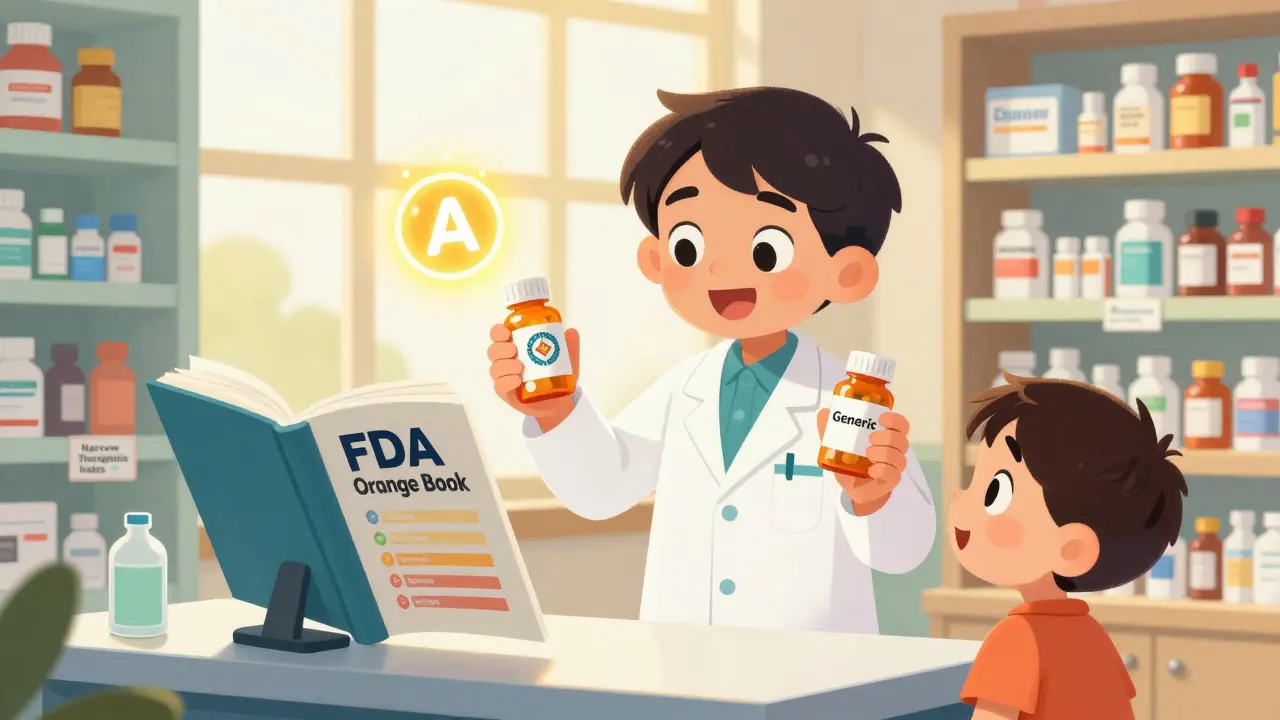
The foundation of all generic substitution is the FDA’s Orange Book a public list of approved drug products with therapeutic equivalence evaluations. This isn’t just a reference guide. It’s the official legal standard. For a generic drug to be eligible for substitution, it must have an "A" rating. That means it’s been proven bioequivalent to the brand-name drug-same active ingredient, same dosage form, same strength, same route of administration, and same performance in the body. The FDA requires this through a rigorous review process called the Abbreviated New Drug Application (ANDA). The manufacturer doesn’t have to repeat expensive clinical trials. But they must prove their version behaves identically in the bloodstream. If it doesn’t, it doesn’t get an "A" rating. And if it doesn’t have an "A" rating? You can’t legally substitute it.
But here’s where it gets tricky: not all "A"-rated drugs are treated the same. Some states have special rules for drugs with a narrow therapeutic index-medications where even a small change in blood level can cause serious harm. Think levothyroxine, warfarin, phenytoin, and digoxin. In states like California and Florida, substitution of these drugs is either banned outright or requires explicit consent-even if the generic has an "A" rating. That’s because bioequivalence doesn’t always mean clinical equivalence in real-world use. A 2019 study in JAMA Internal Medicine found that switching between different generic versions of digoxin led to a 12.7% higher rate of adverse events, even though both met FDA standards.
State Laws: Mandatory vs. Permissive Substitution
The U.S. doesn’t have one national rule for generic substitution. It has 51 different systems: 50 states plus the District of Columbia. And they fall into two main categories: mandatory and permissive.
In mandatory substitution states (like New York, California, and Illinois), the law says you must substitute a generic unless the prescriber specifically writes "dispense as written" or "no substitution." The goal? Lower costs. These states have generic dispensing rates around 92.7%, according to NIH research. But that doesn’t mean pharmacists have no power. They still can’t substitute if the drug isn’t rated "A," if the patient refuses, or if the prescriber has marked it as medically necessary.
In permissive substitution states (like Texas, Pennsylvania, and Ohio), you have the option to substitute, but you’re not required to. Many pharmacists in these states use their professional judgment. If a patient has a history of seizures and is on phenytoin? You might choose not to substitute, even if the generic is rated "A." That’s legal. That’s professional discretion. But you still have to follow your state’s consent rules.
Consent: Presumed vs. Explicit
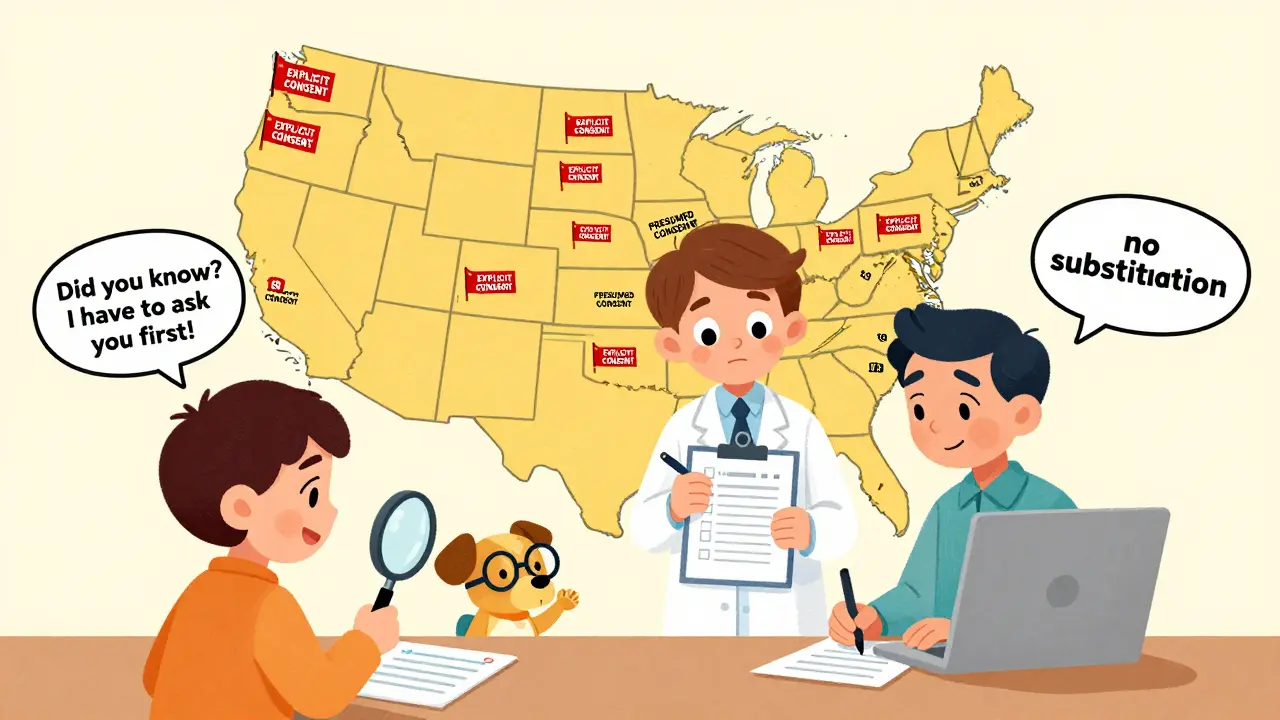
Even if substitution is allowed, you can’t just swap the pill without telling someone. States split on how consent works:
- Presumed consent states (18 of them) assume the patient agrees unless they say otherwise. You can substitute without asking.
- Explicit consent states (32 of them) require you to get the patient’s okay before switching. That means a conversation. A signature. Sometimes even a form.
In explicit consent states, failing to get permission isn’t just a mistake-it’s a violation. And state boards of pharmacy don’t take it lightly. In 2022, 68% of all disciplinary actions against pharmacists for substitution errors were due to documentation failures-not clinical errors. You didn’t check the box. You didn’t write down the patient said yes. That’s enough for a fine, a warning, or worse.
"Medically Necessary" and How to Spot It
One of the biggest sources of confusion for pharmacists? The "medically necessary" designation. This is how prescribers block substitution. But it’s not as simple as writing "no generics."
In states like Florida, the prescriber must write "MEDICALLY NECESSARY" in their own handwriting on a paper prescription. For electronic prescriptions, they must select a specific checkbox or enter a code. If they don’t? You’re allowed to substitute-even if you think it’s risky. You’re not a doctor. You’re bound by the law, not your gut.
But here’s the catch: some prescribers don’t know this. They think writing "no substitution" is enough. It’s not. And when a patient comes back because their seizure control worsened after a switch, the pharmacist is the one who gets questioned. That’s why training matters. You need to know your state’s exact requirements. One typo. One missed checkbox. One handwritten note that’s too vague-and you’re in violation.
Special Cases: Epilepsy, Thyroid, and Heart Drugs
Some drugs are off-limits for substitution in certain states-even if they’re "A" rated.
Antiepileptic drugs like phenytoin and carbamazepine are banned from substitution in Tennessee, Hawaii, and several others. Why? Because even tiny variations in blood levels can trigger seizures. A Reddit post from a Tennessee pharmacist in 2023 described a near-fatal incident: a patient had a grand mal seizure after a generic was substituted because the pharmacist didn’t know the state’s rule. That’s not hypothetical. It’s documented.
Thyroid medications like levothyroxine are restricted in California, New York, and others. Why? Because the body is incredibly sensitive to small changes in hormone levels. A 2022 survey of 1,247 patients found that 78% were happy with generics-but 63% of those who had negative experiences cited "not being told" about the switch. That’s a trust issue. And trust is harder to rebuild than a prescription error.
Cardiac glycosides like digoxin and anticoagulants like warfarin are also high-risk. While federal law doesn’t ban substitution, many states have formularies that exclude them. Florida’s pharmacy formulary, for example, explicitly prohibits substitution for drugs with a narrow therapeutic index unless the prescriber approves.
What Happens When You Get It Wrong?
Pharmacists aren’t just risking a complaint. They’re risking their license.
State boards of pharmacy handle thousands of complaints each year. In 2022, the National Association of State Boards of Pharmacy (NASPA) reported that substitution-related violations were the second most common reason for disciplinary action-after controlled substance errors. The penalties? Fines. Mandatory education. Probation. Suspension. In extreme cases, revocation.
But the real cost isn’t just legal. It’s professional. A patient who had a bad reaction because they weren’t told about the switch? They may never come back. They may tell friends. They may file a lawsuit. And in a profession built on trust, that’s more damaging than any fine.
How to Stay Compliant
Here’s how to avoid trouble:
- Know your state’s law. Check your board’s website monthly. Laws change. In 2022 alone, 17 states updated their substitution rules.
- Use the FDA Orange Book. Always verify the generic’s rating before substituting. Don’t rely on your EHR or a label.
- Document everything. If you get consent, write it down. If the prescriber says "medically necessary," copy it exactly. If you don’t substitute, note why.
- Train your staff. Pharmacy technicians often handle the initial screen. If they don’t know the rules, you’re at risk.
- Counsel patients. Even if you’re not required to get consent, explain why you’re switching-or why you’re not. Patients appreciate honesty. And it protects you.
There’s no shortcut. No app that auto-updates your state laws. No AI that reads handwriting. You have to do the work. Because the law doesn’t care if you were busy. It doesn’t care if you were tired. It only cares if you followed it.
What’s Changing in 2026?
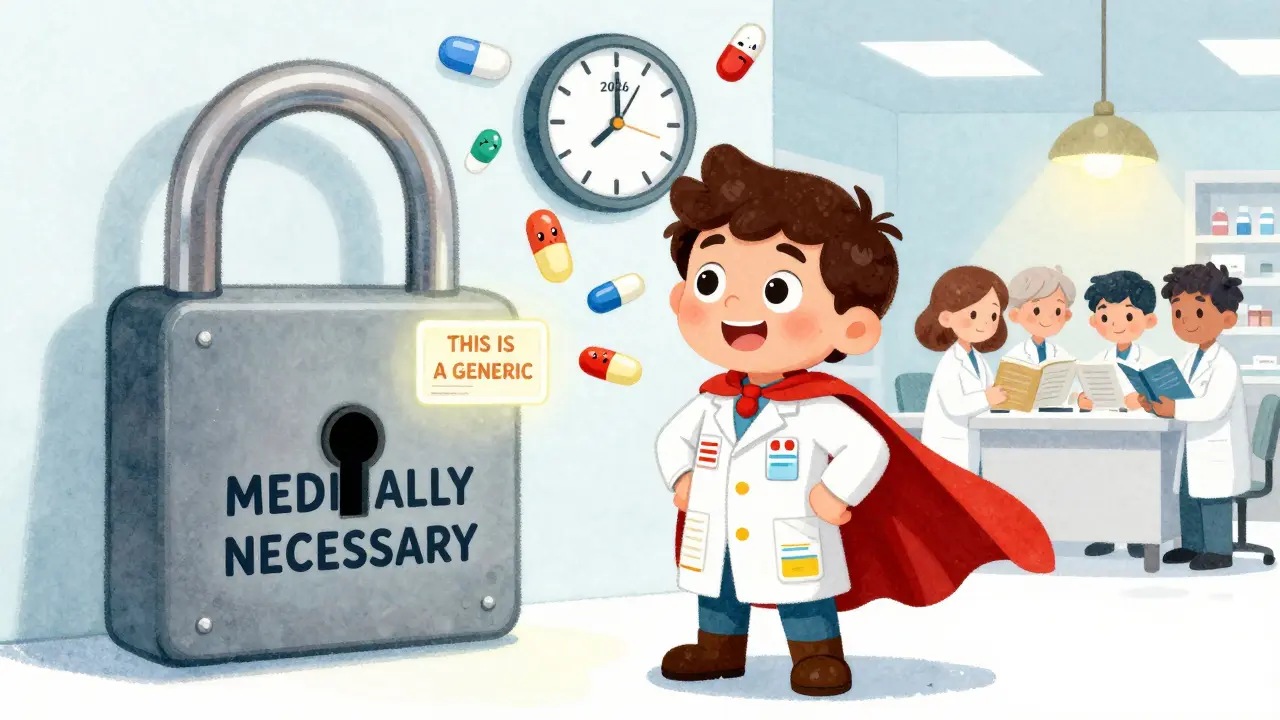
The landscape is shifting. In 2022, Congress passed the Consolidated Appropriations Act, which required the FDA to update labeling on all generic drugs by December 2024 to improve patient understanding. Now, in 2026, pharmacists are seeing new labels that clearly state "this is a generic version" and list the brand name. It’s a small change-but it’s a big step toward transparency.
Also, 19 states are now considering new rules around biosimilars-biologic drugs that mimic complex medications like Humira or Enbrel. These aren’t traditional generics. They’re harder to replicate. And their substitution rules are different. Pharmacists who ignore this trend will be left behind.
The bottom line? Generic substitution saves the U.S. healthcare system over $300 billion a year. But it only works if pharmacists understand their legal duties. You’re not just a dispenser. You’re a legal gatekeeper. And that responsibility doesn’t come with a manual. It comes with vigilance.
Can a pharmacist substitute a generic drug without the patient’s permission?
It depends on the state. In 32 states, pharmacists must get explicit patient consent before substituting a generic. In the other 18, substitution is allowed under presumed consent-meaning the patient doesn’t need to say yes, but they can say no. Always check your state’s rules. Failure to follow consent requirements is one of the most common reasons pharmacists face disciplinary action.
Are all generic drugs safe to substitute for brand-name drugs?
The FDA says yes-if they have an "A" rating in the Orange Book. But some drugs, like levothyroxine, warfarin, and phenytoin, have a narrow therapeutic index, meaning tiny changes in blood levels can cause serious side effects. Many states ban or restrict substitution for these drugs, even if they’re rated "A." Pharmacists must know which drugs are high-risk in their state.
What does "dispense as written" mean on a prescription?
It means the prescriber has instructed the pharmacist not to substitute the brand-name drug with a generic. This instruction must be clearly written or electronically marked according to state law. In some states, like Florida, "medically necessary" must be handwritten on paper prescriptions. If you see this, you cannot substitute-regardless of cost or convenience.
Can a pharmacist refuse to substitute a generic even if the law allows it?
Yes. In permissive substitution states, pharmacists have the right to use professional judgment. If a patient has a history of adverse reactions, or if the drug has a narrow therapeutic index, the pharmacist can choose not to substitute-even if legally allowed. This is part of their ethical duty to prioritize patient safety over cost savings.
What happens if a pharmacist makes a substitution error?
Consequences vary by state and severity. Minor documentation errors may lead to a warning or mandatory training. More serious errors-like substituting a restricted drug without consent or failing to check the Orange Book-can result in fines, suspension of license, or even revocation. In cases where a patient is harmed, civil lawsuits or criminal charges are possible. The most common violation? Failing to document consent or medical necessity.
14 Comments
Man, I never realized how wild it is that pharmacists have to memorize 51 different state laws just to fill a prescription. In India, we just give the generic unless the doctor says otherwise. No forms, no consent, no paperwork. Just hand over the bottle and say 'take twice a day.' Simple. Efficient. Maybe too simple?
As a pharmacist in Ohio, I can confirm: permissive substitution is a blessing and a curse. I’ve refused to swap levothyroxine for a patient who’d been stable on the brand for 8 years. She cried when I explained why. That’s the job-protecting people even when the law lets you cut corners.
soooo... like, i work in a pharmacy in dublin and we dont even have this whole 'substitution' drama. generics are just... the default. no orange book checks, no consent forms, no 'medically necessary' scribbles. we just give what's cheapest and the doc says 'no' if they care. i mean, why is the us so complicated? also, typo: 'medically necessary' should be in caps, right? or am i wrong? lol
My aunt was on warfarin for 12 years. Switched to generic without warning. INR spiked. Ended up in the ER. They didn’t even document it. That’s not negligence-it’s systemic failure. Pharmacists aren’t robots. We need better training, clearer rules, and more respect for the clinical judgment part of this job.
Really appreciate this breakdown. I’m a med student in Delhi, and we barely learn about pharmacy law. This makes me realize how much responsibility pharmacists carry. They’re the last line before a patient takes a pill. That’s huge.
There is a deeper philosophical tension here: autonomy versus efficiency. The system prioritizes cost containment-understandable, given the financial strain on healthcare. But at what cost to individualized care? When a patient’s life hinges on milligrams of phenytoin, does a 12.7% increase in adverse events constitute a systemic failure of medical ethics? Or merely an inevitable trade-off in a market-driven system? The answer is not in the Orange Book-it’s in our collective conscience.
OMG this is wild. I work in a clinic and patients come in like ‘why did you give me a different pill??’ and I’m like, ‘uhhh because your insurance only covers generic?’ and then they flip out. We need a universal sticker on generics-like ‘THIS IS NOT THE BRAND’ in bold letters. Also, pharmacists: you’re heroes. Seriously. No one talks about how much you carry.
Let’s be real-most patients don’t even know what a generic is. They think it’s ‘fake medicine.’ And pharmacists? They’re stuck between a rock and a hard place: follow the law or protect the patient? Spoiler: the law wins every time. That’s why people die quietly. And no one gets fired. Just fined.
YES! YES! YES! I’ve been saying this for years!!! Documentation is EVERYTHING!!! I had a patient once who got switched to a generic digoxin, had a stroke, and sued the pharmacy-because the tech didn’t check the box for consent. We lost. We lost everything. So now? I print out a consent form. I have them sign it. I take a photo. I file it. I sleep better. Thank you for writing this!!!
Oh wow, so pharmacists are now legal gatekeepers? Next they’ll be making us sign waivers before breathing. I mean, if the FDA says it’s bioequivalent, why are we treating patients like lab rats? It’s all about profit. The brand companies bribe lawmakers. The generics? They’re just cheaper poison. Wake up, sheeple.
Compliance with state-specific substitution laws remains a critical operational challenge for community pharmacy practice. The absence of a centralized regulatory database contributes to inadvertent noncompliance. It is recommended that pharmacy management systems integrate real-time updates from state boards of pharmacy to mitigate legal risk.
Generic drugs are just brand drugs with a discount sticker. The FDA approves them. So why are we acting like this is rocket science? You’re a pharmacist. You don’t need to be a lawyer. Just give the pill. People are dying from overthinking, not underdosing.
My best friend’s mom had a seizure because of a generic swap. She’s paralyzed now. The pharmacist said ‘it was legal.’ Legal doesn’t mean right. And now she can’t hug her grandkids. I’m not mad. I’m just… heartbroken. And the system just shrugs. That’s the real tragedy.
They're hiding something. The FDA doesn't test generics long enough. Big Pharma owns the Orange Book. They want you to take the cheap one so they can sell you the expensive one later. You think this is about safety? No. It's about control. And your blood. They're watching your levels. Always.