

When a child needs medicine, parents often assume a generic version is just as safe as the brand-name one. But for kids, that assumption can be dangerous. Generic drugs for children aren’t just smaller versions of adult pills-they’re complex formulations that can behave differently in young bodies. The truth? Many generic drugs used in kids have never been properly tested for safety in children. And even when they’re chemically identical, tiny differences in inactive ingredients can trigger serious reactions.
Why Kids Aren’t Just Small Adults
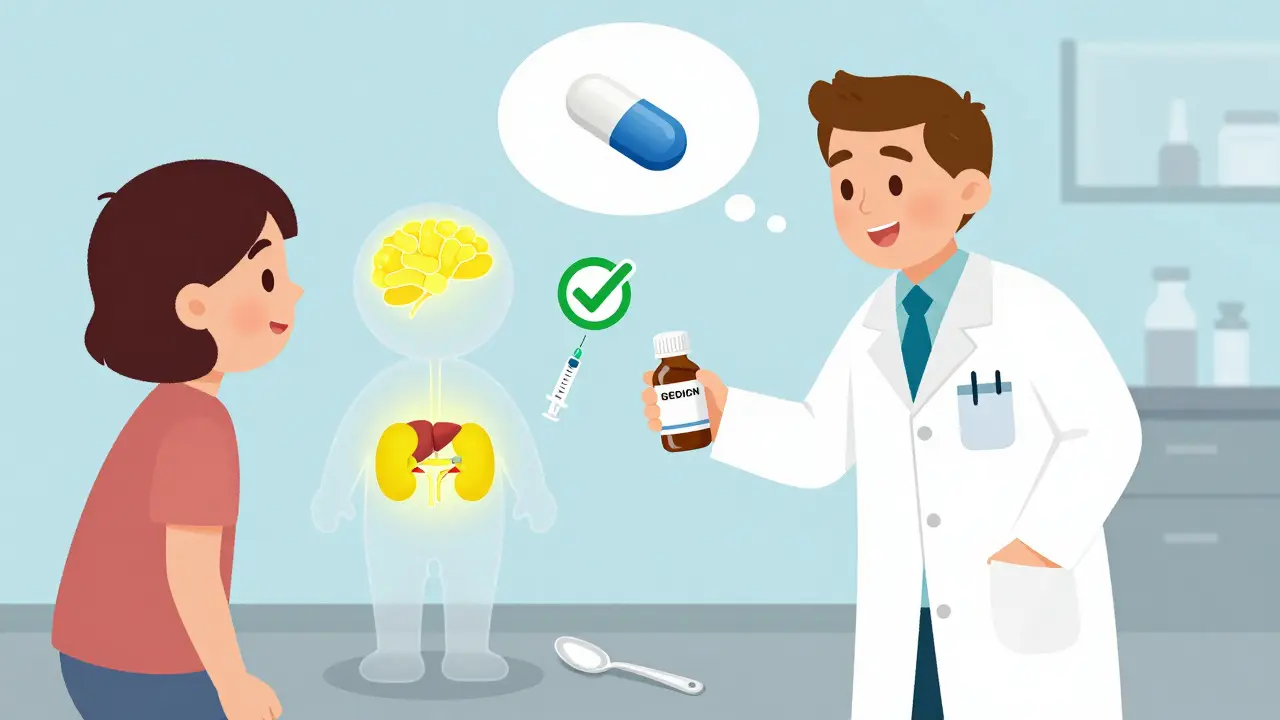
Children’s bodies process drugs in ways that adults simply don’t. Babies under two years old have immature livers and kidneys, which means drugs can build up in their system longer than expected. Their skin is thinner, their stomachs more sensitive, and their brains still developing. These differences aren’t minor-they change how a drug works, how long it lasts, and whether it’s safe at all. For example, acetaminophen (the active ingredient in Tylenol) is less toxic in young children than in adults because their livers produce more glutathione, a natural detoxifier. But that doesn’t mean a generic version is interchangeable. Some generic liquid formulations use different preservatives or flavorings that can cause allergic reactions or upset stomachs. One parent on Reddit reported her 3-year-old developed severe diarrhea after switching from brand-name loperamide to a generic version-no change in active ingredient, but a different filler triggered a reaction.The Hidden Risks in Inactive Ingredients
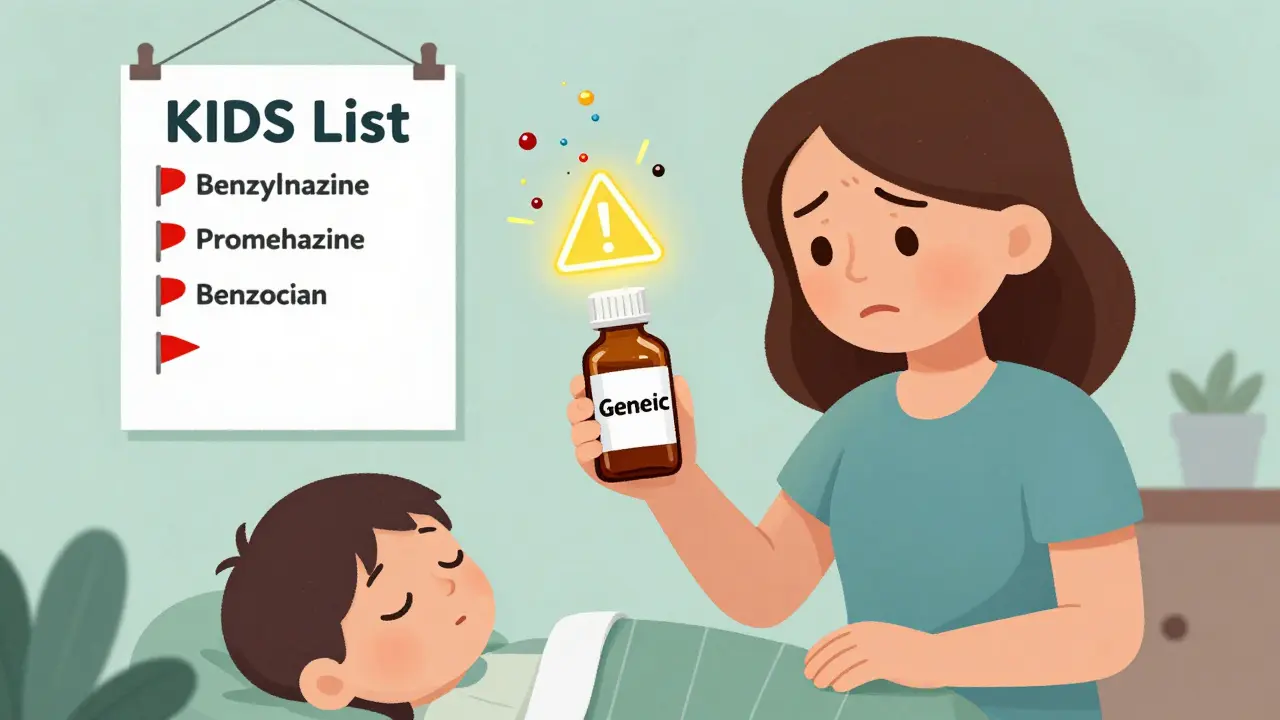
The FDA requires generic drugs to have the same active ingredient as the brand-name version. But it doesn’t require them to match the inactive ingredients. That’s where the danger lies. Many generic liquid medications contain alcohol, artificial colors, or preservatives like benzyl alcohol or propylene glycol. These are harmless to adults but can be toxic to infants. Benzocaine, a common numbing agent in generic teething gels, has caused methemoglobinemia-a rare but deadly blood disorder-in children under two. Lidocaine viscous, used for mouth sores, has led to seizures and coma in toddlers when swallowed. The KIDs List (Key Potentially Inappropriate Drugs List), updated in 2025 by the Pediatric Pharmacy Association, flags over 4,100 drugs with pediatric safety concerns. Among them:- Promethazine (generic antihistamine): Avoid in children under 2. Linked to fatal respiratory depression.
- Trimethobenzamide (generic anti-nausea drug): Banned for anyone under 18 due to severe muscle spasms.
- Betamethasone (generic steroid cream): Avoid on diaper rash in kids under 2. Can cause adrenal suppression and Cushing syndrome.
Off-Label Use: The Norm, Not the Exception
Sixty percent of generic drugs prescribed to children have no FDA-approved pediatric labeling. That means doctors are guessing the dose. And when they guess, mistakes happen. A child’s dose isn’t just “half of an adult dose.” It’s calculated by weight (milligrams per kilogram), age, and sometimes even body surface area. One wrong decimal point can mean a 10-fold overdose. Dr. John N. van den Anker, a leading pediatric pharmacologist, calls this the “zero rule”: never write 1.0 mg. Always write 1 mg. A period after a whole number can be mistaken for a zero-leading to a 10-times-too-high dose. The most common errors?- Using adult liquid concentrations (e.g., 10 mg/mL instead of 5 mg/mL)
- Measuring with kitchen spoons instead of oral syringes
- Confusing milligrams (mg) with milliliters (mL)
When Brand-Name Is Safer
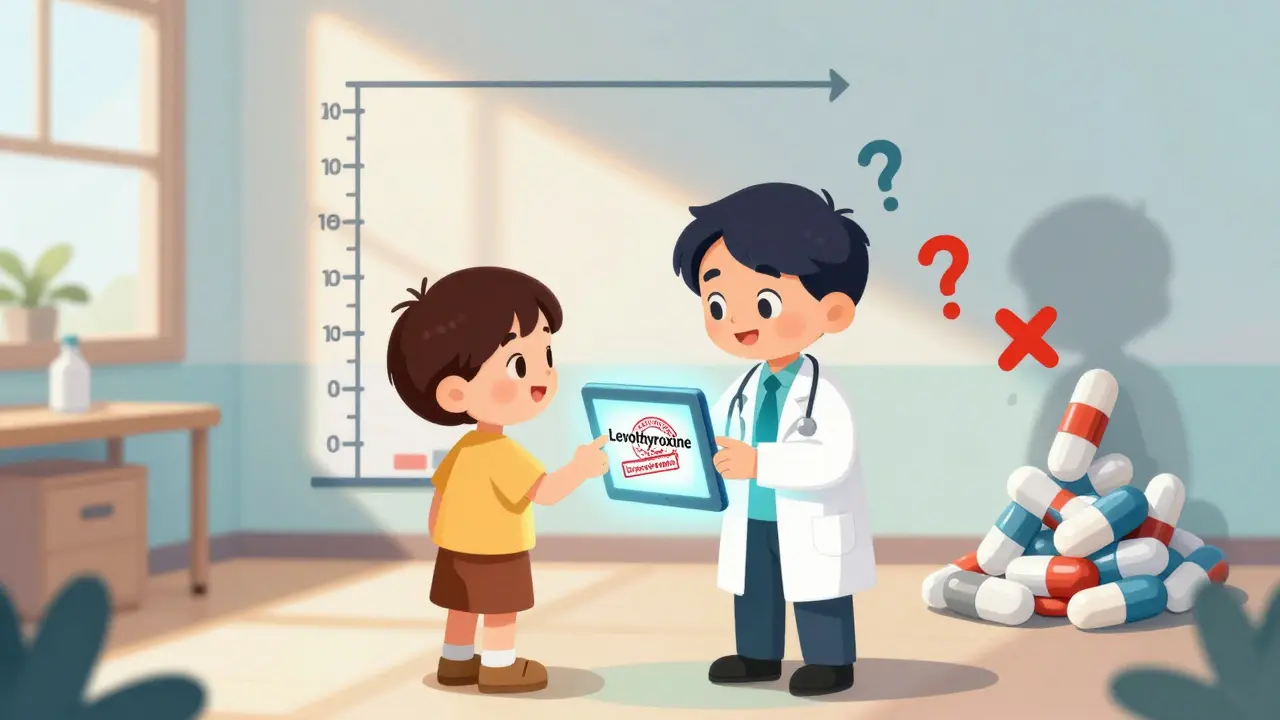
Sometimes, the brand-name drug is the only safe option. Take levothyroxine, used to treat underactive thyroid. Even small differences in absorption between generic and brand versions can throw off a child’s hormone levels, affecting growth and brain development. The American Academy of Pediatrics advises that for drugs with a narrow therapeutic index-like levothyroxine, phenytoin, or warfarin-doctors should specify “Dispense as Written” on the prescription. That means the pharmacy can’t swap it out for a generic without permission. Parents don’t always know they have this right. A 2023 survey by HealthyChildren.org found that 68% of parents whose children had a bad reaction to a generic drug didn’t realize they could have asked for the brand-name version.What Parents Can Do
You don’t need a medical degree to protect your child. Here’s what works:- Check the label: Does it say “for children” or “for adults”? Never give adult medicine to a child, even if you cut the dose.
- Use an oral syringe: Not a teaspoon. Not a medicine cup. A syringe from the pharmacy gives you precision.
- Ask about inactive ingredients: If your child has allergies or sensitivities, ask the pharmacist: “What’s in this generic version besides the active drug?”
- Keep a medication list: Write down every pill, liquid, and supplement your child takes-including vitamins and OTC drugs. Bring it to every appointment.
- Turn on the light: Most dosing errors happen in dim light. Always measure medicine with good lighting.
The Bigger Picture: Regulation Is Catching Up
The good news? Change is coming. In 2024, the FDA required all generic drug manufacturers to include pediatric dosing information if it exists-full compliance is due by December 2025. The Pediatric Pharmacy Association now updates its KIDs List quarterly, adding new risks like linaclotide (avoid under 2) and guaifenesin (avoid under 4). The American Academy of Pediatrics is launching a mobile app in late 2024 that gives doctors instant access to the KIDs List and automated dosing calculators. Early AI tools are already predicting safe dosing for generic drugs with 89% accuracy. But until every generic drug is tested in kids, the safest choice is often to ask: “Is there a pediatric-specific version?” If not, ask if the brand-name is necessary.Final Thought: Safety Isn’t About Cost
Generic drugs save money. But for children, safety isn’t a trade-off. A $2 generic that causes a hospital visit costs far more than a $20 brand-name drug that works safely the first time. Always prioritize your child’s health over cost-especially when the science says the risks are real.Are generic drugs for children always safe?
No. Many generic drugs used in children haven’t been tested for safety in kids. Even when the active ingredient is the same, differences in inactive ingredients-like preservatives, dyes, or flavorings-can cause allergic reactions, toxicity, or dosing errors. The FDA doesn’t require generic manufacturers to prove safety in children, so assumptions can be dangerous.
Can I ask the pharmacist to give me the brand-name drug instead of generic?
Yes. You have the right to request the brand-name version. Tell the pharmacist: “I’d like the brand-name drug because my child has had a reaction to the generic before.” You can also ask your doctor to write “Dispense as Written” on the prescription. This legally prevents automatic substitution.
What should I do if my child has a reaction to a generic drug?
Stop giving the medication immediately. Contact your pediatrician or poison control (1-800-222-1222 in the U.S.). Document the drug name, dosage, and symptoms. Report the reaction to the FDA’s MedWatch system. Many reactions are preventable and help improve safety for other children.
How do I measure liquid medicine for my child accurately?
Always use the oral syringe that comes with the medicine or one from your pharmacy. Never use a kitchen spoon, cup, or dropper. Oral syringes are marked in milliliters (mL) and give you exact measurements. Make sure you’re reading the syringe at eye level, and always turn on the light to avoid mistakes.
What drugs should I absolutely avoid giving my child as generics?
Avoid generic versions of drugs flagged on the KIDs List: promethazine (under age 2), trimethobenzamide (under 18), benzocaine (oral use under 2), lidocaine viscous (under 2), and betamethasone creams (on diaper rash under 2). Also avoid generics for levothyroxine, phenytoin, and warfarin unless your doctor specifically approves the substitution. Always check the latest KIDs List updates at pediatricpharmacy.org.
12 Comments
India sees this every day - generics saved our healthcare system, but kids? Different ballgame. Saw a neighbor’s toddler go into seizures after a generic teething gel. No one knew benzocaine was in it. We need labels like ‘NOT FOR CHILDREN UNDER 2’ stamped in red. No fluff. Just facts.
Pharmacists here don’t even ask. They just hand it over. We need training. Not just for them - for us too.
Stop. Just stop. If you’re giving your kid a generic, you’re gambling. Period.
This is an incredibly well-researched and sobering piece. The data on inactive ingredients is alarming - particularly the systemic failure to require pediatric-specific testing. It’s not just about cost-cutting; it’s about institutional negligence masked as efficiency.
That 32% error rate among pharmacy technicians is not a statistic - it’s a moral failure. We owe our children more than assumptions. The FDA’s new requirements, while overdue, are a necessary first step. But accountability must extend beyond regulation into clinical culture.
OMG this is REAL 🥺💔 I work in a pediatric clinic in Cape Town and we’ve had TWO cases of methemoglobinemia from generic benzocaine gels last year. Parents don’t know. Pharmacists don’t know. Even some docs don’t know.
KIDs List? We print it out and tape it to the counter. Also - PLEASE use oral syringes. A teaspoon ≠ 5mL. It’s chaos. 🙏
Of course the FDA doesn’t care. Big Pharma owns them. The real story? Brand-name companies bribe regulators to keep generics out of pediatric use - then charge $200 for a bottle of levothyroxine. It’s a monopoly disguised as safety.
And don’t get me started on the ‘oral syringe’ nonsense - that’s just another way to sell you more gear. I’ve given my kid meds with a dropper for 12 years. No problems. Coincidence? Maybe. Or maybe you’re being manipulated.
YOU THINK THIS IS A COINCIDENCE?!
THE FDA, BIG PHARMA, AND THE AAP ARE ALL IN BED TOGETHER. THEY WANT YOUR KIDS TO NEED MORE MEDS. THAT’S WHY THEY LET TOXIC INGREDIENTS SLIP IN - SO YOU’LL COME BACK NEXT MONTH. THEY’RE PROFITING OFF YOUR FEAR.
I SAW A VIDEO ON TIKTOK WHERE A DOCTOR ADMITTED THEY’RE FORCED TO PRESCRIBE GENERICS TO MEET QUOTAS. THEY’RE SILENCING PARENTS WHO SPEAK UP. THE ‘KIDS LIST’? A FAKE. A DISTRACTION.
CALL THE FDA. ASK THEM ABOUT ‘PROJECT LULLABY.’ THEY’LL BLOCK YOU. I KNOW BECAUSE I TRIED.
THEY’RE HIDING THE TRUTH. AND YOUR CHILD IS A STATISTIC.
⚠️ SHARE THIS. ⚠️
Thanks for laying this out so clearly. It’s easy to assume generics are fine - I did too, until my niece had a reaction. Now I always ask: ‘What’s in the filler?’
And yes, the oral syringe thing? Game-changer. I used to use a measuring cup. Now I’ve got three on my counter. One for each kid. Label them. It’s simple. Doesn’t cost much. Saves so much stress.
Also - ‘Dispense as Written’ is a right. Use it. No shame.
Pathetic. This is why Western medicine is in decline. You’re treating children like lab rats while ignoring centuries of traditional dosing. In India, we’ve used herbal suspensions for generations - no benzyl alcohol, no propylene glycol.
And you’re worried about a 0.1mL variance? The real issue is over-medicalization. Your ‘KIDs List’ is just a profit engine for brand-name manufacturers.
Let parents use Ayurveda. Let them trust intuition. Not FDA spreadsheets.
This is one of those posts that makes you pause. I’m a pharmacist, and I didn’t know half of this.
My clinic just started a ‘Pediatric Safety Checklist’ - we print it, hand it to parents, and walk through it. Simple. No jargon. Just: ‘What’s in it? How do you measure? Did you check the label?’
Small steps. Big impact. Thanks for the reminder - I needed this.
MY KID HAD A SEIZURE FROM A GENERIC GEL.
I didn’t know. I trusted the pharmacy. I trusted the label. I trusted ‘same active ingredient.’
Turns out? The filler had propylene glycol. Kids under 2? Toxic. I almost lost her.
Now I only buy brand. I call the pharmacy before every refill. I carry the KIDs List on my phone.
You think this is overblown? It’s not. It’s survival.
I read this while nursing my 18-month-old. I had no idea. I’ve been using the generic ibuprofen since she was 6 months. I’m checking the bottle right now.
Thanks for the wake-up call. I’m going to call my pediatrician tomorrow. And get a syringe. Definitely a syringe.
Just wondering - are there any studies comparing absorption rates between brand and generic levothyroxine in infants under 1 year? I’ve seen conflicting data and want to be sure before I switch back.