

![How to Buy Premarin (Conjugated Estrogens) Online Safely in the UK [2025 Guide]](/uploads/2025/09/thumbnail-how-to-buy-premarin-conjugated-estrogens-online-safely-in-the-uk-2025-guide.webp)


Have you ever opened a pharmacy bill and felt like you were reading a foreign language? You aren't alone. For decades, Medicare Part D-the optional prescription drug coverage for seniors-has been one of the most confusing parts of the healthcare system. But if you are navigating your medications in 2026, things look very different than they did just a few years ago.
The good news is that the worst part of the old system is gone. The "donut hole"-that scary gap where you had to pay nearly everything out of pocket-is officially history. Thanks to changes from the Inflation Reduction Act, there is now a hard cap on what you can spend on drugs each year. However, knowing how much you will actually pay still requires understanding the new rules, the tiers, and the specific plan you choose. Let’s break down exactly how this works so you can keep more money in your pocket.
How the New Coverage Phases Work
Gone are the complicated four-phase structures that confused millions of beneficiaries. As of recent updates, Medicare Part D operates on a simplified three-phase model. Understanding these phases helps you predict your costs throughout the year.
Phase 1: The Deductible
At the start of the year, you pay 100% of your drug costs until you hit the deductible limit. For 2025, this maximum deductible was $590. In 2026, this amount may adjust slightly based on inflation, but the concept remains the same: you cover the full cost of prescriptions until this threshold is met. Some plans have $0 deductibles, which means you skip this phase entirely and move straight to sharing costs with your insurer.
Phase 2: Initial Coverage
Once you pass the deductible, you enter the initial coverage phase. Here, you typically pay 25% of the cost for covered drugs, while your plan and drug manufacturers cover the rest. This continues until your total out-of-pocket spending reaches the annual cap. This is where most people spend the majority of their year.
Phase 3: Catastrophic Coverage
This is the big change. Once your true out-of-pocket costs reach the annual threshold-which was $2,000 in 2025 and is projected to be around $2,100 in 2026-you enter catastrophic coverage. From that point forward, you pay nothing out of pocket for covered drugs for the rest of the calendar year. No more 5% coinsurance. No more guessing games. Your plan, the government, and manufacturers split the remaining costs.
| Phase | What You Pay | Threshold / Limit |
|---|---|---|
| Deductible | 100% of drug costs | Up to max deductible (~$590-600) |
| Initial Coverage | Typically 25% coinsurance | Until you hit the Out-of-Pocket Cap |
| Catastrophic | $0 | After reaching ~$2,000-$2,100 OOP |
Understanding Your Monthly Premiums
Your out-of-pocket drug costs are only half the story. The other half is the monthly premium you pay to keep the plan active. This varies wildly depending on the type of plan you choose.
You generally have two main options for getting Medicare Part D prescription drug coverage offered through private insurers approved by Medicare:
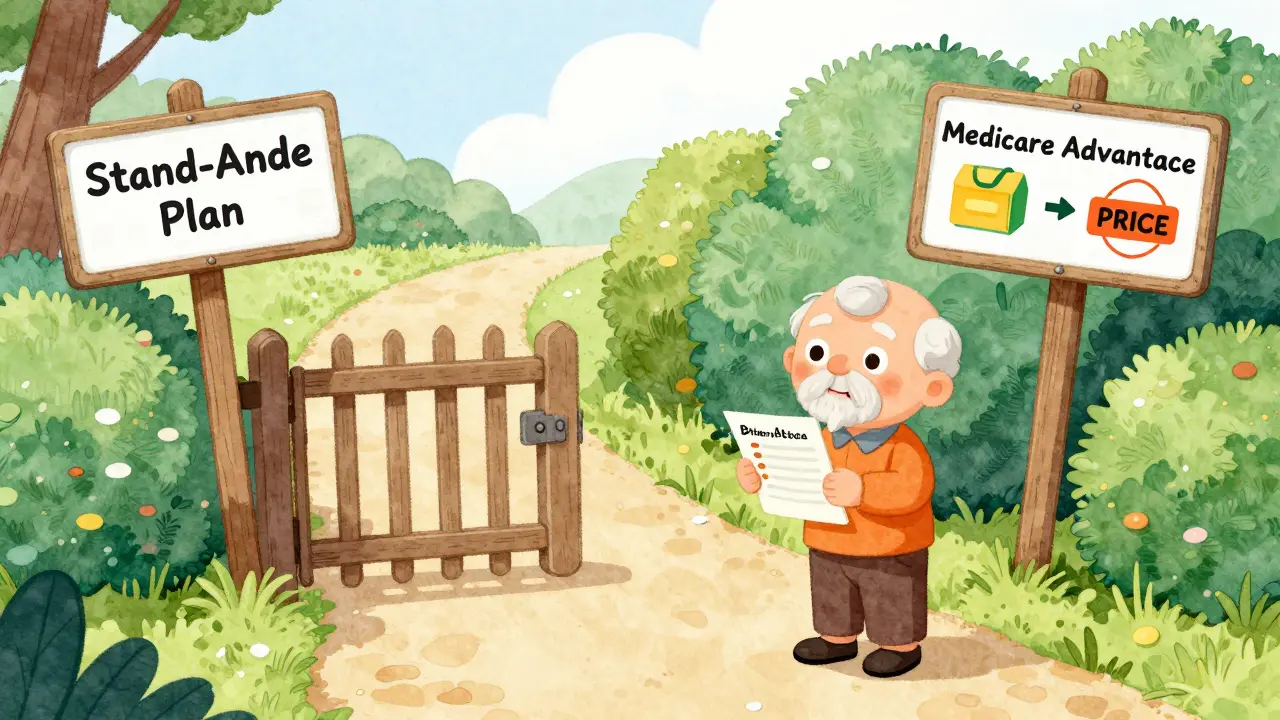
- Stand-Alone Prescription Drug Plans (PDPs): These work alongside Original Medicare (Parts A and B). In 2025, the average premium for these was around $45 per month. They offer flexibility if you prefer to manage your medical care separately from your drug coverage.
- Medicare Advantage Drug Plans (MA-PDs): These bundle hospital, medical, and drug coverage into one plan. The average premium here was significantly lower, often around $7 per month or even $0. However, these plans usually have stricter networks of doctors and pharmacies.
If you have low income, you might qualify for the "Extra Help" program (Low-Income Subsidy). If you do, you could access benchmark plans with $0 premiums and reduced cost-sharing for your medications. It is worth checking your eligibility annually, as your financial situation might change.
The Formulary Trap: Why Plan Choice Matters
Here is the catch: not all plans cover all drugs equally. Every Part D plan has a formulary, which is simply a list of covered medications. Even though the law requires plans to cover at least two drugs in every major class, the specific brand or generic you take might not be on the list-or it might be placed in a high-cost tier.
Plans organize drugs into tiers:
- Tier 1: Preferred generics (lowest cost).
- Tier 2: Non-preferred generics.
- Tier 3: Preferred brands.
- Tier 4: Non-preferred brands.
- Tier 5: Specialty drugs (highest cost).
If your essential blood pressure medication is Tier 1 in Plan A but Tier 4 in Plan B, your annual costs could differ by hundreds of dollars, even if the premiums look similar. Always check if your specific medications are covered before signing up.

Special Rules for Insulin
If you manage diabetes, there is a bright spot in the current landscape. Thanks to federal mandates, the out-of-pocket cost for most insulin products is capped at $35 per month. This applies regardless of which phase of coverage you are in. Make sure your plan includes your specific type of insulin on its formulary to ensure this cap applies seamlessly.
Avoiding Penalties and Making Smart Moves
One common mistake is skipping Part D because you don’t take any meds right now. Be careful. If you go without creditable drug coverage (coverage that is at least as good as Part D) when you first become eligible, you may face a late enrollment penalty. This penalty is calculated as 1% of the national base beneficiary premium for every month you delayed. That fee gets added to your monthly premium for as long as you have Part D coverage.
To avoid surprises, use the Medicare Plan Finder tool on Medicare.gov during the Annual Enrollment Period (October 15 to December 7). Enter your exact medications, dosages, and preferred pharmacies. The tool will show you side-by-side comparisons of total estimated annual costs, not just monthly premiums.
Is the $2,000 out-of-pocket cap the same for everyone?
The $2,000 cap (which rises to approximately $2,100 in 2026) applies to all standard Part D enrollees. However, those who qualify for Extra Help (Low-Income Subsidy) have much lower out-of-pocket costs throughout the year and reach catastrophic coverage almost immediately, effectively paying little to nothing after a small deductible.
Do I need Part D if I have Medicare Advantage?
Most Medicare Advantage plans include Part D drug coverage automatically. Check your plan documents; if it says "MA-PD," it includes drugs. If it is just "MA," it does not, and you would need to buy a separate stand-alone Part D plan.
When should I switch my Part D plan?
You can switch plans during the Annual Enrollment Period from October 15 to December 7 each year. Changes made then take effect on January 1. You may also qualify for a Special Enrollment Period if you move, lose other coverage, or join a Medicare Advantage plan for the first time.
Why are my drug costs higher in some months?
Costs vary based on the tier of your medication and whether you are in the deductible or initial coverage phase. Additionally, manufacturer discounts and plan rebates fluctuate. Using the Plan Finder tool with your specific med list helps predict these variations better than looking at averages.
Does the out-of-pocket cap include my monthly premium?
No. The out-of-pocket cap ($2,000 in 2025, ~$2,100 in 2026) only counts toward deductibles, copayments, and coinsurance for drugs. Your monthly premium is paid separately and does not count toward this limit.
8 Comments
Hi everyone! I just read through this guide and wanted to share a quick tip. If you're feeling overwhelmed by the new phases, remember that Phase 3 is basically your safety net. Once you hit that ~$2,100 out-of-pocket mark in 2026, you pay $0 for the rest of the year. It's a huge relief compared to the old donut hole days. Don't forget to check if your specific meds are on the formulary though, because tiers can really change your costs. You've got this!
Good system. Finally makes sense. No more guessing games with the donut hole. Keep your premiums low. Check your drugs. Done.
the article says the cap is around 2100 but doesnt mention if premiums count towards it. they dont. its a common mistake people make. also insulin is capped at 35 which is good. just use the plan finder tool. it shows total annual cost not just monthly. saves money.
It is fascinating how the landscape has shifted from a confusing maze to something resembling a structured pathway. The elimination of the 'donut hole' feels like removing a heavy fog that obscured our financial horizon. However, we must remain vigilant about the 'Formulary Trap.' Just as a gardener must choose the right soil for each plant, we must ensure our medications align with the preferred tiers of our chosen plans. A Tier 1 drug in one plan might be a costly Tier 4 in another, turning potential savings into unexpected burdens. Let us approach this with both optimism and careful scrutiny.
Hey there! Reading this from South Africa, and it sounds like things are getting much clearer over there. The idea of having a hard cap on spending is really reassuring. It reminds me of how important it is to have predictable healthcare costs. I hope everyone takes advantage of the Medicare Plan Finder tool during enrollment. It’s great to see systems evolving to protect seniors better. Stay well!
so yeah the new rules are kinda nice. no more scary gap. but u gotta watch out for the premiums. if u have extra help u might get 0 premium plans. thats pretty cool. just make sure u check eligibility every year cause stuff changes. dont skip part d or u get fined. simple as that lol
It is imperative that beneficiaries understand the distinction between Stand-Alone PDPs and MA-PDs. While MA-PDs often boast lower average premiums, approximately $7 per month compared to $45 for PDPs, they impose stricter network limitations. One must weigh the financial benefit against the flexibility of provider choice. Furthermore, failing to secure creditable coverage upon initial eligibility incurs a late enrollment penalty calculated at 1% of the national base beneficiary premium per month delayed. This fee persists for the duration of Part D coverage. Prudence dictates utilizing the Annual Enrollment Period (October 15–December 7) to compare total estimated annual costs via the Medicare Plan Finder.
Greetings from India! As a cultural ambassador of sorts, I appreciate the clarity this guide brings to the complex lexicon of US healthcare policy. The transition from a four-phase to a three-phase model significantly reduces cognitive load for enrollees. Specifically, the catastrophic coverage phase acting as a fiscal firewall is a robust mechanism. For those managing chronic conditions like diabetes, the $35 insulin cap represents a critical value proposition. I encourage all stakeholders to leverage the digital tools provided by Medicare.gov to optimize their benefit architecture. Knowledge is indeed power in navigating these systemic frameworks.