

Hyperthyroidism & Stimulant Risk Checker
This tool evaluates your risk of dangerous heart and anxiety reactions when taking stimulant medications with hyperthyroidism. Always consult your doctor before changing medications.
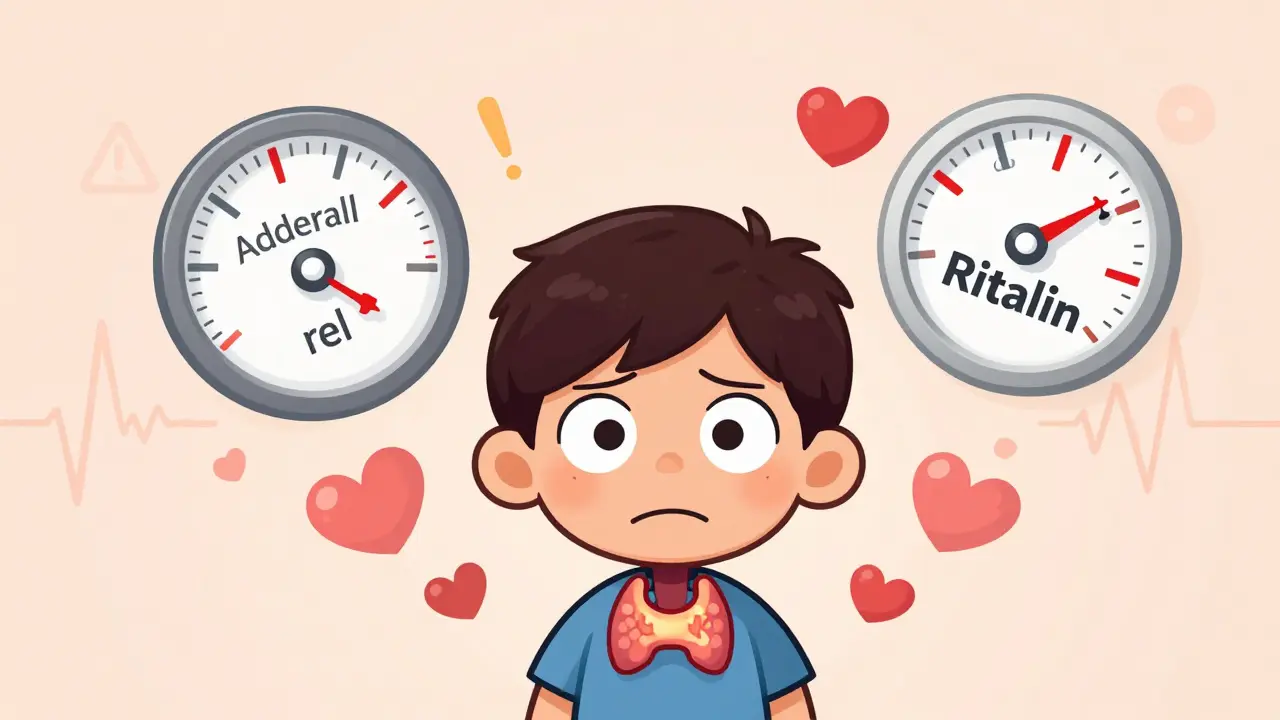
When you have hyperthyroidism, your body is already running on high. Your heart beats faster, your nerves are on edge, and even simple tasks can leave you drained. Now imagine adding a stimulant medication like Adderall or Ritalin into the mix. What seems like a quick fix for focus or fatigue can turn into a medical emergency. This isn’t hypothetical - it’s happening to people right now, often because the connection between thyroid function and stimulant drugs isn’t widely understood.
Why Hyperthyroidism Makes Stimulants Dangerous
Hyperthyroidism means your thyroid gland is pumping out too much T3 and T4 hormone. These hormones control your metabolism - how fast your body uses energy. When levels are too high, your heart rate spikes, your blood pressure climbs, and your nervous system goes into overdrive. That’s why people with untreated hyperthyroidism often feel jittery, anxious, or like their heart is pounding out of their chest. Stimulant medications like Adderall and methylphenidate do something similar. They flood your brain with dopamine and norepinephrine, which speeds up your heart, raises your blood pressure, and triggers alertness. On its own, Adderall can increase heart rate by 5-10 beats per minute in healthy people. But when your thyroid is already overactive, that same dose can push your heart rate from 80 bpm to 140 bpm - fast enough to trigger palpitations, dizziness, or even fainting. A 2021 study in the Journal of Clinical Endocrinology & Metabolism found that hyperthyroidism increases your body’s sensitivity to adrenaline-like chemicals by 30-40%. That means stimulants hit harder and faster. The result? A dangerous synergy. Your heart doesn’t just work harder - it’s being forced to race under conditions it wasn’t designed for.The Real Risk: Atrial Fibrillation and Heart Attacks
The biggest danger isn’t just feeling anxious or having a fast heartbeat. It’s what happens when that stress becomes chronic. According to the American Heart Association, people with hyperthyroidism who take stimulants have a 3.2-fold higher risk of developing atrial fibrillation - an irregular, often rapid heart rhythm that can lead to stroke or heart failure. Adderall, which contains both dextroamphetamine and levoamphetamine, is especially risky. At doses above 30mg per day, it increases the chance of ventricular tachycardia - a life-threatening heart rhythm - by 4.7 times in hyperthyroid patients, according to the American College of Cardiology. Even lower doses can be dangerous if your thyroid isn’t controlled. One patient on Reddit described taking Adderall with undiagnosed hyperthyroidism: “My heart was racing at 140 bpm nonstop. I ended up in the ER.” That’s not rare. A Drugs.com survey of 1,842 hyperthyroid patients on Adderall found that 68% reported worsened symptoms - mostly heart palpitations, chest tightness, or panic attacks within minutes of dosing.Anxiety Doesn’t Just Get Worse - It Explodes
Anxiety is a core symptom of hyperthyroidism. But stimulants don’t just add to it - they magnify it. Thyroid UK’s 2023 data shows that 78% of hyperthyroid patients on stimulants report severe anxiety, compared to just 22% of those not taking them. Why? Because stimulants activate the same brain pathways that thyroid hormones overstimulate. The result? Racing thoughts, panic attacks, trembling hands, and a constant sense of impending doom. Many patients mistake this for “just ADHD” or “stress,” not realizing their thyroid is the root cause. Dr. Angela Leung from UCLA found that stimulants can even lower thyroxine (T4) levels in children, making thyroid management harder. And in adults, the anxiety doesn’t fade after the drug wears off - it lingers, because the underlying hormonal imbalance remains untreated.
Not All Stimulants Are the Same - But Most Are Still Risky
Some people think switching from Adderall to Ritalin (methylphenidate) is safer. It’s a bit better - but not safe. Methylphenidate still raises blood pressure by 10-15 mmHg in hyperthyroid patients, enough to push some into hypertensive crisis (over 140/90). It also increases heart rate, just less dramatically than Adderall. Vyvanse (lisdexamfetamine) has a slower release, which may reduce peak heart rate spikes by 15-20%. But it’s still an amphetamine. The Endocrine Society’s 2022 guidelines state that Adderall is contraindicated in all hyperthyroid patients. Vyvanse isn’t explicitly banned, but it’s still not recommended unless thyroid levels are perfectly controlled - and even then, only under close monitoring. The real alternative? Non-stimulants like atomoxetine (Strattera). Unlike stimulants, it doesn’t trigger adrenaline surges. It raises heart rate by only 2-3 bpm, regardless of thyroid status. For someone with hyperthyroidism, that’s the difference between manageable and life-threatening.Doctors Are Missing the Diagnosis - And It’s Costing Lives
Here’s the scary part: many people with hyperthyroidism are first misdiagnosed with ADHD. Symptoms like restlessness, poor focus, irritability, weight loss, and trouble sleeping look identical. The Endocrine Society reports that 15-20% of adults with undiagnosed hyperthyroidism are initially told they have ADHD. Paloma Health’s 2022 survey found that 41% of patients diagnosed with ADHD had undiagnosed thyroid problems. After treating their thyroid, 33% no longer needed stimulants at all. Their focus improved. Their anxiety dropped. Their heart rate normalized. The American Thyroid Association now says: “Ruling out thyroid problems before diagnosing ADHD is crucial.” Yet only 27% of psychiatrists routinely order thyroid tests before prescribing stimulants - up from 12% in 2018, but still far too low.
What You Need to Do: A Practical Checklist
If you have hyperthyroidism - or think you might - here’s what to do before even thinking about stimulants:- Get your thyroid tested - TSH, free T4, and free T3. Don’t rely on TSH alone. Normal TSH doesn’t rule out subclinical hyperthyroidism (TSH 0.1-0.4 mIU/L).
- Ask for a baseline ECG and 24-hour Holter monitor - Especially if you’ve had heart palpitations, dizziness, or chest discomfort.
- Don’t start stimulants unless your thyroid is stable - That means TSH between 0.5 and 2.5 mIU/L for at least 3 months after medication adjustment.
- If you’re already on stimulants - Tell your endocrinologist. Get a thyroid panel immediately. Stop the stimulant if your heart rate exceeds 110 bpm at rest or if anxiety doesn’t fade within 2 hours of dosing.
- Consider Strattera or other non-stimulants - They work for ADHD without the cardiac risk.
- Separate thyroid meds from calcium or iron supplements - Take levothyroxine on an empty stomach, 4 hours away from iron, calcium, or antacids. Otherwise, your thyroid meds won’t absorb.
What Happens If You Ignore This?
Ignoring the link between hyperthyroidism and stimulants isn’t just risky - it’s dangerous. People end up in emergency rooms with heart rhythms they can’t control. Others suffer long-term damage: atrial fibrillation that won’t go away, chronic anxiety disorders, or even heart muscle weakness from years of overwork. And it’s avoidable. Simple blood tests, a little patience, and a switch to safer medications can change everything. You don’t need to suffer. You don’t need to risk your heart. You just need to know the facts.Thyroid disease affects 1 in 8 Americans. ADHD affects 1 in 23 adults. The overlap is real. The danger is real. But the solution? It’s simple: test before you treat. Always.
Can I take Adderall if I have hyperthyroidism?
No. Adderall is contraindicated in patients with hyperthyroidism according to the Endocrine Society and FDA guidelines. It can dangerously increase heart rate, blood pressure, and anxiety, raising the risk of atrial fibrillation, heart attack, or stroke. Even low doses are risky if thyroid levels aren’t perfectly controlled.
Can methylphenidate (Ritalin) be safer than Adderall with hyperthyroidism?
Methylphenidate carries less cardiac risk than Adderall, but it’s still not safe for most people with hyperthyroidism. It can raise blood pressure by 10-15 mmHg and increase heart rate significantly. Only in rare cases - with mild subclinical hyperthyroidism and strict monitoring - might low-dose methylphenidate be considered. Never start without thyroid testing and cardiac evaluation.
What are the signs I’m having a bad reaction to stimulants with hyperthyroidism?
Watch for: heart rate over 110 bpm at rest, chest pain or pressure, dizziness or fainting, panic attacks that don’t fade after 2 hours, severe trembling, or trouble breathing. These are red flags. Stop the medication and seek medical help immediately.
Can treating my thyroid fix ADHD-like symptoms?
Yes. Many people with undiagnosed hyperthyroidism are misdiagnosed with ADHD. Once thyroid levels are normalized with medication like levothyroxine, symptoms like poor focus, restlessness, and anxiety often improve dramatically - without stimulants. Studies show 33% of patients no longer need ADHD meds after treating their thyroid.
Should I get thyroid tested before starting any ADHD medication?
Absolutely. The American Thyroid Association and American Academy of Pediatrics now recommend thyroid testing before starting stimulants, especially if you have unexplained weight loss, rapid heartbeat, anxiety, or tremors. Many doctors still skip this step - so insist on it. A simple TSH blood test can prevent serious harm.
9 Comments
OMG I CANNOT BELIEVE THIS ISN’T COMMON KNOWLEDGE 😭 I was on Adderall for 3 years thinking I had ADHD, then found out I had silent hyperthyroidism. My heart was doing the cha-cha at 130 bpm while I tried to ‘focus’ on spreadsheets. My doctor just shrugged and said ‘maybe you’re just anxious.’ NO, I WASN’T ANXIOUS-I WAS A HUMAN JITTERBUG WITH A THYROID THAT THOUGHT IT WAS A RACECAR ENGINE 🚗💨 Now I’m on Strattera and actually sleeping. Why do we let Big Pharma push stimulants like candy?!
These western doctors are so careless. In India, we know thyroid is serious. We don’t just give pills to fix symptoms. We fix the root. Why do Americans take pills for everything? Even your heart is not safe. This is why your health system is broken. I saw a man die from this in Delhi hospital. He was on Adderall for ‘focus’ and died of heart attack. No test. No care. Just pills.
There’s a beautiful, terrifying symmetry here: our culture treats the mind as a machine that needs tuning, while ignoring the biological orchestra it’s embedded in. The thyroid isn’t just a gland-it’s the metronome of your entire physiology. Stimulants are like slamming a drumstick into a symphony that’s already playing at 120 BPM. You don’t get ‘more focus’-you get a cardiac meltdown. The real tragedy isn’t the lack of awareness-it’s that we’ve normalized self-optimization over self-preservation. We’re not fixing ADHD. We’re medicating evolution’s misfires.
Just to clarify based on the study cited: the 30-40% increased sensitivity to adrenaline-like chemicals in hyperthyroid patients refers specifically to catecholamine receptor upregulation in cardiac and neural tissues, not a generalized metabolic hypersensitivity. Also, the 68% of patients reporting worsened symptoms on Drugs.com was a self-reported survey-no objective cardiac monitoring was done. Still, the clinical correlation is strong enough to warrant caution. I’d add that subclinical hyperthyroidism (TSH 0.1–0.4) can be especially insidious because patients feel ‘fine’ until their heart rate hits 120 during a Zoom call.
Y’all need to chill and listen. I’m a nurse who’s seen this play out 12 times. One kid, 19, on Vyvanse, thyroid undiagnosed-ended up in ICU with atrial fibrillation. His mom thought he was just ‘high-energy.’ But here’s the good news: once we treated his thyroid, he didn’t need ANY stimulant. His focus got better. His anxiety vanished. He started running marathons. It’s not magic-it’s biology. Get tested. Talk to your endo. Don’t let fear or stigma keep you from the real fix. You don’t need to be a superhero. Just be informed. 💪🩺
So what? People die from caffeine too. This is just fearmongering. You think doctors are stupid? They know what they're doing. If you can't handle Adderall, maybe you shouldn't take it. Also, thyroid is overdiagnosed. Stop blaming your laziness on hormones.
Let me tell you about my cousin. He’s a grad student in Chicago. Took Adderall for ‘productivity.’ Thought he was just ‘a high-strung genius.’ Three months in, he started having night sweats, shaking like a leaf, and crying during Netflix documentaries. He went to his PCP, who said ‘maybe you’re depressed.’ He went to a therapist, who said ‘you’re just stressed.’ He finally saw an endocrinologist after his pulse hit 148 during a yoga class (yes, really). TSH was 0.02. Free T4 was through the roof. They put him on methimazole. Within 6 weeks, he was reading books again-not because of drugs, but because his brain wasn’t on fire. He said: ‘I didn’t need focus. I needed to stop burning alive.’
My brother had this exact issue. He was on Ritalin for ADHD. Then he lost 20 lbs in 3 months, couldn’t sleep, and kept saying his chest felt tight. We took him to a doc who finally checked his thyroid. Turned out he had Graves’. After treatment, he stopped the meds and now uses a planner and walks every morning. No drugs. No panic. Just peace. Sometimes the answer isn’t more chemicals-it’s listening to your body. Simple, right?
YALL ARE ALL BEING MANIPULATED BY THE PHARMA INDUSTRY 😤 THEY WANT YOU TO THINK THYROID IS THE PROBLEM SO YOU’LL STAY ON MEDS FOREVER. I’VE BEEN ON ADDERALL FOR 8 YEARS AND MY THYROID IS FINE. THEY JUST WANT YOU TO BE DEPENDENT. ALSO I THINK 5G CAUSES THYROID ISSUES. CHECK THE CDC SITE IT’S PROVEN. 😡