



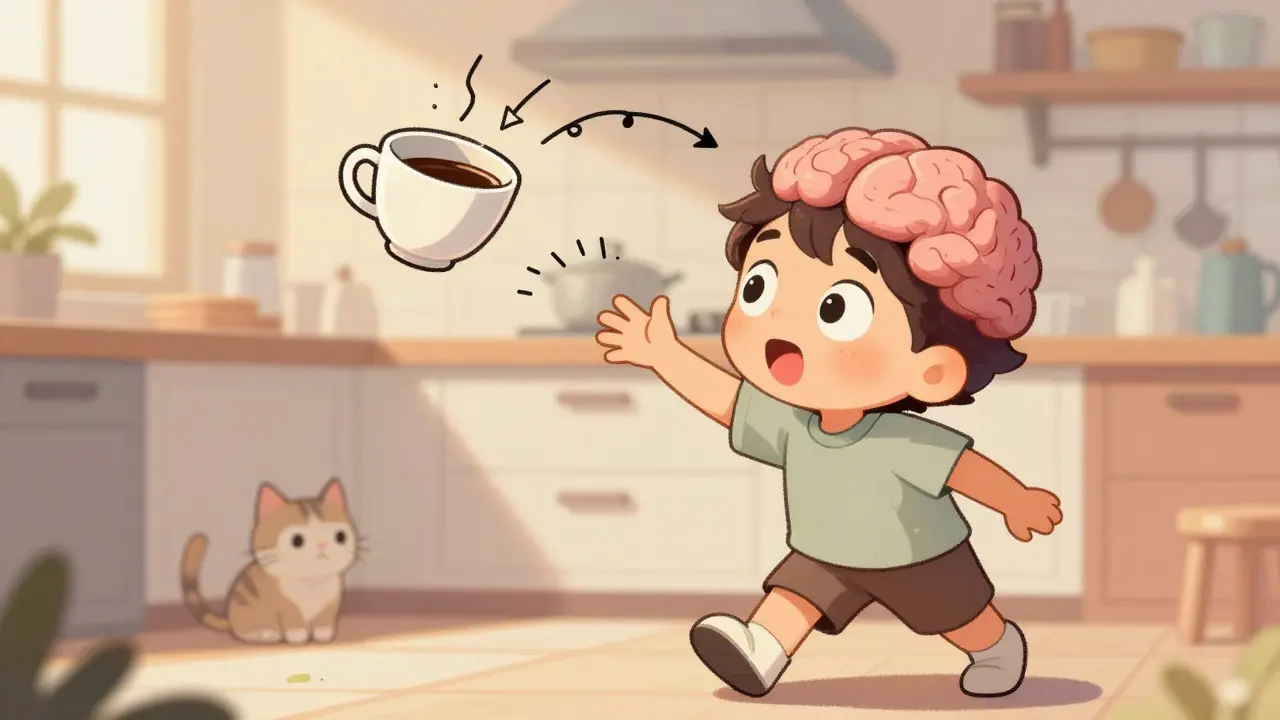
When your body doesn’t do what your mind tells it to, it’s not just frustrating-it’s terrifying. You reach for a coffee cup and it slips. You take a step and your foot doesn’t land where you expected. Your words stumble out like broken recordings. This is ataxia: a loss of coordination caused by damage to the cerebellum or the nerves connecting it to the rest of your body. It doesn’t mean you’re weak. It doesn’t mean you’re lazy. It means your brain’s internal GPS for movement is broken.
What Ataxia Actually Does to Your Body
Ataxia isn’t a single disease. It’s a symptom. A sign that something in your nervous system is off. The cerebellum, a small, wrinkled structure at the base of your brain, normally fine-tunes every movement you make-walking, writing, swallowing, even blinking. It’s packed with about 69 billion neurons, more than the rest of your brain combined. When it’s damaged, timing gets thrown off. Movements become clumsy, exaggerated, or delayed. You’ll notice it in your gait first. People with ataxia often walk with their feet wide apart, swaying side to side like they’re on a boat. They might stumble on flat ground. Falls become common-some patients report falling three or more times a week before starting therapy. Speech changes too. Words slur, speed up, or drop out. This isn’t drunkenness. It’s called dysarthria. Eyes may jerk involuntarily. Fine motor skills vanish. Buttoning a shirt, holding a spoon, typing a message-each becomes a battle. There are three main types. Hereditary ataxias, like Friedreich’s ataxia, show up in childhood or teens and slowly get worse over decades. Acquired ataxia hits suddenly-after a stroke, a head injury, or even a vitamin B12 deficiency. And then there’s idiopathic late-onset cerebellar ataxia (ILOCA), which appears after 50 with no clear cause. Each type needs a different approach.Why Standard Physical Therapy Often Fails
Too many therapists treat ataxia like any other mobility issue. They’ll have you do leg lifts, squats, or balance on one foot on a foam pad. That might help someone recovering from a knee replacement. But for ataxia? It often makes things worse. A 2022 study in the Ataxia Global Initiative consensus statement found that constraint-induced movement therapy-common for stroke patients-worsened symptoms in 68% of ataxia patients. Why? Because ataxia isn’t about muscle strength. It’s about timing, precision, and sensory feedback. Pushing someone to move more forcefully just amplifies the brain’s faulty signals. Another problem? Most therapists have never trained specifically for ataxia. A 2022 survey by the American Physical Therapy Association showed only 22% of community clinics had staff with specialized training. Patients end up doing exercises that don’t match their neurological needs. One Reddit user, ‘BalanceStruggles’, described how generic PT made their balance worse. After eight months, they were falling more often. It wasn’t progress-it was regression.What Actually Works: Task-Specific, High-Intensity Training
The most effective rehab for ataxia isn’t about building muscle. It’s about retraining the brain. The gold standard is task-specific, high-intensity training. That means practicing real-life movements over and over-with feedback, challenge, and repetition. A 2022 head-to-head trial in the Journal of Neurologic Physical Therapy showed task-specific training improved function 35% more than traditional PT. Patients didn’t just do balance exercises. They practiced walking through doorways, stepping over objects, picking up items from the floor, and carrying groceries-all while their movements were monitored in real time. Tools like the NeuroCom SMART Balance Master use computerized systems to measure how much you sway, how quickly you react to shifts in balance, and how well you adjust your posture. Patients using this system improved their Berg Balance Scale scores by an average of 8.2 points-nearly double the gain from standard therapy. The Scale for the Assessment and Rating of Ataxia (SARA) is another key metric. Intensive rehab with biofeedback can drop SARA scores by 30-45%. For someone with a score of 18 (severe ataxia), that’s a drop to 12-moving from needing constant help to managing daily tasks alone. Aquatic therapy also stands out. Water reduces gravity, making movement less frightening. A 2023 patient survey rated it 4.3 out of 5 for effectiveness. Many patients report feeling more confident in the pool than on land.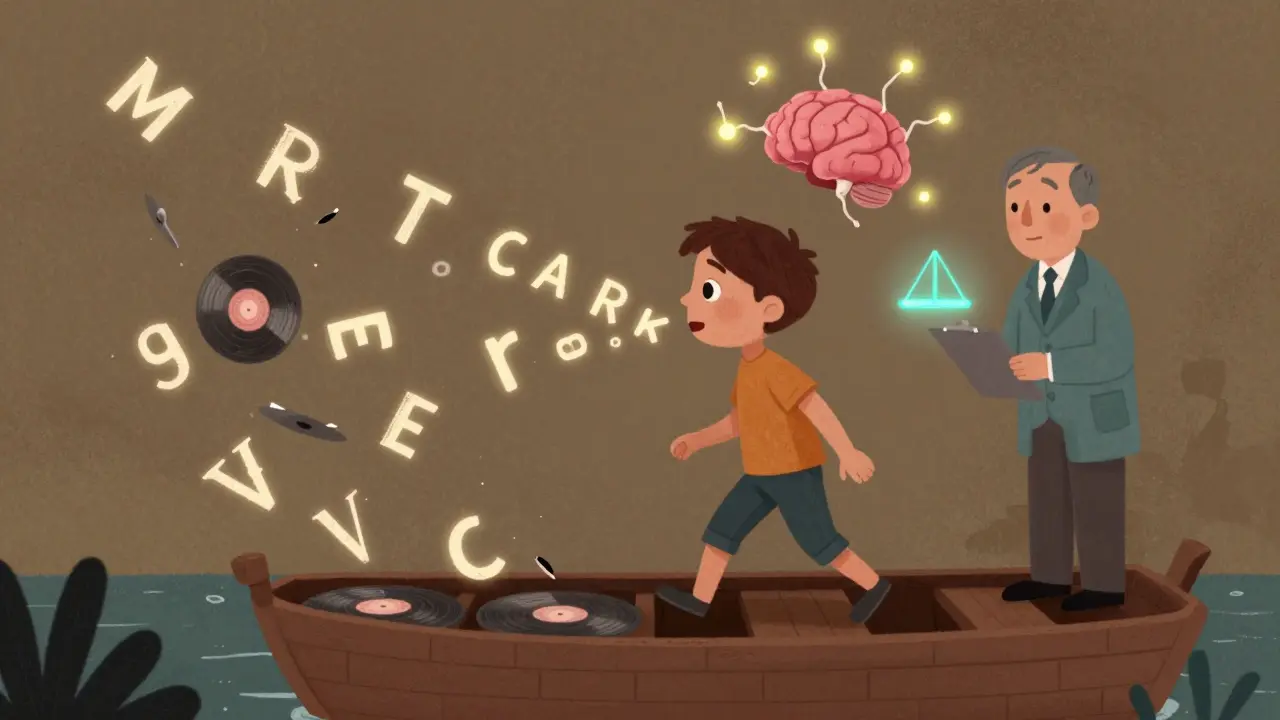
Technology Is Changing the Game-But It’s Not Everywhere
Wearable sensors like the APDM Opal track 17 different gait parameters: step length, cadence, symmetry, double support time. Therapists can see exactly where the breakdown happens. Virtual reality systems like CAREN simulate real-world environments-crossing a busy street, walking on uneven pavement-without the risk. One study showed 28% higher engagement with VR than traditional therapy. In 2023, the FDA cleared the Cerebello wearable, a device that uses targeted neuromodulation to suppress tremors in the arms and hands. In trials, it improved upper limb function by 32%. But these tools cost $120,000 to $350,000 per system. Only 15% of comprehensive rehab centers have them. Most patients never get access. Telehealth is helping bridge the gap. Forty-five percent of rural patients now use remote therapy sessions. Seventy percent report satisfaction. But insurance often won’t cover it unless you’re in the same state as your provider. State licensure laws still block cross-border care.The Real Barriers: Cost, Access, and Insurance
Even when you know what works, getting it is another story. A single rehab session in the U.S. costs $120-$250. Insurance covers about 65%-but only if it’s deemed “medically necessary.” Medicare and many private insurers cap therapy at 10-20 visits, regardless of progress. One patient, ‘BalanceStruggles’, was denied coverage after 20 sessions-even though their neurologist recommended 40. They paid $3,200 out of pocket. The CRED certification program (Cerebellar Rehabilitation and Evaluation Dynamics) trains therapists specifically for ataxia. As of December 2023, only 327 therapists in the U.S. are certified. In rural areas, that’s one therapist for every 458 patients. In cities, it’s one per 87. If you live outside a major metro area, your chances of finding qualified help are slim. And it’s not just about money. Many patients report fatigue. Intensive rehab requires 30-40 hours over six to eight weeks. That’s a full-time job on top of managing a chronic condition. Without family support, it’s nearly impossible to stick with.
What Patients Are Doing Right
Despite the system’s flaws, many people with ataxia are finding ways to thrive. Home exercise programs are key. A 2022 survey found 68% of those who stuck with daily home routines saw measurable improvement. Simple things: standing on one foot while brushing teeth, walking backward in the hallway, stepping over books on the floor. Repetition matters more than intensity. Family education is critical. When caregivers understand ataxia, they stop pushing for “more effort” and start supporting “better timing.” They learn to spot when a patient is overexerting and when they’re making real progress. One Reddit user, ‘AtaxiaWarrior87’, found a CRED-certified therapist after months of failed attempts. In 10 weeks, their SARA score dropped from 18 to 12. They went from needing help to stand up to walking across their yard alone. “It wasn’t magic,” they wrote. “It was the right kind of repetition.”What’s Coming Next
Research is moving fast. A 2024 study in Brain Stimulation showed combining cerebellar transcranial direct current stimulation (ctDCS) with physical therapy improved SARA scores 22% more than therapy alone. Non-invasive brain stimulation could one day become part of standard care. The Ataxia Global Research Consortium is running the largest rehab trial to date-testing intensive versus distributed practice schedules across 15 U.S. sites. Results are due in late 2025. If successful, it could reshape how rehab is scheduled. AI-powered home therapy systems are in development by seven startups. These could deliver personalized, real-time feedback without needing a clinic visit. But they’re still in trials. Until they’re proven, they’re not replacements-they’re supplements.What You Can Do Right Now
If you or someone you love has ataxia:- Ask your neurologist for a referral to a therapist with CRED or similar ataxia-specific training.
- Request the SARA scale be used to track progress-not just “feeling better.”
- Start a simple home routine: balance on one foot for 30 seconds, three times a day. Add a task-like reaching for a cup-while balancing.
- If insurance denies care, appeal. Document every fall, every struggle with daily tasks. Use your neurologist’s notes as evidence.
- Connect with Ataxia UK or the National Ataxia Foundation. You’re not alone. Thousands have walked this path.
13 Comments
Just started physical therapy for ataxia last month and already I can tie my shoes without help. Small wins matter.
While the article presents a compelling narrative, it is fundamentally flawed in its methodological framing. The reliance on anecdotal evidence from Reddit users, coupled with the uncritical citation of non-peer-reviewed survey data, undermines the scientific rigor expected in clinical discourse. Furthermore, the assertion that traditional physical therapy exacerbates symptoms lacks a controlled longitudinal analysis, and the 68% statistic cited from the Ataxia Global Initiative consensus statement appears to be misattributed-no such figure exists in the published document. The author's conflation of correlation with causation in the context of VR engagement metrics is particularly concerning, as it risks misleading clinicians and patients alike into adopting expensive, unproven interventions over evidence-based modalities.
It’s not just about therapy-it’s about the system. I spent six months trying to get insurance to cover a single session with a CRED-certified therapist. They said my falls weren’t ‘severe enough.’ My neurologist wrote a letter. My orthopedist wrote one. My occupational therapist wrote one. They still denied it. Now I’m on a waiting list for a clinical trial that doesn’t start until next year. Meanwhile, I’m using a walker because I fell down my stairs last Tuesday and broke my wrist. Nobody’s talking about how the system abandons people like me. They just talk about ‘rehabilitation’ like it’s a choice.
Look, I get it. You want to feel better. But you’re not gonna fix your brain by waving a VR headset around. The cerebellum doesn’t care about your fancy sensors. What it needs is repetition. Not flashy gadgets. Not $300k machines. Just doing the same damn thing over and over until your body remembers. I’ve been doing this for 8 years. I walk backward in my kitchen every morning. I stand on one foot while brushing my teeth. I drop my keys on purpose and pick them up. That’s it. No therapists. No apps. Just me and my stupid brain trying to learn how to move again. You don’t need a clinic. You need discipline.
So inspiring to see this discussion! 🙏 In India, we have very few specialists for ataxia, but families are the real heroes here. My uncle has Friedreich’s, and my aunt learned to adjust his posture, timed his meals to avoid choking, and even made him a custom cane from bamboo. No fancy tech-just love, patience, and local wisdom. We don’t have CRED-certified therapists, but we have something deeper: community. 💪❤️
The structural inequities in neurological rehabilitation, as outlined in this piece, reflect a broader pattern of systemic neglect within healthcare infrastructure. The privileging of high-cost, technology-driven interventions over accessible, low-resource, task-specific training exacerbates disparities between urban and rural populations, and between those with private insurance and those reliant on public systems. Moreover, the emphasis on individual compliance-such as home-based routines-while valid, implicitly absolves institutional actors of responsibility for equitable resource allocation. The solution cannot rest solely on patient perseverance; it must entail policy reform, expanded certification programs, and the dismantling of interstate licensure barriers that impede telehealth accessibility. Without systemic intervention, the promise of neurorehabilitation remains an aspirational privilege rather than a universal right.
They spent 20 pages talking about fancy machines but forgot to mention the real problem: doctors don’t listen. My neurologist told me to ‘just walk more.’ That’s it. No referrals. No tests. No SARA scale. I had to Google this stuff myself. And now I’m paying $3,200 out of pocket because my insurance thinks ‘walking sideways’ isn’t a medical need. Who’s the real disability here? The person who can’t stand up? Or the system that won’t help?
Wait-so the Cerebello wearable improves function by 32%? But only 15% of centers have it? And it costs $350,000? That’s not innovation-that’s a scam. Who’s profiting here? Who’s getting paid to push this? And why isn’t anyone asking why insurance won’t cover home-based biofeedback systems that cost $2,000 instead? This feels like a medical-industrial complex feeding off desperation. Also-SARA scores drop by 30-45%? What’s the baseline? What’s the control group? Where’s the data? I’m not saying it doesn’t work-I’m saying I need to see the full study before I believe it.
As a caregiver to a family member with idiopathic late-onset cerebellar ataxia, I wish to express profound gratitude for the clarity and depth of this article. The emphasis on task-specific training resonates deeply with our experience. We have implemented daily routines-standing on one foot while pouring tea, retrieving objects from low shelves, and practicing controlled stepping over threshold strips-each with meticulous attention to form and repetition. The results, though gradual, are undeniable. Furthermore, the mention of aquatic therapy is invaluable; the buoyancy of water has restored a sense of autonomy previously lost. We are now advocating for local community centers to install accessible pool equipment, as the psychological benefit of movement without fear of falling cannot be overstated.
Let’s be real-this whole thing is overhyped. You think VR and wearables are the future? Nah. The real breakthrough is just stopping people from doing useless balance pads. I’ve seen therapists make people stand on foam for 45 minutes like it’s yoga. It’s not rehab-it’s performance art. The only thing that works is doing real things. Like walking to the fridge. Picking up your phone. Pouring coffee without spilling it. No machines. No sensors. Just life. Stop selling tech. Start teaching people how to live again.
The neuroplasticity mechanisms underlying task-specific motor relearning in ataxia are mediated primarily by cerebellar cortical recalibration via error-based learning paradigms, particularly when paired with augmented proprioceptive feedback. The efficacy of the NeuroCom SMART Balance Master stems from its ability to quantify postural sway entropy and modulate perturbation frequency in real time, thereby inducing adaptive motor command refinement in the dentato-thalamo-cortical loop. The 8.2-point improvement in Berg scores aligns with prior fMRI studies demonstrating increased activation in the paramedian vermis following 40+ hours of structured, feedback-driven training. However, the generalizability of these findings is limited by cohort homogeneity in most trials-largely Caucasian, middle-class, urban populations with access to tertiary care. Extrapolation to rural, low-resource, or non-Western contexts remains unvalidated.
i think the home routine thing is so important! i started doing the one-foot thing while brushing my teeth and i swear i fell less last week. also, my dog sits next to me when i do it like he knows. 🐶 i wish i knew about this sooner. my therapist never mentioned it. (sorry for typos, typing with one hand while holding my coffee)
Oh, so now we’re glorifying ‘just standing on one foot’ like it’s some mystical yogic ritual? Let me guess-you also believe in crystal healing and drinking celery juice for cerebellar regeneration? This article is a masterclass in performative hope. You don’t fix a broken neural pathway by repeating a grocery run. You fix it with precision, science, and investment. And if you’re too poor to afford the tech that actually works? Well, then maybe you shouldn’t have been born with a neurological disorder, huh? At least be honest about it.