



Levodopa Protein Interaction Calculator
Your Profile
Results & Strategy
Enter your details and click calculate to see personalized recommendations based on current clinical guidelines.
Quick Reference Guide
Protein Redistribution Diet (PRD)
Shift 80-85% of daily protein to evening meals.
- Best for daytime mobility
- 60-100% response rate
- Maintains normal total intake
Low Protein Diet (LPD)
Restrict to 0.6-0.8g per kg body weight daily.
- Effective but hard to sustain
- 68% quit within 1 year
- Good for short-term crisis
Medication Timing
Take levodopa 30-60 minutes before meals.
- No dietary restrictions needed
- 30-65% variable success
- Requires strict adherence
Imagine swallowing your morning medication, waiting for that familiar lift in mobility, only to feel the stiffness creep back in an hour later. For many people with Parkinson’s disease is a progressive neurological disorder characterized by tremors, rigidity, and bradykinesia, this isn’t just bad luck-it’s biology at work. The culprit might be sitting right on your plate: protein.
If you take Levodopa is the gold-standard medication for treating Parkinson's symptoms by converting into dopamine in the brain, you’ve likely heard whispers about food interactions. But why does a steak or a bowl of chicken soup sometimes sabotage your meds? It comes down to a microscopic traffic jam at your blood-brain barrier. This article breaks down exactly how high-protein diets interfere with levodopa, why it happens, and-most importantly-how to eat well without losing control of your motor function.
The Science Behind the Traffic Jam
To understand why protein blocks levodopa, we need to look at how nutrients enter your brain. Both levodopa and certain dietary proteins travel using the same shuttle system. Specifically, they compete for the Large Neutral Amino Acid (LNAA) transporter is a carrier system in the gut and blood-brain barrier that transports essential amino acids like leucine, isoleucine, and valine. Think of this transporter as a single-lane bridge. If too many trucks carrying amino acids (from your dinner) are on the bridge, the bus carrying levodopa gets stuck in traffic.
This competition doesn’t just happen in your stomach; it’s critical at the Blood-Brain Barrier (BBB) is a selective semipermeable border that separates the circulating blood from the brain and extracellular fluid in the central nervous system. Research from the 1970s established that when plasma levels of LNAAs spike after eating, they outcompete levodopa for entry into the brain. The result? Less medication reaches the neurons that need it to produce dopamine. Studies show that consuming a high-protein meal can reduce levodopa absorption by 25-40% and delay its peak effect by up to 90 minutes. That’s the difference between moving smoothly and being frozen in place.
When Does Protein Become a Problem?
Here’s the good news: not everyone needs to worry about this immediately. In the early stages of Parkinson’s, your body usually handles the competition fine. However, as the disease progresses, so does the sensitivity to these interactions. Typically, patients start noticing issues around 8 years after starting levodopa therapy or 13 years after motor symptoms first appear.
You’re likely experiencing this interference if you notice "off" periods-times when your medication stops working effectively-shortly after eating meals rich in meat, dairy, eggs, or legumes. About 40-50% of long-term levodopa users face motor fluctuations directly linked to diet. If you find yourself shuffling more or trembling harder within an hour of lunch, protein competition is a strong suspect. The threshold seems to be roughly 10 grams of protein per meal; anything above that significantly impacts absorption, while loads over 20 grams can cause substantial reductions in drug bioavailability.
Three Dietary Strategies to Regain Control
You don’t have to give up all protein-that would lead to muscle wasting and weakness, which is dangerous for anyone with movement disorders. Instead, clinicians recommend three main approaches to manage this balance.
- Low Protein Diet (LPD): This involves restricting total daily protein to 0.6-0.8g per kilogram of body weight. For a 70kg person, that’s about 40-50g of protein a day. While effective, this is hard to sustain long-term because it limits food variety significantly.
- Protein Redistribution Diet (PRD): This is the most popular and clinically supported method. You keep your normal daily protein intake but shift when you eat it. You consume very low-protein foods during the day (when you need your medication to work best) and save the majority of your protein (80-85%) for the evening meal. Since many people are less active at night and may sleep through some dosing times, this minimizes the impact on daily mobility.
- Medication Timing: Some patients find success simply by taking their levodopa 30-60 minutes before any meal. This allows the drug to pass through the gut and reach the brain before the amino acid flood arrives. However, this requires strict adherence and may not work for those with slow gastric emptying.
Why Protein Redistribution Works Best
Among these options, the Protein Redistribution Diet (PRD) is a dietary strategy where protein intake is shifted to evening hours to minimize competition with levodopa during daytime activity has shown the most consistent results. A meta-analysis published in *Frontiers in Aging Neuroscience* found that PRD helped 60-100% of patients who experienced motor fluctuations. One study showed that patients on PRD reduced their daily "off" time by nearly two hours compared to those on a balanced diet.
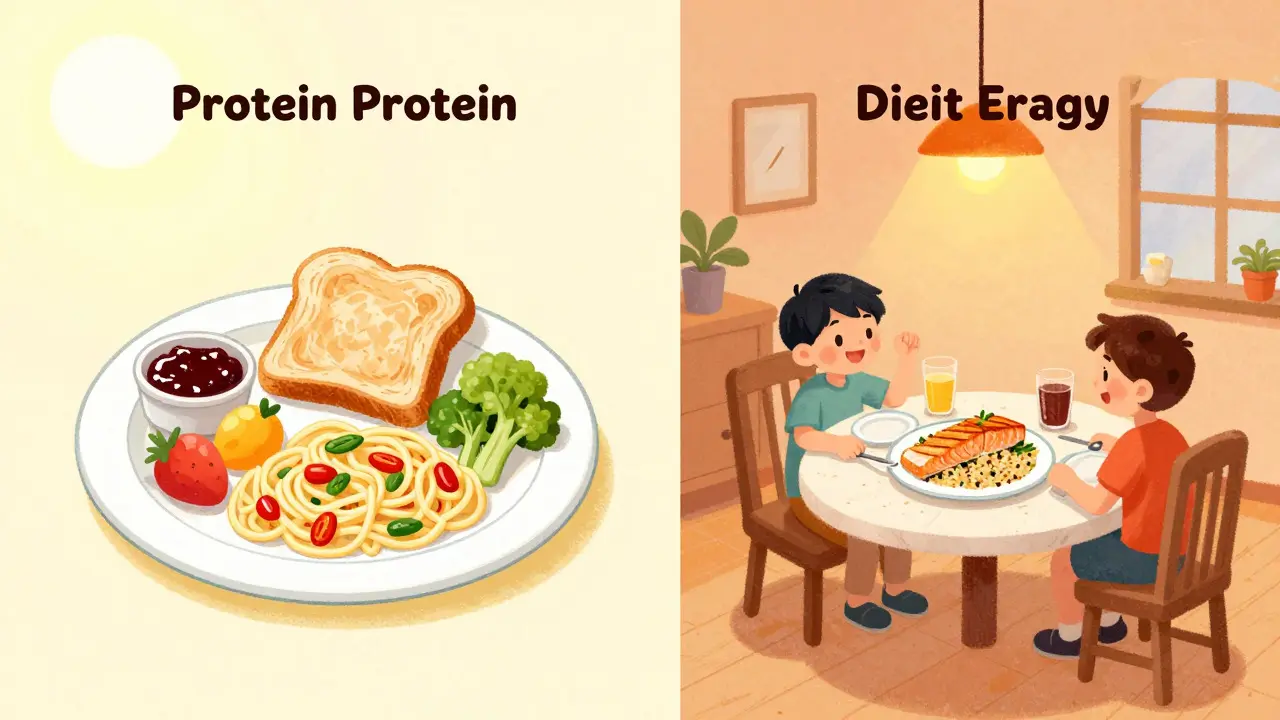
What makes PRD special is that it doesn’t require you to eat less overall. You still get enough protein to maintain muscle mass, but you time it strategically. For example, breakfast might consist of toast with jam and fruit (low protein), lunch could be pasta with olive oil and vegetables (low protein), and dinner features a generous portion of grilled salmon with quinoa (high protein). This approach correlates strongly with better outcomes in advanced stages of Parkinson’s (Hoehn & Yahr stages 3-4).
| Strategy | Daily Protein Limit | Efficacy Rate | Long-Term Adherence | Best For |
|---|---|---|---|---|
| Low Protein Diet (LPD) | 40-50g total | Moderate | Poor (68% quit within 1 year) | Short-term crisis management |
| Protein Redistribution (PRD) | Normal amount, timed | High (60-100% response) | Moderate (better with support) | Daytime mobility improvement |
| Medication Timing Only | No restriction | Variable (30-65%) | High | Mild fluctuations |
Navigating the Social and Practical Challenges
We know what works on paper, but life isn’t a lab experiment. The biggest hurdle isn’t the science; it’s the social isolation. Eating differently than everyone else at family dinners or business lunches can be lonely. Surveys indicate that 58% of patients struggle with maintaining relationships due to dietary restrictions. It’s common to feel left out when others order burgers and you’re settling for plain rice.
However, practical tips from the community can help. Many users report success with "protein holidays," where they allow themselves one high-protein meal in the evening. Others use specialized low-protein products-breads, pastas, and milks designed to have minimal protein content-to make daytime meals more satisfying. Tracking apps like MyFitnessPal are cited by nearly half of successful dieters to monitor hidden protein sources. Remember, consistency matters more than perfection. Even small adjustments, like swapping a turkey sandwich for a veggie wrap at lunch, can free up enough transporter capacity for your medication to work.

Safety First: Monitoring Nutrition and Weight
While managing motor control is vital, don’t sacrifice your general health. Strict protein restriction can lead to unintended weight loss and muscle weakness. If your BMI is under 20, talk to your doctor before starting any restriction. Long-term PRD users should monitor for deficiencies in vitamin B12 and iron, as cutting back on meat and dairy can lower these levels. Regular blood tests are wise.
Also, watch your weight. Losing more than 5% of body weight in six months is a red flag. If you’re struggling, consider working with a registered dietitian who specializes in neurological conditions. Professional guidance increases the chance of success by nearly double. They can help you create culturally tailored meal plans that respect your preferences while keeping protein levels in check during critical daytime hours.
Looking Ahead: New Horizons in Treatment
Science is evolving. Researchers are currently investigating "protein pacing," a method involving timed micro-doses of protein throughout the day to stabilize amino acid levels without overwhelming the transporters. Early trials show promise for improving both efficacy and quality of life. Additionally, new medications are being developed that bypass the LNAA transporter entirely, potentially eliminating this dietary headache altogether.
Until then, understanding the relationship between your plate and your pills is your most powerful tool. By recognizing the signs of protein interference and adopting a strategic diet like PRD, you can reclaim control over your movement and enjoy your days with greater confidence.
How much protein should I avoid when taking levodopa?
You don't necessarily need to avoid protein entirely, but you should limit it to under 7-10 grams per meal during the day. Meals exceeding 20 grams of protein can significantly block levodopa absorption. Focus on shifting higher protein intakes to your evening meal.
Does coffee or tea affect levodopa absorption?
Caffeine itself does not compete with levodopa for transporters. However, adding milk or cream adds protein and fat, which can slow digestion. Black coffee or tea is generally safe and may even enhance alertness, but always check with your doctor regarding individual tolerance.
Can I eat eggs with my levodopa?
Eggs contain about 6 grams of protein each. Eating one egg might be okay depending on your sensitivity, but two eggs could trigger competition. If you experience "off" periods after breakfast, try replacing eggs with fruit or toast for a few days to see if your mobility improves.
How long does it take to see results from a Protein Redistribution Diet?
Many patients notice improvements within a few days to a week. However, mastering the meal planning and adjusting to the new routine can take 2-3 months. Consistency is key; sporadic adherence will yield inconsistent results.
Are there supplements that help with protein competition?
Carbidopa-Levodopa combinations already include carbidopa to prevent peripheral conversion of levodopa, but they do not solve the transporter competition issue. There are no specific supplements approved to block this competition yet, though research into LNAA-blocking agents is ongoing. Always consult your neurologist before adding supplements.