
When a brand-name drug’s patent expires, it opens the door for cheaper generic versions to hit the market. But figuring out exactly when that happens isn’t as simple as checking a calendar. For pharmacists, generic drug manufacturers, and even patients waiting for lower-cost options, the FDA Orange Book is the go-to source for accurate patent expiration dates. It’s not just a list-it’s a legal roadmap that determines when generics can legally launch.
What the FDA Orange Book Actually Is
The FDA Orange Book, officially called Approved Drug Products with Therapeutic Equivalence Evaluations, has been around since 1985. It was created under the Hatch-Waxman Act to balance innovation and access. The law gave drug companies extra patent time to make up for delays in FDA approval, while also setting a clear path for generics to enter the market after those protections end. It’s not a marketing tool. It’s a regulatory database. Every approved small-molecule drug in the U.S. that has patents or exclusivity is listed here. That includes brand-name drugs like Brilinta, Lipitor, or Humira. Each entry shows the patent numbers, their expiration dates, and any regulatory exclusivity periods that delay generic competition. You won’t find this in a pharmacy brochure or on a drug package. You have to go directly to the FDA’s website to access it. And if you’re trying to time a generic launch or understand why a drug still has no competitors, this is where you start.How to Find Patent Expiration Dates in the Electronic Orange Book
The FDA stopped printing the Orange Book in 1999. Today, it’s all online. The current version, called the Electronic Orange Book, is updated daily. Here’s how to find what you need:- Go to https://www.accessdata.fda.gov/scripts/cder/ob/index.cfm (this link is for reference; no hyperlinks are allowed in final output).
- Search by the drug’s brand name, active ingredient, or application number. For example, if you’re looking up Brilinta, type in “ticagrelor,” the active ingredient.
- Click on the application number linked to the drug you’re researching.
- At the bottom of the drug’s page, click “View.” This opens the full patent and exclusivity listing.
- The patent number
- The expiration date in MMM DD, YYYY format (like July 9, 2021)
- A patent use code (like U-123), which tells you what specific medical use the patent covers
- Whether the patent owner requested to delist it (a red flag that the patent may be invalid or unenforceable)
Why Patent Expiration Dates Can Be Misleading
Don’t assume the date you see is the final word. There are three big reasons why: 1. Patent Term Extensions (PTE)If the FDA took too long to approve a drug, the patent holder can apply for extra time-up to five years-to make up for it. The Orange Book includes these extensions. But they’re not always obvious. A patent originally set to expire in 2020 might now show 2025 because of PTE. 2. Pediatric Exclusivity
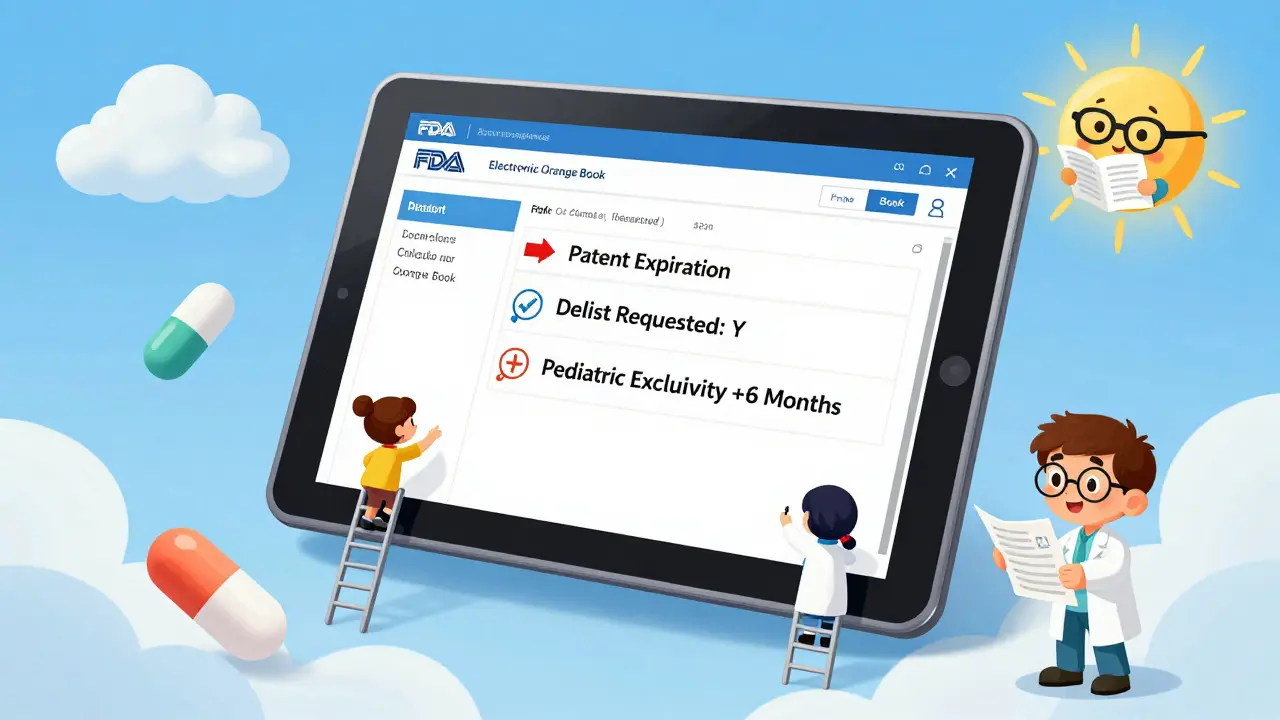
If a company does extra studies on how the drug works in children, they get a six-month bonus exclusivity period. This doesn’t create a new patent. Instead, it gets tacked onto every existing patent and exclusivity period for that drug. So you’ll see the same patent listed twice: once with the original date, and once with the six-month extension. Many people miss this and think there’s a new patent. 3. Early Patent Expirations Patents can die before their listed date. Why? Because patent owners have to pay maintenance fees every few years. If they don’t, the patent expires early. The FDA doesn’t update the Orange Book to reflect these early expirations. A 2023 study found that 46% of patents listed in the Orange Book had already expired early due to unpaid fees. That means the database shows a patent as active when it’s not. If you’re planning to launch a generic, you can’t rely on the Orange Book alone. You need to cross-check with the USPTO Patent Center database to see if maintenance fees were paid. Otherwise, you might wait for a patent that’s already dead.
How to Use the Data Files for Bulk Analysis
If you’re a manufacturer, researcher, or analyst working with dozens of drugs, the web interface won’t cut it. The FDA provides downloadable data files updated every day at https://www.fda.gov/drugs/drug-approval-applications-das/orange-book-data-files (this link is for reference; no hyperlinks are allowed in final output). These files are CSV or tab-delimited and include columns like:- Product No - The unique ID for each drug product
- Patent No - The actual patent number
- Patent Expiration - The date in MM/DD/YYYY format
- Drug Substance Flag - Shows if the patent covers the active ingredient (Y) or just the formulation (null)
- Delist Requested Flag - Y means the company asked to remove the patent (a major signal)
- Patent Use Code - The U-code that links to the specific medical use
What You Shouldn’t Trust
Third-party websites, patent databases, and even some pharmacy software often pull data from the Orange Book-but they don’t update daily. Some only refresh once a month. That’s dangerous. A patent could be delisted on Monday, and by Friday, you’re still seeing it as active on a slow-updating site. Also, don’t confuse exclusivity with patents. Exclusivity is a separate FDA protection that doesn’t come from a patent. It can delay generics even if all patents have expired. For example, a drug might have no active patents, but still be protected by three years of exclusivity because it was a new use. The Orange Book lists both, but they’re different.Why This Matters to Everyone
If you’re a patient, this affects your out-of-pocket costs. If you’re a pharmacist, it tells you when generics will be available to prescribe. For generic manufacturers, this data is the foundation of their business model. A single patent expiration can mean billions in revenue. In 2023, the FDA updated the Orange Book to improve transparency after the Orange Book Transparency Act of 2020. Filters were added, search became faster, and the “View All Patents” button now shows every patent linked to a drug-no more hidden listings. Still, the system isn’t perfect. The FDA admits it doesn’t retroactively correct old entries. That means older drugs might have outdated or incomplete data. Always check the most recent version. And if you’re making decisions based on this, verify with the USPTO and monitor for delisting requests. Those are the real signals that a patent is no longer a barrier.
Quick Reference: What to Look For
- Patent Expiration Date: The date the patent legally ends. Look for this first.
- Patent Use Code: Helps you know if the patent covers the drug’s use (not just its form).
- Delist Requested Flag: If it says “Y,” the patent owner may have given up on enforcement.
- Exclusivity Expiration: Separate from patents. Can block generics even if patents are gone.
- Drug Substance Flag: “Y” means the patent covers the active ingredient-this is the most important type.
Frequently Asked Questions
Is the FDA Orange Book free to use?
Yes. The Electronic Orange Book and all downloadable data files are completely free and publicly accessible through the FDA’s website. No subscription, login, or payment is required.
Do biologics like Humira show up in the Orange Book?
No. The Orange Book only covers small-molecule drugs-traditional pills and injections. Biologics, including Humira, Enbrel, and Humalog, are listed in a separate database called the Purple Book. If you’re looking for biologic patent info, you need to check the Purple Book instead.
Can a patent expire early even if the Orange Book says it’s still active?
Yes. Patents can expire early if the owner fails to pay required maintenance fees. The FDA doesn’t update the Orange Book to reflect this. Studies show nearly half of all patents listed in the Orange Book have already expired early. Always verify with the USPTO Patent Center to confirm current status.
Why does the same patent appear twice in the Orange Book?
That’s usually because of pediatric exclusivity. When a company completes pediatric studies, the FDA adds six months to all existing patent and exclusivity periods. The Orange Book shows the original date and the extended date as two separate entries. It’s not a new patent-it’s the same one with extra time.
How often is the Orange Book updated?
The web interface is updated daily. The downloadable data files are also refreshed every day, usually by 5:00 PM Eastern Time. If you’re using the files for analysis, always download the latest version before making decisions.
Next Steps
If you’re looking to predict when generics will enter the market:- Start with the FDA Orange Book for the official expiration dates.
- Check the USPTO Patent Center for maintenance fee payments-this tells you if the patent is still alive.
- Look for “Y” in the Delist Requested Flag. That’s often the first sign a company is stepping back.
- Don’t ignore exclusivity. Even with no patents, a drug might be protected for years.
15 Comments
The Orange Book is a game-changer for anyone working with generics. I’ve seen pharmacies miss launches because they trusted third-party sites that updated monthly. Daily FDA updates are non-negotiable. Always pull the latest CSV-your supply chain depends on it.
Also, never ignore the delist requested flag. If it says Y, that’s your green light. Companies don’t request delisting unless they’re already preparing for generic competition. It’s not a bug-it’s a signal.
So let me get this straight-we’re supposed to trust a government database that doesn’t even fix outdated entries? And you’re telling me to cross-check with USPTO? Yeah right. That’s like asking a cop to verify his own speeding ticket. The whole system’s rigged to keep prices high.
I work in a small pharmacy in Kerala, and I can tell you-this isn’t just about patents. It’s about access. Last year, a patient came in asking why her insulin wasn’t cheaper even though the patent ‘expired.’ We checked the Orange Book, then the Purple Book, then the USPTO, and turns out the exclusivity was still active. She cried. Not because of the cost, but because she thought the system was broken. It’s not broken. It’s designed this way. The real question is-who benefits? And why do we keep pretending it’s about health?
Wow. A government database that’s actually useful? Who knew? I guess if you take away all the corporate lobbying and patent trolling, maybe the FDA does something right once in a blue moon. Still, I’m not surprised 46% of patents are dead but still listed. Someone’s gotta pay those maintenance fees, right? Or is that just another tax on the poor?
Delist requested flag is the key. If it's Y, the patent is dead. No need to overcomplicate it. Check USPTO. Done.
Exclusivity is separate. Always. Don't mix them up.
Orange Book = bible. USPTO = truth. Third-party sites = lies. I’ve been in this game 15 years. If you’re not cross-checking, you’re just guessing. And guessing costs money. And patients.
It’s fascinating how we treat patents like sacred texts when they’re just legal constructs. A patent isn’t a moral right-it’s a temporary monopoly granted by society to incentivize innovation. But when we let maintenance fees go unpaid, or allow six-month extensions for pediatric studies, we’re not protecting innovation-we’re gaming the system. The real tragedy isn’t that generics can’t enter-it’s that we pretend this is about fairness when it’s really about profit margins.
Why do we even have this Orange Book? It’s just another way for Big Pharma to delay generics. The FDA’s too cozy with these companies. They don’t fix old entries because they don’t want you to know how many patents are already dead. You think this is transparency? It’s theater. And we’re all just watching the show.
Just dropped a spreadsheet I built from the daily CSV files-217 drugs with expirations in 2025. Filtered by drug substance flag = Y and delist requested = Y. Got 37 hits. 12 of them already had expired patents in USPTO. This is where real opportunity lies. If you’re not automating this, you’re leaving money on the table. 📊
Oh my GOD. I just spent 3 hours digging into this and I’m emotionally drained. I mean, imagine being a patient who can’t afford Brilinta because some corporate lawyer paid a $500 fee to keep a patent alive that was already dead? And then the FDA doesn’t update it? This isn’t healthcare-it’s a horror movie written by patent attorneys. I need a nap. And a therapist. And maybe a revolution.
Wait, so if a patent expires early because they didn’t pay the fee, but the Orange Book still shows it as active-then generics can’t launch? That’s insane. I thought this was supposed to be a public service. I’m just a nurse, but even I know this is messed up. Why aren’t people screaming about this?
Just used the Orange Book for the first time. Took me 10 minutes. Found a drug my clinic’s prescribing that’s gonna go generic next month. Saved us $20K this quarter. 🙌
The system works if you understand the rules. The Orange Book isn’t perfect, but it’s the only consistent source we have. The real issue is the lack of public education. Most pharmacists don’t know how to read the use codes. Most manufacturers don’t check delist flags. We’re not failing the database. We’re failing ourselves.
Who controls the FDA? Who funds the patent office? Who benefits when generics are delayed? I’ve seen the documents. The same lobbyists who wrote the Hatch-Waxman Act now sit on advisory boards. The Orange Book isn’t a tool-it’s a weapon. And they’re using it to kill competition. You think this is about health? It’s about control. And they’re winning.
As someone from India, I’ve seen how this affects global access. The U.S. system delays generics, but then those same drugs become affordable in India and get exported back. The Orange Book is a U.S. problem-but it’s a global consequence. If you’re a manufacturer trying to launch in the U.S., you’re playing chess with someone who’s also moving the board.