



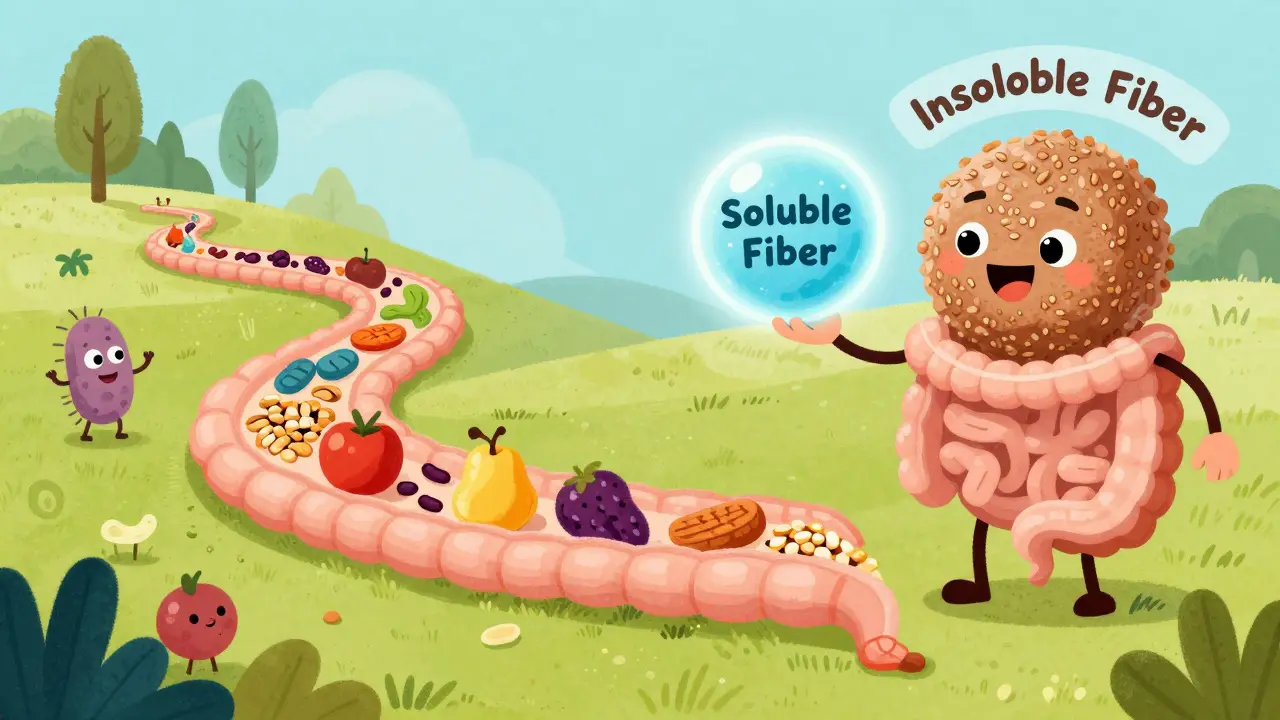
Most people know fiber is good for digestion, but few realize soluble and insoluble fiber do completely different jobs in your gut. One softens stools and calms IBS. The other pushes waste through fast and prevents diverticulosis. Mixing them up can make bloating worse - or fix it. If you’ve ever felt bloated after eating bran cereal or had diarrhea after a salad, it’s probably not the vegetables. It’s the type of fiber you’re eating - and how much you’re eating all at once.
What soluble fiber actually does in your gut
Soluble fiber doesn’t just add bulk. It turns into a gel when it hits water. Think of it like oatmeal thickening in your bowl. That gel slows digestion, which means sugar from your meal enters your bloodstream slowly. Studies show this can cut post-meal blood sugar spikes by 20-30%. That’s why people with type 2 diabetes often feel more stable after adding oats or beans to their breakfast. This gel also feeds the good bacteria in your colon. Those bacteria turn soluble fiber into short-chain fatty acids - especially butyrate - which is the main fuel for the cells lining your colon. A 2024 review in PMC found that this process doesn’t just keep your gut lining healthy; it also helps regulate your immune system and reduces inflammation. People who eat more soluble fiber report better mood and less brain fog, likely because of the gut-brain connection. Chia seeds, lentils, apples, and psyllium husk are top sources. One tablespoon of chia seeds soaked in water gives you over 5 grams of soluble fiber - more than a whole bowl of oatmeal.Insoluble fiber: the gut’s broom
Insoluble fiber doesn’t dissolve. It doesn’t turn to gel. It’s like roughage that sweeps things along. Think wheat bran, whole-wheat bread, or the skin of a kiwi. It grabs water as it moves through your intestines, swelling up to 2-3 times its size. That adds bulk to stool and speeds things up. Research shows it can reduce constipation by 30-50% by cutting transit time by a day or two. This is why doctors often recommend whole grains for people with chronic constipation. But here’s the catch: if you have Crohn’s disease or ulcerative colitis during a flare-up, insoluble fiber can irritate already inflamed tissue. Nuts, seeds, and raw veggies with tough skins might make symptoms worse. That’s why during flare-ups, many GI specialists recommend limiting insoluble fiber to 10-15 grams a day until things calm down.Why you need both - and how much
The Institute of Medicine says women under 50 need 25 grams of total fiber daily. Men need 38. But the average American eats only 15 grams. That’s half the target. And most of that comes from white bread and processed snacks - which have almost no fiber at all. The key isn’t just hitting your fiber number. It’s splitting it right. Most whole foods naturally contain both types. A cup of cooked lentils has about 2 grams of soluble fiber and 3 grams of insoluble. A medium apple has 1.4 grams soluble and 1.2 grams insoluble. The goal is balance. Experts like Dr. David Ludwig from Harvard say soluble fiber is king for metabolic health - lowering cholesterol by 5-10% when you eat 5-10 grams daily. But Dr. Robynne Chutkan reminds us that insoluble fiber cuts your risk of diverticular disease by 40% over time. The Mediterranean Diet gets it right. It’s not about supplements. It’s about eating a variety of plants: legumes, whole grains, fruits, vegetables, nuts, and seeds. That diet naturally delivers about 30-50 grams of fiber daily, with a 3:1 ratio of insoluble to soluble. That’s the sweet spot.
What happens if you go too fast
Jumping from 10 grams to 30 grams of fiber in a week is a recipe for bloating, gas, and cramps. A Mayo Clinic survey found 45% of people who increased fiber too quickly experienced these symptoms. The fix? Slow and steady. Add 5 grams of extra fiber per week. That’s one extra serving of beans, or a handful of almonds, or half an avocado. And don’t forget water. Every 25 grams of fiber needs at least 1.5 to 2 liters of water. Without enough fluid, insoluble fiber turns from a broom into a brick. Your stool hardens. Constipation gets worse. Drink water with meals. Keep a bottle nearby. It’s that simple.Who should be careful
If you have IBS, soluble fiber is your friend. Oats, bananas, and psyllium husk can calm both diarrhea and constipation. A Reddit thread from early 2023 with 147 IBS sufferers showed 68% felt better within two weeks of adding soluble fiber. But if you have active IBD - Crohn’s or ulcerative colitis - stick to low-residue foods during flares. Avoid raw veggies, nuts, and whole grains. Once you’re in remission, slowly reintroduce insoluble fiber. Diabetics benefit most from soluble fiber. It slows sugar absorption and improves insulin sensitivity by 10-15%. But even then, don’t rely on fiber supplements. A 2024 review in PMC says isolated fiber powders can’t match the benefits of whole foods. The other nutrients in fruits and legumes - antioxidants, polyphenols, vitamins - work together with fiber. Supplements miss the point.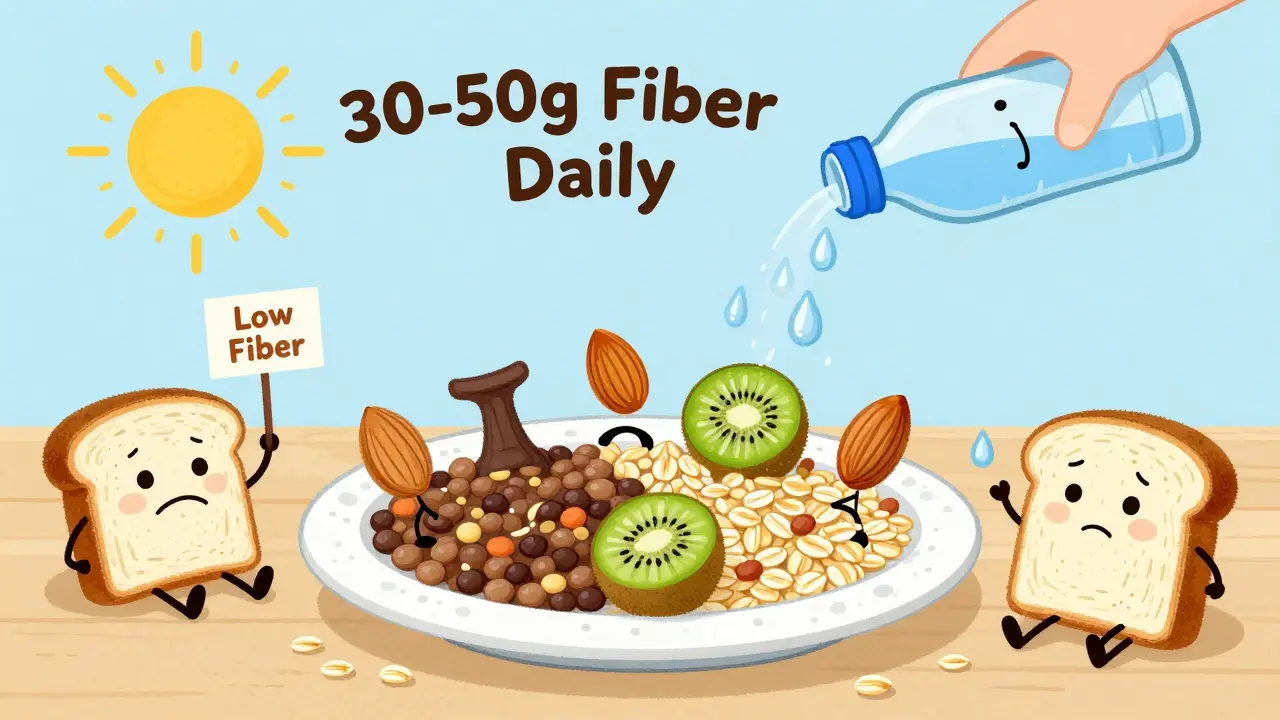
12 Comments
People still don’t get it. Fiber isn’t a magic bullet. It’s a tool. And if you’re chugging psyllium husk like it’s protein powder because some influencer said so, you’re just poisoning your microbiome with synthetic grit. Real food doesn’t come in a jar labeled ‘fiber supplement.’ It comes from a garden, a tree, or a field. Stop outsourcing your gut health to Big Pharma’s latest cash grab.
And yes, I’ve seen the studies. The ones that say soluble fiber reduces inflammation? They’re funded by oat conglomerates. The ones that say insoluble fiber prevents diverticulosis? They’re from the 1980s. Science evolves. Your gut doesn’t care about your supplement label.
Start with lentils. Not powders. Not gummies. Not chewables. Lentils. They’ve been feeding humans for 10,000 years. They don’t need a patent.
Also, drink water. Not because I said so. Because your colon isn’t a desert. It’s a river. And you’re trying to move boulders through it with a teaspoon.
Stop blaming the vegetables. Start blaming the processed crap you ate before you ate the vegetables.
You’re all missing the point. Fiber doesn’t fix anything. It just masks the real problem: you’re eating too many carbs. The reason you get bloated after oatmeal isn’t because you need more soluble fiber-it’s because your insulin is shot. Your gut’s just the collateral damage.
Try keto for a month. Then come back and tell me you still need chia seeds to ‘calm your IBS.’ Spoiler: you won’t. Your body just needs less sugar. Less grain. Less fear of fat.
And stop drinking water with every meal. That’s how you dilute your stomach acid and create more bloating. Eat. Chew. Wait. Then drink. Simple. Not rocket science.
Also, ‘Mediterranean diet’? That’s just a fancy name for eating like a peasant in 1950. We’ve evolved since then. Time to upgrade your nutrition philosophy.
While the article presents a reasonably comprehensive overview of the physiological distinctions between soluble and insoluble dietary fiber, it lacks critical engagement with the epistemological limitations of population-based dietary guidelines. The Institute of Medicine’s recommended daily intake of 25–38 grams is derived from epidemiological correlations, not mechanistic causality.
Moreover, the conflation of ‘whole foods’ with ‘optimal microbiome modulation’ ignores inter-individual variability in microbial fermentation profiles. Recent metagenomic analyses (e.g., Zeevi et al., Cell 2015; 2024 follow-ups) demonstrate that fiber response is highly personalized, rendering generalized recommendations biologically untenable.
Furthermore, the dismissal of isolated fiber supplements as ‘inferior’ is not empirically supported in clinical contexts where dietary adherence is poor. Psyllium, for instance, remains first-line in constipation-predominant IBS per ACG guidelines, with NNT < 3.
Recommendation: Prioritize individualized fiber profiling via stool metabolomics over ideological adherence to ‘real food’ dogma.
Let’s be clear: this is what happens when you let PhDs with no real-world experience dictate what Americans eat. Fiber? We used to eat meat, potatoes, and eggs. We didn’t need lentils and chia seeds to be healthy. Our grandparents didn’t have IBS, diverticulosis, or ‘brain fog.’ They had work ethic.
Now we’re told to soak seeds, drink liters of water, and eat ‘plants’ like some kind of organic cult. Meanwhile, our kids are obese, diabetic, and addicted to smartphones. You think fiber fixes that?
What we need is less ‘gut health’ nonsense and more discipline. Stop eating processed junk. Stop obsessing over every gram of fiber. Eat real food-meat, eggs, butter, vegetables cooked properly. Not blended into a smoothie with flaxseed and honey.
This article reads like a marketing brochure for Whole Foods. I’m not buying it.
Wow. So we’ve gone from ‘eat your veggies’ to ‘here’s a 12-part scientific thesis on why your chia seed smoothie is a betrayal of evolutionary biology.’
I’m just here for the guy who ate 50 grams of fiber in one day and now his colon is staging a coup. I’m also here for the person who thinks ‘butyrate’ is a new TikTok dance.
Look. I eat an apple. I drink water. I don’t check the soluble-to-insoluble ratio like I’m preparing for a chemistry final. My gut doesn’t care about your PMC reviews. It just wants to not feel like a balloon filled with angry bees.
Also, if you’re taking psyllium because you think it’s ‘natural,’ you’re just replacing one pill with another pill that looks like sawdust. We’re all just trying to poop without crying. That’s it.
And yes, I typed ‘poop’ in a formal comment. Sue me.
The entire premise of this post is dangerously reductive. You imply that soluble fiber ‘calms IBS’ and insoluble fiber ‘prevents diverticulosis’ as if these are universal truths. But the data doesn’t support blanket generalizations.
Multiple RCTs show that soluble fiber (e.g., psyllium) improves IBS symptoms in only 58% of patients. The rest report no change or worsening. Meanwhile, insoluble fiber increases risk of intestinal obstruction in patients with strictures-a condition present in 12% of the adult population and often undiagnosed.
Also, the ‘Mediterranean diet = 30–50g fiber’ claim is misleading. Most Mediterranean populations consume 20–25g daily. The higher numbers come from urban elites with access to imported chia and organic lentils.
And let’s not ignore the placebo effect: people who believe fiber ‘fixes’ their gut report better outcomes regardless of actual intake. This isn’t nutrition science. It’s belief engineering.
Stop selling hope. Start presenting risk-benefit analyses.
i just ate a bowl of bran cereal and now my stomach sounds like a washing machine on spin cycle. why is this so hard??
also why does everyone act like they’re a gastroenterologist now? i just want to not feel like i swallowed a cactus.
ps: i tried the chia seeds. they tasted like dirt. and i drank 3 liters of water. still felt like a balloon.
who else just wants to eat toast and be done with it?
It’s funny how we’ve turned something so simple-eating plants-into a high-stakes science experiment. We’ve got spreadsheets for fiber ratios, lab tests for gut bacteria, and TikTok gurus selling ‘fiber blends’ that cost more than our rent.
But here’s the truth: your gut doesn’t care if your chia seeds are organic or if your lentils are soaked overnight. It just wants variety. It wants time. It wants you to stop stressing about it.
I used to obsess over soluble vs. insoluble. Then I started eating a rainbow of foods: sweet potatoes, berries, beans, nuts, greens. I didn’t track grams. I just ate. And guess what? My bloating disappeared.
Maybe the answer isn’t more science. Maybe it’s less obsession.
Also, water. Always water. Even if you forget everything else, don’t forget the water.
Oh, I love this. I’m from the UK and we’ve been doing this for ages-beans on toast, porridge with apple, stewed pears, brown rice with lentils. No one here talks about ‘soluble’ or ‘insoluble.’ We just say, ‘Eat your greens, love, and don’t forget the water.’
My nan used to say, ‘If your bottom’s happy, your head’s happy.’ And she never read a single PubMed article.
Here’s the thing: fiber isn’t a supplement. It’s a rhythm. It’s the way you start your day. It’s the snack you grab on the way to work. It’s the way you sit down to dinner without scrolling.
And yes, sometimes your belly gurgles. That’s not a problem. That’s your gut saying, ‘Hey, thanks for not feeding me junk today.’
So skip the capsules. Skip the spreadsheets. Just eat something green. Then eat something brown. Then drink a glass of water. That’s your daily dose of wisdom.
And if you’re still confused? Ask your body. It’s smarter than any algorithm.
I’m from India and we’ve been eating dal, roti, and curd for generations. No one here calls it ‘soluble fiber.’ We just call it food.
My mom makes dal every day. It’s not about the grams. It’s about the love. And yes, sometimes I get bloated-but I drink warm water with ajwain. That’s it.
Why do we make everything so complicated? Fiber is just part of the meal. Not a supplement. Not a trend. Not a biohack.
Also, I’ve seen people in the US take fiber powders and still eat pizza and soda. That’s not going to fix anything.
Just eat real food. Slowly. With family. And drink water. That’s the real science.
While the article references several peer-reviewed studies, it fails to adequately address confounding variables in observational fiber intake data, including socioeconomic status, physical activity levels, and dietary patterns that correlate with higher fiber consumption. The purported causal relationships between fiber intake and reduced inflammation, improved insulin sensitivity, and decreased diverticulosis risk are not established through randomized controlled trials with adequate blinding and control for dietary adherence.
Furthermore, the recommendation to increase fiber intake incrementally is clinically sound, yet the article omits the potential for fiber to exacerbate small intestinal bacterial overgrowth (SIBO), a condition prevalent in up to 80% of patients with functional GI disorders. In such cases, soluble fiber may serve as a fermentable substrate, worsening bloating and distension.
Therefore, the blanket endorsement of increased fiber intake without prior diagnostic evaluation constitutes a potential clinical hazard. A personalized, stepwise approach with biomarker monitoring is warranted before implementing dietary interventions of this nature.
And yet, here we are. The guy who wrote the original post? He’s not wrong. The data’s real. The science’s real. But we’ve turned it into a religion.
People are buying fiber gummies because they think it’s ‘health.’ Meanwhile, their real problem? They’re eating processed crap all day and then swallowing a spoonful of psyllium like it’s a magic bullet.
It’s not about the fiber. It’s about what you’re not eating.
Stop trying to fix your gut with supplements. Start by removing the things that are breaking it.
White bread. Sugary cereal. Industrial seed oils. That’s your enemy. Not the lack of chia seeds.
And if your gut still gurgles after you fix that? Then maybe, just maybe, you need a doctor. Not a blog post.